
Plusnet is a budget-friendly broadband provider with some of the best reliability and customer satisfaction scores in the market.
Part-fibre and full fibre plans are available, with average download speeds up to 900Mbps.
While cheap - Plusnet offers a no-frills, broadband-only service, with no home phone or WiFi guarantee. The included Plusnet Hub Two is also limited to older WiFi 5.

Price:

Speed:


Reliability:
Customer Service:
At a glance
| Monthly price | From £20.99 |
|---|---|
| Setup cost | £9.99 |
| Minimum term | 24 months |
| Annual price increase | £4 per month on 31 March |
| Network | Openreach (FTTC/FTTP) |
| Broadband connection | Copper, part fibre or full fibre to the home |
| Download speeds | 66Mb, 74Mb, 145Mb, 300Mb, 500Mb, 900Mb |
| Upload speeds | 17Mb, 20Mb, 30Mb, 50Mb, 75Mb, 115Mb |
| Router | Plusnet Hub Two (WiFi 5) |
| WiFi guarantee | Not available |
| Parental controls | Plusnet SafeGuard |
| Home phone | Not available |
Best Plusnet broadband deals
| Package | Broadband | Monthly price | Upfront price | Contract term | |
|---|---|---|---|---|---|
 |
300Mb - 24 months | 300Mb 50Mb upload |
£23.99 | £9.99 | 24 months |
Offer: £155 Reward Card £27.99 from March 2027, then £31.99 from March 2028 | |||||
|
900Mb - 24 months | 900Mb 115Mb upload |
£26.99 | £9.99 | 24 months |
Offer: £160 Reward Card £30.99 from March 2027, then £34.99 from March 2028 | |||||
Our review of Plusnet broadband
| Pros | Cons |
|---|---|
| Some of the cheapest prices in the UK | Plusnet Hub Two only supports up to WiFi 5 and there is no WiFi guarantee available |
| Fewest broadband complaints in several recent Ofcom reports | No option for a home phone plan |
| High levels of satisfaction among existing customers | Plusnet TV and Plusnet mobile have both been withdrawn |
| UK-based customer services | Providers such as Sky and EE offer more for only a few pounds more each month |
Verdict: Is Plusnet broadband any good?
Plusnet broadband is one of the best-value options for households that just want a simple, reliable connection at a low price.
Plusnet's full fibre plans consistently rank among the cheapest in the UK, with speeds from 74Mbps up to 900Mbps, the same range offered by bigger names like BT, Sky and Virgin Media. New customers can also often claim a Reward Card worth up to £150 or more, which helps offset the £9.99 setup fee and the £4 per month price rise each March.
Where Plusnet really stand out, though, is in how well they perform on service for a budget provider. They have consistently recorded some of the lowest fault levels and highest satisfaction scores among major providers, and complaint levels have been well below the industry average, all backed by UK-based customer support.
The trade-off is a much slimmer service than it once was. Parent company BT has withdrawn Plusnet TV and Plusnet Mobile, along with the bundle discounts that came with them, and there's no longer any home phone option. Customers who need to keep a landline are now being pointed towards sister brand EE instead.
The included Plusnet Hub Two is also starting to show its age. It only supports WiFi 5, putting it behind the WiFi 6 routers from BT, Sky and Virgin Media, and the WiFi 7 hub EE now includes as standard. There's no WiFi guarantee either, and adding mesh means connecting a third-party system over Ethernet, rather than simply ordering extra discs as with BT or Sky.
Overall, Plusnet remain a strong choice for anyone looking 'just for broadband', offering low prices without sacrificing reliability or service. Larger homes, or those with lots of connected devices, may want to budget for their own router or mesh system to get the most out of faster full fibre speeds.
Plusnet broadband packages
Summary: Plusnet offer part-fibre and full fibre broadband, with speeds from 66Mbps up to 900Mbps on 24-month contracts.
Plusnet offer the standard range of full fibre speeds on the Openreach network, from 74Mbps up to 900Mbps, along with a single part-fibre plan for homes that can't get full fibre yet.
Choosing a plan is simple, as every package comes on a 24-month contract and is broadband-only, with no home phone option to consider.
Current pricing on Plusnet broadband is:
| Package | Broadband | Monthly price | Upfront price | Contract term | |
|---|---|---|---|---|---|
|
74Mb - 24 months | 74Mb 20Mb upload |
£20.99 | £9.99 | 24 months |
| £24.99 from March 2027, then £28.99 from March 2028 | |||||
|
145Mb - 24 months | 145Mb 30Mb upload |
£22.99 | £9.99 | 24 months |
Offer: £145 Reward Card £26.99 from March 2027, then £30.99 from March 2028 | |||||
|
300Mb - 24 months | 300Mb 50Mb upload |
£23.99 | £9.99 | 24 months |
Offer: £155 Reward Card £27.99 from March 2027, then £31.99 from March 2028 | |||||
|
500Mb - 24 months | 500Mb 75Mb upload |
£25.99 | £9.99 | 24 months |
Offer: £155 Reward Card £29.99 from March 2027, then £33.99 from March 2028 | |||||
|
900Mb - 24 months | 900Mb 115Mb upload |
£26.99 | £9.99 | 24 months |
Offer: £160 Reward Card £30.99 from March 2027, then £34.99 from March 2028 | |||||
Plusnet first launched full fibre deals in August 2022, and now provide connections over the Openreach FTTP network wherever it's available, which currently covers around 23 million premises.
Full fibre customers have the widest choice, with speeds from 74Mbps up to 900Mbps. Households still waiting for full fibre can sign up to Plusnet's part-fibre Fibre plan instead, which offers average download speeds of 66Mbps for £22.99 per month.
What's included?
Plusnet is now a broadband-only provider, having gradually slimmed down its range over the past few years.
Plusnet TV was withdrawn first, followed by Plusnet Mobile, along with the discounts for bundling either with broadband. As of August 2023, Plusnet also no longer offer a home phone line on any plan, including part-fibre, and customers who need to keep a landline are now being directed to sister brand EE.
All customers are provided with the Plusnet Hub Two, a rebranded BT Smart Hub 2. It's a dual-band router that only supports WiFi 5, putting it a step behind the WiFi 6 and WiFi 7 hubs now included by BT, Sky, Virgin Media and EE. It should be fine for most homes, but it may struggle to deliver full speeds to every room on the fastest full fibre plans.
Unlike BT and Virgin Media, Plusnet also don't offer a WiFi guarantee or mesh add-on, so households wanting better coverage will need to buy their own mesh system and connect it to the Hub Two via Ethernet. There is a £9.99 setup fee on all plans.
Plusnet also increase prices on an annual basis, with the same £4 per month rise each March as parent company BT. This has applied to contracts taken out since 5th August 2025.
Overall, Plusnet offer basic broadband deals, but their competitive pricing and strong service metrics, which we look at more below, make them a strong option.
Social broadband tariff
Plusnet don't offer a social broadband tariff directly, but existing Plusnet broadband customers who are eligible for a social tariff can move to BT Home Essentials without incurring any early cancellation fees for leaving a contract early.
Eligible customers include those in receipt of Universal Credit, Pension Credit, Income Support, Jobseeker's Allowance, or Employment and Support Allowance.
Read more about social tariffs for broadband and phone here.
How does Plusnet broadband compare?
Summary: Plusnet broadband is one of the cheapest options in the UK, and backs up its low prices with good customer service, although rivals like Sky now offer a better router for a similar price.
Low-cost broadband has been one of Plusnet's main selling points for several years, and they remain one of the cheapest providers in the UK.
However, the gap with rivals has narrowed. Sky now match Plusnet on price at entry level while including a WiFi 6 router, and while NOW Broadband's standard router is also WiFi 5, customers there at least have the option to upgrade, which Plusnet don't offer.
Looking at entry-level full fibre plans, here's how Plusnet Full Fibre 145 compares against equivalent packages on the Openreach network:
| Package | Broadband | Monthly price | Upfront price | Contract term | |
|---|---|---|---|---|---|
|
145Mb - 24 months | 145Mb 30Mb upload |
£22.99 | £9.99 | 24 months |
Offer: £145 Reward Card £26.99 from March 2027, then £30.99 from March 2028 | |||||
 |
Full Fibre 150 | 150Mb 27Mb upload |
£23 | £5 | 24 months |
Offer: £5 refundable setup fee Price may change during the minimum term | |||||
 |
Full Fibre 100 | 100Mb 18Mb upload |
£23 | £5 | 24 months |
Offer: £5 refundable setup fee Price may change during the minimum term | |||||
 |
Full Fibre 150 | 150Mb 27Mb upload |
£24 | Free | 24 months |
Offer: £75 bill credit & £2/mth off for Vodafone mobile customers £27.50 from April 2027, then £31.00 from April 2028 | |||||
Plusnet Full Fibre 145 is the cheapest option here, but only just, coming in 1p less per month than Sky Full Fibre 150 and NOW Full Fibre 100, and £1.01 less than Vodafone Full Fibre 150. Plusnet's £9.99 setup fee is higher than rivals, though the Reward Card offered with most plans more than makes up for it.
Full Fibre 145 isn't Plusnet's cheapest full fibre deal, with Full Fibre 74 costing £20.99 per month. However, for just £2 more, Full Fibre 145 doubles the download speed, making it the better value entry-level choice for most households.
With prices this close, the router and extras are worth comparing too. Sky and Vodafone both include a WiFi 6 router at this price, compared to Plusnet's WiFi 5 Hub Two, and Sky, NOW and Vodafone all offer an optional home phone service, which isn't available with Plusnet.
Looking at faster packages, Plusnet Full Fibre 500 is also competitively priced, coming in as one of the cheapest 500Mbps plans available.
| Package | Broadband | Monthly price | Upfront price | Contract term | |
|---|---|---|---|---|---|
|
500Mb - 24 months | 500Mb 75Mb upload |
£25.99 | £9.99 | 24 months |
Offer: £155 Reward Card £29.99 from March 2027, then £33.99 from March 2028 | |||||
|
Full Fibre 500 | 500Mb 60Mb upload |
£26 | £5 | 24 months |
Offer: £5 refundable setup fee Price may change during the minimum term | |||||
 |
M500 Fibre Broadband | 516Mb 52Mb upload |
£27.99 | Free | 24 months |
Offer: £300 Switching Credit £31.99 from April 2027, then £35.99 from April 2028 | |||||
|
Full Fibre 500 | 500Mb 68Mb upload |
£28 | Free | 24 months |
Offer: £75 bill credit & £2/mth off for Vodafone mobile customers £31.50 from April 2027, then £35.00 from April 2028 | |||||
Plusnet Full Fibre 500 is again the cheapest option, costing 1p less per month than Sky Full Fibre 500, and £2 less than Virgin Media M500 and Vodafone Full Fibre 500. It also has the fastest upload speed of the group, at 75Mbps.
Upfront costs and incentives vary, however. Virgin Media's £300 Switching Credit is almost double Plusnet's £155 Reward Card, while Vodafone and Virgin Media charge no setup fee, and Sky's £5 fee is refundable.
Overall, Plusnet offer good prices for new customers, although with such small differences between providers it's always best to compare prices for the speed tier you want.
Superfast part-fibre
Plusnet now offer just one superfast part-fibre package, Fibre, which has an average download speed of 66Mbps for £22.99 per month.
Actual speeds will vary by location, ranging from around 36Mbps up to 70Mbps, but customers will always get the fastest part-fibre speed available on their line.
At this price, Plusnet are competitive but not the cheapest, with Onestream's 80Mbps plan coming in 5p less per month, while NOW and Sky are 1p and £1.01 more respectively. It's also worth noting Plusnet Fibre costs the same as Full Fibre 145, so anyone who can get full fibre will get more than double the speed for no extra cost.
| Package | Broadband | Monthly price | Upfront price | Contract term | |
|---|---|---|---|---|---|
|
66Mb - 24 months | 66Mb 17Mb upload |
£22.99 | £9.99 | 24 months |
Offer: £50 Reward Card £26.99 from March 2027, then £30.99 from March 2028 | |||||
 |
80Mb - 24 months | 80Mb 20Mb upload |
£22.94 | £4.95 | 24 months |
Offer: Priority support & McAfee add-ons may be included at checkout - cancel to avoid charges £25.69 from April 2027, then £28.44 from April 2028 | |||||
|
Superfast | 67Mb 16Mb upload |
£23 | £5 | 24 months |
Offer: £5 refundable setup fee Price may change during the minimum term | |||||
|
Superfast Broadband | 67Mb 16Mb upload |
£24 | £5 | 24 months |
Offer: £5 refundable setup fee Price may change during the minimum term | |||||
Plusnet Fibre is also cheaper than equivalent part-fibre deals from TalkTalk, Vodafone and BT, and only Onestream undercuts it among the plans above.
With such small price gaps, the package and service behind each deal are worth weighing up too. Onestream's lower price comes with a single-band router, for example, while the Plusnet Hub Two's dual-band setup offers a stronger wireless signal. Onestream customers should also watch for optional add-ons at checkout, which need cancelling to avoid extra charges.
Plusnet also have fewer complaints and better customer service scores than budget rivals Vodafone and NOW Broadband, which can make a few pence per month well worth paying.
How fast is Plusnet broadband?
Summary: Plusnet offer a range of broadband speeds, including average downloads up to 900Mbps on their Full Fibre 900 plan.
After launching their full fibre deals without a gigabit-capable plan back in August 2022, Plusnet now offer a full array of speed choices.
Plusnet offer one superfast part-fibre deal, with average download speeds of 66Mbps, and for those in full fibre enabled areas, they offer a choice of speeds including 74Mbps, 145Mbps, 300Mbps, 500Mbps and 900Mbps.
| Average download speed | Average upload speed | |
|---|---|---|
| Fibre | 66Mb | 17Mb |
| Full Fibre 74 | 74Mb | 20Mb |
| Full Fibre 145 | 145Mb | 30Mb |
| Full Fibre 300 | 300Mb | 50Mb |
| Full Fibre 500 | 500Mb | 75Mb |
| Full Fibre 900 | 900Mb | 115Mb |
Broadband providers can only advertise average download speeds experienced by at least 50% of their customers during the peak hours of 8pm to 10pm, so the speeds advertised are now a good indication of what's being delivered.
However, Plusnet's previous move to amalgamate their Unlimited Fibre and Unlimited Fibre Extra plans, means the part-fibre deal now covers a wider array of possible speeds.
Part-fibre customers will get the fastest speed available on their line; however, this can now range from an average of 36Mbps to 70Mbps.
Minimum guaranteed speeds
Plusnet provide customers with personalised speed estimates as well as a guaranteed minimum download speed when they sign up.
These speeds help form a service guarantee, and is in line with Ofcom's code of practice on broadband speeds, and what the regulator wants providers to do.
If a customer doesn't receive the minimum guaranteed download speed for at least 3 days or more, and Plusnet can't resolve the issue within 30 days of being notified, the customer should have the right to then leave their contract early and without penalty.
We tested two locations with part-fibre and full fibre, and were offered the below speeds.
| Estimated speed range | Minimum guaranteed speed | |
|---|---|---|
| Fibre | 71 - 72Mb | 71Mb |
| Full Fibre 74 | 74Mb | 40Mb |
| Full Fibre 145 | 145Mb | 80Mb |
| Full Fibre 300 | 300Mb | 165Mb |
| Full Fibre 500 | 500Mb | 275Mb |
| Full Fibre 900 | 900Mb | 500Mb |
Estimated speed ranges and minimum guaranteed download speeds are often personalised to a property or address, so they can vary, particularly in the case of part-fibre.
Reliability
Summary: Plusnet customers are among the most satisfied with the reliability of their service, and Plusnet had the lowest rate of repeat faults of any major provider, though repairs take longer than average.
Ofcom's latest Comparing Customer Service report, published in May 2025 and covering 2024, found 88% of Plusnet customers were satisfied with the reliability of their broadband, compared to an industry average of 83%.
Plusnet also had the lowest proportion of repeat faults of any provider, with just 2% of customers having to get back in touch within 48 hours after a total loss of service, against an industry average of 12%.
| Plusnet | Industry average | |
|---|---|---|
| Satisfaction with reliability of service | 88% | 83% |
| Proportion of repeat faults (within 48 hours) | 2% | 12% |
| Average time to repair a total loss of service (days) | 3 | 1 |
| Proportion of appointments missed | 2% | 3% |
Plusnet were unable to provide comparable data on their total number of faults this time, so they aren't ranked on that measure, although Ofcom noted their fault levels had fallen compared to 2023.
The weaker area is repair times. Plusnet took 3 days on average to fix a total loss of service, compared to an industry average of just 1 day, with only EE taking longer. Virgin Media, which runs its own network, was the quickest, typically fixing faults on the same day.
Overall, Plusnet still offer a reliable broadband service compared to other major providers, with faults that are usually fixed properly the first time, even if they can take a little longer to resolve.
However, as a no-frills provider, Plusnet don't offer a WiFi guarantee like BT and Virgin Media. These promise a minimum WiFi signal in every room, and while they cost extra each month, they can be useful for larger households.
Plusnet customers can add their own mesh system connected to the Hub Two via Ethernet, and those with a large home or lots of users may want to consider upgrading the free router to get better WiFi coverage and speeds.
Router
Summary: Plusnet provide all customers with the Plusnet Hub Two, a rebranded version of BT's older WiFi 5 Smart Hub 2, while BT customers now get the newer WiFi 6 Smart Hub 3.
All of Plusnet's fibre and full fibre packages now come with the Plusnet Hub Two. It's a rebranded version of BT's Smart Hub 2, although Plusnet say the firmware differs so performance may not be exactly comparable.
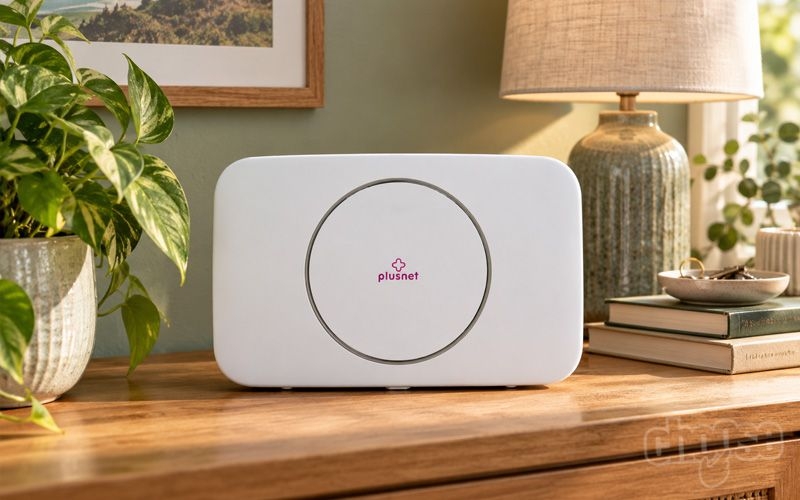
Plusnet Hub Two router. Credit: Choose.co.uk
The Plusnet Hub Two offers dual-band wireless channels over the WiFi 5 protocol, with 7 internal antennae. It offers a stronger signal than routers from some other budget providers, such as the NOW Broadband hub, but misses out on the newer WiFi 6 and WiFi 7 standards.
BT have now replaced the Smart Hub 2 with the Smart Hub 3 for new customers, bringing WiFi 6 support, while sister brand EE include a WiFi 7 router as standard. Plusnet, however, are still supplying the older Hub Two, leaving them a generation behind the rest of the BT group.
Here are the specifications of the Plusnet Hub Two router, and how they compare to BT's new Smart Hub 3:
| Plusnet Hub Two | BT Smart Hub 3 | |
|---|---|---|
| WiFi Protocol | 5 | 6 |
| WiFi Bands | Dual | Dual |
| 2.4GHz WiFi Band | 3x3 | 3x3 |
| 5GHz WiFi Band | 4x4 | 4x4 |
| Ethernet LAN | 3 x 1Gb | 4 x 1Gb |
| WAN port | 1Gb | 2.5Gb |
| WPA3 security | No | Yes |
| Antennae | 7 | 7 |
The Plusnet Hub Two was a big step up for Plusnet customers when BT launched it as the Smart Hub 2 back in 2018, but it's now clearly showing its age.
While the layout of antennae and bands is similar, the Smart Hub 3 brings WiFi 6 for faster, more efficient connections when lots of devices are online, along with WPA3 security and a 2.5Gb WAN port, ready for full fibre speeds beyond 1Gbps. The Plusnet Hub Two also doesn't support mesh in the same way BT's hubs do.
While the Plusnet Hub Two will be adequate for most homes, customers with larger homes or multiple users may want to consider upgrading to a mesh router if they aren't getting the speeds they expect.
Customer service
Summary: Plusnet are the least complained-about broadband provider in Ofcom's latest figures, and their customers are the most satisfied of any major provider.
Ofcom's latest Comparing Customer Service report, published in May 2025 and covering 2024 found Plusnet customers had the highest overall satisfaction of any major provider, at 91%, and were the least likely to have a reason to complain.
| Plusnet | Industry average | |
|---|---|---|
| Satisfaction with service overall | 91% | 84% |
| Satisfaction with speed of service | 84% | 83% |
| Satisfaction with reliability of service | 88% | 83% |
| Customers with a reason to complain | 17% | 23% |
| Overall satisfaction with complaints handling | 65% | 58% |
| Average call waiting time | 50 seconds | 2 minutes, 1 second |
Plusnet customers were also more likely than average to recommend their provider, and only EE scored higher for satisfaction with complaints handling.
Complaint levels tell a similar story. Plusnet recorded the fewest broadband complaints of any major provider across 2025, with 18 complaints per 100,000 customers, compared to an industry average of 33, ending Sky's run at the top which stretched back to 2021.
Virgin Media briefly matched Plusnet as joint least complained-about provider in Q4 2025, but Plusnet regained sole top spot in the latest Q1 2026 figures, with just 4 complaints per 100,000 customers against an industry average of 6.
It's a big turnaround from a few years ago. Complaints were high for Plusnet prior to 2020, due in part to a botched billing system update in 2018 that led to high levels of complaints throughout 2019.
Complaints then fell by over two thirds by Q2 2020, before rebounding alongside other providers later that year following the first Covid-19 lockdown. Since the Q4 2021 report, when Plusnet dropped below the industry average, complaints have been on a steady downward trajectory.
The one exception is landline, where Plusnet recorded the highest complaint rate in Q1 2026, likely linked to the withdrawal of its home phone service and customers being moved to EE.
Overall, Plusnet are the UK's top broadband provider for customer service, leading on complaints and overall satisfaction, and comfortably ahead of budget rivals TalkTalk and Vodafone, who continue to record the highest complaint levels.
Summary: Is Plusnet broadband worth it?
Plusnet offer some of the cheapest broadband plans in the UK, and back up those low prices with the best customer service record of any major provider. They're currently the least complained-about broadband provider, and their customers report the highest overall satisfaction in Ofcom's latest research.
That makes them a stand-out option for a budget provider, even if the service itself is now very much no-frills.
Customers in Openreach full fibre areas can choose from the full range of speeds up to 900Mbps, while part-fibre has been trimmed to a single plan. With TV, mobile and home phone all withdrawn, Plusnet is now a simple broadband-only provider, which does at least make choosing a package straightforward.
The main weak spot is the router. The Plusnet Hub Two is based on BT's older WiFi 5 Smart Hub 2, while BT now supply the WiFi 6 Smart Hub 3 and EE include WiFi 7, and there's no WiFi guarantee or mesh add-on to fall back on.
Reasons to choose Plusnet as a provider include:
- Some of the cheapest full fibre prices in the UK
- Fewest broadband complaints of any major provider
- Highest overall customer satisfaction among major providers
- Strong reliability scores, with the lowest rate of repeat faults
- Short call waiting times and UK-based customer support
However, drawbacks and reasons to look elsewhere include:
- The Plusnet Hub Two only supports WiFi 5, behind the WiFi 6 and WiFi 7 routers from BT, Sky, Virgin Media and EE
- No WiFi guarantee or mesh add-on, although coverage can be improved with third-party mesh systems
- Repairs for a total loss of service take longer than average
- Plusnet TV and Plusnet mobile have been withdrawn, along with bundle discounts on TNT Sports (was BT Sport) and mobile plans
- No home phone line option on any plan, with landline customers now being directed to EE
Ultimately, Plusnet are a great option for customers who just want low-cost, reliable broadband with good support, although larger homes may want to budget for their own mesh system. Those who also want to bundle TV or a home phone will need to look at providers including BT, Sky, Vodafone, or Virgin Media if it's available in their area.
See our Plusnet deals page for the latest prices and to see which packages are available in your area.