
Sky broadband has one of the best customer service records of any major provider, is cheaper than BT across most speed tiers, and supplies a WiFi 6 router as standard - with WiFi 7 available on its faster CityFibre plans.
BT includes free virus protection as standard and a solid range of extras, but is still shipping the same Smart Hub 2 router it launched in 2018.
Overall, Sky is the stronger choice for most customers, though BT's security offering gives it something Sky can't match.
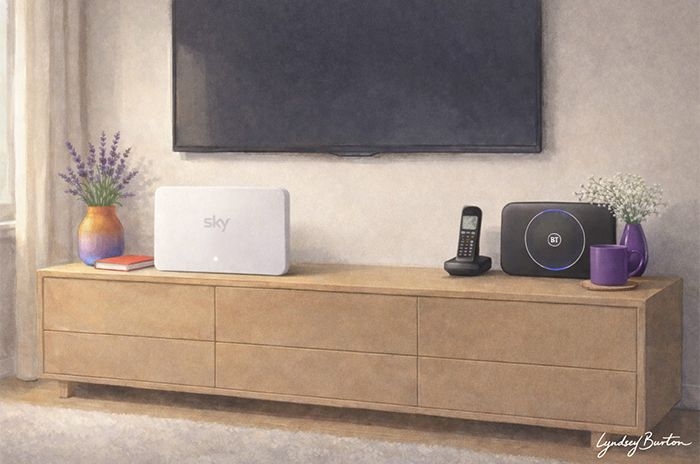
Quick verdict
Sky is cheaper than BT across most speed tiers, includes a home phone line on all plans, supplies a more up-to-date router, and has a significantly better customer service record.
BT pushes back with free virus protection on all plans, slightly stronger minimum speed guarantees at gigabit speeds, and cheaper access to TNT Sports via EE TV.
Decision: for most households Sky is the stronger choice. Choose BT if free security software is a priority, or if TNT Sports is your main TV consideration.
At a glance: Sky vs BT
| Sky Broadband | BT Broadband | |
|---|---|---|
| Monthly price | From £23 | From £24.99 |
| Setup cost | £5 (Refundable) | Free |
| Minimum term | 24 months | 24 months |
| Annual price rise | Price may change during the minimum term | Broadband: £4 per month from March 2027 TV: £2 per month from March 2027 |
| Network availability | Openreach (FTTC & FTTP), CityFibre | Openreach (FTTC & FTTP) |
| Part fibre | 67Mb | 36Mb, 50Mb, 67Mb |
| Full fibre | 75Mb, 150Mb, 500Mb, 900Mb | 74Mb, 150Mb, 300Mb, 500Mb, 900Mb |
| Multi-gigabit | 2.5Gb, 5Gb | - |
| Router | Sky Max Hub (WiFi 6) / Sky Gigafast+ Hub (WiFi 7) | BT Smart Hub 2 (WiFi 5) |
| WiFi guarantee | £4/mth for up to 25Mbps | £10/mth for 'strong' signal |
| Parental controls | Sky Broadband Shield | BT Parental Controls |
| Home phone | Included with PAYG calls | £5/mth |
| Anytime calls | £18/mth (inc. UK mobiles) | £18/mth (inc. UK mobiles) |
| TV | Optional: Sky TV | Optional: EE TV |
Top picks: Sky and BT broadband deals
| Average speed | Monthly price | Contract | |
|---|---|---|---|
 |
150Mb 27Mb upload |
£23 | 24 months £5 setup |
Offer: £5 refundable setup fee Price may change during the minimum term | |||
 |
150Mb 30Mb upload |
£23.99 | 24 months £30 setup |
Offer: £100 BT Reward Card (Ends in 2 days) £27.99 from March 2027, then £31.99 from March 2028 | |||
Price
Winner: Sky broadband is cheaper than BT across most speed tiers, includes a home phone line as standard, and provides a more up-to-date router at no extra cost.
Sky's Full Fibre 150 plan comes in at £23 per month - £5.99 less than BT's equivalent at £28.99:
| Average speed | Monthly price | Contract | |
|---|---|---|---|
|
150Mb 27Mb upload |
£23 | 24 months £5 setup |
Offer: £5 refundable setup fee Price may change during the minimum term | |||
|
150Mb 30Mb upload |
£23.99 | 24 months £30 setup |
Offer: £100 BT Reward Card (Ends in 2 days) £27.99 from March 2027, then £31.99 from March 2028 | |||
The saving is modest in isolation, but factor in BT's £5 per month home phone charge and Sky's WiFi 6 router as standard, and the real-world difference is more significant. A customer taking Sky Full Fibre 150 with a phone line would pay the same monthly total as a BT customer getting a slower, older router with no phone calls included.
The saving continues at 500Mbps, where Sky undercuts BT by £5.99 per month:
| Average speed | Monthly price | Contract | |
|---|---|---|---|
|
500Mb 60Mb upload |
£26 | 24 months £5 setup |
Offer: £5 refundable setup fee Price may change during the minimum term | |||
|
500Mb 73Mb upload |
£27.99 | 24 months £10 setup |
Offer: £140 BT Reward Card (Ends in 2 days) £31.99 from March 2027, then £35.99 from March 2028 | |||
At this speed tier the router gap matters more - customers paying for 500Mbps connections benefit from the headroom a WiFi 6 router provides, and Sky includes that as standard where BT does not.
At gigabit speeds the picture stays the same - BT Full Fibre 900 at £34.99 is £4.99 more than Sky Full Fibre Gigafast at £30. For customers specifically after a gigabit plan, Sky remains the better value option at this tier.
Sky also includes a home phone line on all plans at no extra cost - BT charges £5 per month for the same - and supplies a WiFi 6 router as standard on full fibre plans, while BT still ships the WiFi 5 Smart Hub 2. Sky's £5 setup fee is refundable; BT's setup is free.
Sky's WiFi Max whole home WiFi guarantee is also significantly cheaper at £4 per month, compared to £10 per month for BT Complete WiFi. For those wanting to bundle broadband with TV, Sky is also generally the cheaper option - though EE TV is cheaper for TNT Sports at £20 per month versus £28 with Sky. We cover this in more detail in our BT TV vs Sky TV guide.
Annual price rises
Both Sky and BT now specify fixed annual price rises in pounds rather than percentages, making it easier to know in advance what you'll pay over the course of a contract.
BT will increase prices by £4 per month each March from 2027 for new customers signing up now. Sky increased prices by £3 per month in April 2026. Further rises after April 2026 may still carry exit rights if announced mid-contract.
Read more about annual price rises on broadband.
Overall, Sky is generally the cheaper option, and the gap widens further when home phone, router quality and WiFi guarantee costs are taken into account.
Broadband packages
Winner: Sky. It offers a comparable range of plans to BT but at lower prices, with a more up-to-date router included as standard.
Sky and BT both sell broadband over the Openreach network, so the underlying connection is identical - the differences come down to price, hardware and extras. Both also own budget sub-brands: Plusnet (BT) and NOW Broadband (Sky), for customers who want a no-frills service at a lower price point.
Here are the key differences between the two:
- Sky is cheaper across most equivalent speed tiers - by up to £5.99 per month on Openreach plans
- Sky includes a home phone line on all plans; BT charges £5 per month extra
- Sky full fibre plans include a WiFi 6 router as standard; BT still ships the WiFi 5 Smart Hub 2 from 2018
- Sky offers multi-gigabit speeds up to 5Gbps on CityFibre with WiFi 7; BT tops out at 900Mbps on Openreach
- BT includes free virus protection covering two devices; Sky charges extra for equivalent security
- Both require a 24-month minimum term
Full fibre packages
For most customers, the choice between Sky and BT comes down to their full fibre Openreach plans, which cover speeds from 150Mbps up to 900Mbps. Sky is cheaper at most tiers - by up to £5.99 per month - and includes a WiFi 6 Max Hub router as standard. BT customers get the WiFi 5 Smart Hub 2 regardless of which plan they choose:
| Average speed | Monthly price | Contract | |
|---|---|---|---|
|
150Mb 27Mb upload |
£23 | 24 months £5 setup |
Offer: £5 refundable setup fee Price may change during the minimum term | |||
|
500Mb 60Mb upload |
£26 | 24 months £5 setup |
Offer: £5 refundable setup fee Price may change during the minimum term | |||
|
150Mb 30Mb upload |
£23.99 | 24 months £30 setup |
Offer: £100 BT Reward Card (Ends in 2 days) £27.99 from March 2027, then £31.99 from March 2028 | |||
|
900Mb 90Mb upload |
£29 | 24 months £5 setup |
Offer: £5 refundable setup fee Price may change during the minimum term | |||
|
500Mb 73Mb upload |
£27.99 | 24 months £10 setup |
Offer: £140 BT Reward Card (Ends in 2 days) £31.99 from March 2027, then £35.99 from March 2028 | |||
|
900Mb 110Mb upload |
£32.99 | 24 months £10 setup |
Offer: £145 BT Reward Card (Ends in 2 days) £36.99 from March 2027, then £40.99 from March 2028 | |||
The price gap is fairly consistent throughout the range. Factor in BT's £5 per month home phone charge - included free with Sky - and the saving with Sky is more substantial than the headline figures suggest. BT's setup is free where Sky charges a refundable £5, so that largely cancels out.
Multi-gigabit packages
This is where the gap between Sky and BT widens considerably. Sky offers multi-gigabit broadband on the CityFibre network - 2.5Gbps and 5Gbps plans with fully symmetrical upload speeds and a WiFi 7 router included as standard. BT has no equivalent; its fastest plan tops out at 900Mbps on Openreach:
| Average speed | Monthly price | Contract | |
|---|---|---|---|
|
2.5Gb 2.5Gb upload |
£35 | 24 months £5 setup |
| Price may change during the minimum term | |||
|
5Gb 5Gb upload |
£45 | 24 months £5 setup |
| Price may change during the minimum term | |||
Sky's CityFibre plans are currently available to around 4.7 million homes - significantly fewer than Openreach's 20 million plus coverage. Customers can check availability on our broadband deals page. For those in a CityFibre area who want the fastest possible speeds, BT isn't a realistic alternative.
Part fibre packages
Part fibre - delivering broadband over a mix of fibre and copper cabling - is increasingly rare as Openreach's full fibre rollout continues. Both Sky and BT still offer part fibre plans for addresses not yet reached by full fibre, though where full fibre is available, that's what both providers will offer at the checkout:
| Average speed | Monthly price | Contract | |
|---|---|---|---|
|
67Mb 16Mb upload |
£24 | 24 months £5 setup |
Offer: £5 refundable setup fee Price may change during the minimum term | |||
|
67Mb 18Mb upload |
£24.99 | 24 months £10 setup |
Offer: £80 BT Reward Card (Ends in 2 days) £28.99 from March 2027, then £32.99 from March 2028 | |||
Part fibre plans are worth considering only if full fibre genuinely isn't available at your address - entry-level full fibre pricing is now broadly comparable, and the connection quality is significantly better.
Extras and hardware
Beyond the headline prices, Sky's advantages stack up the further into the details you go. The WiFi Max add-on is a fraction of BT's Complete WiFi cost - £4 per month versus £10 - home phone is included as standard, and full fibre customers get a genuinely current router. BT, meanwhile, is still shipping the same Smart Hub 2 it launched in 2018 with no upgrade path available.
BT does have one meaningful counter - BT Virus Protect comes free on all plans, covering two devices, while Sky charges extra for equivalent security software. For households that would otherwise pay for antivirus separately, it's a genuine saving worth factoring in.
Overall, Sky makes a compelling case on almost every front. The price advantage is consistent, the hardware is more current, and the add-ons are cheaper. BT's free virus protection is a legitimate differentiator, but it doesn't change the overall picture.
Read more in our BT broadband review and our Sky broadband review.
Broadband speed
Winner: Sky. It offers faster top speeds than BT through its CityFibre multi-gigabit plans, while speeds on equivalent Openreach plans are broadly comparable.
On Openreach, Sky and BT are closely matched - both use the same underlying network and both top out at 900Mbps. The real divergence is at the top end, where Sky's CityFibre plans reach 2.5Gbps and 5Gbps with fully symmetrical uploads. BT has nothing comparable.
Openreach speeds
Here are the current average download and upload speeds across BT's Openreach plan range:
| Download speed (average) | Upload speed (average) | |
|---|---|---|
| Fibre Essential (Part-fibre) | 36Mb | 9Mb |
| Fibre 2 (Part-fibre) | 67Mb | 18Mb |
| Full Fibre 150 | 150Mb | 30Mb |
| Full Fibre 500 | 500Mb | 73Mb |
| Full Fibre 900 | 900Mb | 110Mb |
Sky's Openreach plans cover a similar range. Download speeds are effectively identical on equivalent plans - the difference worth noting is uploads, where BT has a modest advantage at the higher tiers:
| Download speed (average) | Upload speed (average) | |
|---|---|---|
| Superfast (Part-fibre) | 67Mb | 16Mb |
| Full Fibre 150 | 150Mb | 30Mb |
| Full Fibre 500 | 500Mb | 60Mb |
| Full Fibre Gigafast | 900Mb | 90Mb |
BT's upload advantage - 110Mb versus Sky's 90Mb at gigabit speeds - won't affect most households.
Streaming, browsing and gaming are all download-heavy activities, so upload speed rarely registers day to day. Where it does matter is for people who regularly back up large files to the cloud, work remotely with video, or upload content professionally.
For everyone else choosing between Sky and BT on Openreach, upload speed is unlikely to be the deciding factor.
CityFibre speeds
Sky's CityFibre plans are where it pulls clearly ahead of BT. Available to around 4.7 million homes, these plans offer multi-gigabit speeds with fully symmetrical uploads - meaning download and upload speeds are identical:
| Download speed (average) | Upload speed (average) | |
|---|---|---|
| Full Fibre 2.5 Gigafast+ | 2,500Mb | 2,500Mb |
| Full Fibre 5 Gigafast+ | 5,000Mb | 5,000Mb |
For most households, speeds at this level go well beyond what everyday use demands. A 2.5Gbps connection can download a 4K film in seconds and handle dozens of simultaneous streams without any noticeable strain.
Where these plans make the most sense is in homes with a very high number of connected devices, households where several people are working or gaming simultaneously, or small businesses running multiple demanding connections at once.
The symmetrical uploads are arguably the more practical feature for many customers. Video calls, cloud backups, remote working and content creation all benefit from fast upload speeds - and 2.5Gbps upload is a level no Openreach plan from either provider can come close to. BT has no CityFibre presence at all, so for anyone in a CityFibre area wanting these speeds, Sky is the only option of the two.
Minimum guaranteed speeds
Both Sky and BT provide personalised speed estimates and a minimum download speed guarantee when signing up - the point at which they'd allow a customer to exit their contract penalty-free if speeds aren't met. Here's how the guarantees compare across the main plans:
| Estimated download speed | Minimum speed guarantee | Provider | |
|---|---|---|---|
| Full Fibre 150 | 151Mb | 100Mb | Sky |
| Full Fibre 150 | 150Mb | 100Mb | BT |
| Full Fibre 500 | 470-515Mb | 400Mb | Sky |
| Full Fibre 500 | 500Mb | 425Mb | BT |
| Full Fibre Gigafast | 780-930Mb | 600Mb | Sky |
| Full Fibre 900 | 900Mb | 700Mb | BT |
| Full Fibre 2.5 Gigafast+ | 2,500Mb | 1,250Mb | Sky |
| Full Fibre 5 Gigafast+ | 5,000Mb | 2,500Mb | Sky |
At entry level, the guarantees are effectively identical - both providers promise 100Mb on their 150 plan, which is comfortably enough for simultaneous streaming, video calls and general browsing across most households.
The more meaningful difference appears at gigabit speeds. BT guarantees 700Mb on its 900 plan versus Sky's 600Mb - a gap that matters most for households who specifically chose a gigabit plan for the headroom it provides. If you're paying for near-gigabit speeds, a higher floor is a reasonable thing to expect, and BT edges ahead here.
Sky's CityFibre plans set a different benchmark altogether. A guaranteed minimum of 1,250Mb on the 2.5Gbps plan - and 2,500Mb on the 5Gbps - puts those packages in a category BT simply isn't competing in.
Read more about broadband speeds and how they work.
Router
Winner: Sky. Full fibre customers get a WiFi 6 router as standard, with WiFi 7 on CityFibre plans - while BT is still shipping the same router it launched in 2018.
The router comparison between Sky and BT is one of the most clear-cut in this guide. Sky has moved its hardware forward considerably over the past couple of years - BT hasn't moved at all.
All Sky Openreach full fibre customers receive the Sky Max Hub as standard - a WiFi 6 router with WPA3 security launched in 2023. On Sky's CityFibre multi-gigabit plans, that steps up to the Gigafast+ Hub, a tri-band WiFi 7 device built to handle the 2.5Gbps and 5Gbps speeds those plans deliver. BT, meanwhile, supplies every customer with the Smart Hub 2 regardless of which plan they take - a router it first launched in November 2018, with no upgrade option available.
Here's how the two standard routers compare:
| BT Smart Hub 2 | Sky Max Hub | |
|---|---|---|
| WiFi protocol | 5 | 6 |
| WiFi bands | Dual-band | Dual-band |
| Intelligent mesh | Yes | Yes |
| Security | WPA2 | WPA3 |
| Antennae | 7 (internal) | 8 (internal) |
| Ethernet LAN | 4 x 1Gb | 4 x 1Gb |
| Launched | November 2018 | 2023 |
The table tells a straightforward story. The BT Smart Hub 2 is not a bad router, but it is seven years old, lacks WiFi 6 support, and uses the older WPA2 security standard. Sky's Max Hub is more current on every meaningful measure - newer protocol, better security, one additional antenna. In practical terms, WiFi 6 handles more simultaneous connections more efficiently than WiFi 5, which matters increasingly in homes with lots of connected devices.
It's worth noting that Sky's hardware advantage, while real, is narrowing relative to other providers. EE now supplies a WiFi 7 router as standard across its entire full fibre range, and Vodafone includes WiFi 7 on its Pro 3 plans. Against BT specifically, Sky is comfortably ahead - but the wider market is moving on.
For customers on Sky's CityFibre plans, the picture is stronger. The Gigafast+ Hub is a tri-band WiFi 7 device with multi-gigabit Ethernet ports - hardware that BT simply has no answer to. WiFi 7 compatible devices are still relatively uncommon, but for anyone signing a 24-month contract today, it's a meaningful piece of future-proofing.
Both providers extend wireless coverage through add-ons. Sky's WiFi Max uses Plume-powered mesh pods - promising minimum speeds of 25Mbps in every room on full fibre plans - at £4 per month. BT's Complete WiFi offers a similar whole home coverage guarantee using WiFi discs at £10 per month. Both are covered in more detail in the WiFi guarantee section below.
Overall, Sky wins this category clearly. BT has had seven years to update its router and hasn't - and there's currently no indication that's about to change.
WiFi guarantee
Winner: Sky. WiFi Max is less than half the price of BT Complete WiFi, promises specific minimum speeds rather than a vague signal strength, and now allows customers to exit early if the guarantee isn't met.
Both Sky and BT offer a whole home WiFi guarantee as a paid add-on, providing mesh booster devices to extend wireless coverage around the home. The two services are similar in concept but diverge significantly on price, what they promise, and what happens if they fall short.
| Sky WiFi Max | BT Complete WiFi | |
|---|---|---|
| Monthly price | £4 | £10 |
| Minimum term | 24 months | 24 months |
| Minimum speed | 10Mb - 25Mb in every room | 'Strong' signal on MyBT app |
| Guarantee | 1 month broadband and WiFi Max refund, plus option to exit early | £100 bill credit |
| Early exit if guarantee not met | Yes | No |
| Other extras | Yes | No |
The price difference is worth flagging - Sky charges £4 per month where BT charges £10. Over a 24-month term, that's a saving of £144 for what is broadly the same concept.
The guarantees themselves are also structured differently. Sky promises specific minimum download speeds in every room - 25Mbps on full fibre plans of 150Mbps or above, and 10Mbps on slower plans. BT only promises a "strong" signal as measured by the MyBT app, which is a considerably vaguer commitment and harder to dispute if things aren't working as expected.
Where Sky has made a meaningful improvement is on what happens if the guarantee isn't met. Sky will now allow customers to exit their WiFi Max contract early if the promised speeds can't be delivered - something BT doesn't offer. BT's remedy is a £100 bill credit, which is a larger upfront refund, but customers remain locked into the add-on for the full 24-month term regardless.
Sky WiFi Max also includes a handful of extras that BT doesn't match - daily line checks, off-peak engineer visits if needed, and 2GB of mobile data on a Sky Mobile SIM if the fixed line goes down.
BT customers who want a mobile backup service as standard would need to look at Hybrid Connect at an additional £7.55 per month, or BT Halo 3.
Overall, Sky's WiFi Max is the stronger offering - cheaper, more specific in what it promises, and more consumer-friendly in how it handles failures. BT's £100 credit is a more generous refund if things go wrong, but the inability to exit the contract is a significant drawback.
TV & broadband bundles
Winner: Sky. It offers a more comprehensive TV service than BT, with more channels, more streaming services included as standard, and better value when bundled with broadband.
Sky TV now offers two base tiers - Essential and Ultimate - alongside optional add-ons for sports, cinema and kids. BT TV is delivered through EE TV, built around NOW memberships and the EE TV Box Pro.
| Plan | Monthly price | Included TV | Average speed | Contract | |
|---|---|---|---|---|---|
|
Sky Ultimate TV + Full Fibre 300 | £41 | Discovery+ Disney+ Hayu HBO Max Netflix Sky Atlantic Sky Entertainment |
300Mb 40Mb upload |
24 months Free setup |
Offer: Sky Ultimate TV £14/mth off + Cheaper broadband with Sky TV Price may change during the minimum term | |||||
|
Entertainment TV + Netflix + Full Fibre 150 | £33.99 | Kids pack Netflix Sky Atlantic Sky Entertainment |
150Mb 30Mb upload |
24 months £30 setup |
Offer: £100 BT Reward Card (Ends in 2 days) £39.99 from March 2027, then £45.99 from March 2028 | |||||
Here's how the two providers' TV options compare in more detail:
| Sky Essential TV | Sky Ultimate TV | BT TV (via EE) | |
|---|---|---|---|
| Monthly price (TV only) | From £15/mth | From £24/mth | From £20/mth |
| Hardware | Sky Stream puck | Sky Stream puck / Sky Glass / Sky Q | EE TV Box Pro |
| Live channels | 100+ (inc. Sky Atlantic) | 130+ (inc. Sky One, Sky Nature, Sky Comedy) | NOW-based memberships |
| Netflix | Included (Standard with Ads) | Included (Standard with Ads) | Included with Entertainment plans |
| Discovery+ | Included | Included | Not included |
| HBO Max | Not included | Included | Included via NOW |
| Disney+ | Not included | Included | Not included |
| Sky Sports | Add-on | Add-on | Add-on (via NOW) |
| TNT Sports | Add-on | Add-on | Add-on (via NOW, cheaper) |
| Sky Cinema | Add-on (£10/mth) | Add-on (£10/mth) | Add-on (via NOW) |
| Contract | 24 months or rolling | 24 months or rolling | 24 months (but plan can be changed monthly) |
Sky has the stronger TV proposition for most customers. Sky Essential TV starts at £15 per month and already includes Netflix Standard with Ads and Discovery+ alongside Sky Atlantic. Sky Ultimate TV at £24 per month adds 35+ extra channels and subscriptions to Disney+, HBO Max and Hayu apps.
BT's TV service - delivered via EE TV - is built around NOW memberships, giving customers more flexibility to change plans month to month. BT customers on the Entertainment tier receive HBO Max through NOW. However, Disney+ and Hayu remain Sky Ultimate exclusives.
The one area where BT holds an advantage is TNT Sports. Access via EE TV works out cheaper than adding it through Sky - £20 per month versus £28. For customers whose main priority is TNT Sports, that saving is worth considering.
For those bundling TV with broadband, Sky's discounts make it the better value option. Sky Ultimate TV with Full Fibre 300 broadband comes in at £41 per month, compared to £46.99 for BT's equivalent Entertainment TV and Netflix bundle - a saving of £5.99 per month, or just over £143 over a 24-month contract. Sky's bundle also includes more content as standard, including Disney+, HBO Max and Hayu.
The Sky Stream Puck also means customers no longer need a satellite dish - Sky TV is now delivered entirely over the internet. Read more in our Sky TV vs BT TV guide.
Call plans
Winner: Sky. A home phone line is included on all plans at no extra cost, an evenings and weekends option is available that BT doesn't offer, and out-of-allowance charges favour Sky on longer calls.
Sky includes a home phone line with pay as you go calls on all broadband plans as standard. BT charges £5 per month extra for the same - a cost that adds up to £120 over a 24-month contract before a single call is made.
Inclusive call plans are also cheaper with Sky. Here's how the two providers compare:
| Call plan | Inclusive calls | Monthly price | |
|---|---|---|---|
| Sky | Pay as you go calls | None | Included |
| Sky | Talk Evenings & Weekends Extra | Evening & weekend calls to UK landlines and UK mobiles | £9 |
| Sky | Talk Anytime Extra | Anytime calls to UK landlines and UK mobiles | £18 |
| BT | Pay as you go calls | None | £5 |
| BT | Unlimited Minutes | Anytime calls to UK landlines and UK mobiles | £18 |
Sky and BT's anytime calls plans are now the same price at £18 per month. Sky also has an evenings and weekends option at £9 per month that BT doesn't offer - for households that mostly call in the evening, that's a more economical choice than paying for full anytime access.
For customers who don't take an inclusive plan, out-of-allowance charges are also worth comparing. Sky charges 25p to connect a call plus 27p per minute, while BT charges 23.75p per minute with no connection fee. For occasional callers making short calls, BT's per-minute rate works out slightly cheaper - for longer calls, Sky's lower per-minute rate becomes more competitive.
For a full breakdown of call charges and landline options, see our cheapest home phone guide.
Customer service
Winner: Sky. It has maintained the lowest complaint levels of any major broadband provider, while BT sits around or just above the industry average.
Sky has held one of the strongest customer service records in the broadband market for several years running, and the latest data confirms that position. Ofcom's most recent quarterly figures, covering Q3 2025, show Sky recording just 6 complaints per 100,000 customers - below the industry average of 8.
BT recorded 9 complaints per 100,000 customers in the same period, just above the industry average. That's a reasonable performance - BT is far from the worst in the market - but Sky's lead is consistent and has been maintained over several years.
The annual picture tells a similar story. Over the full year of 2024, Sky recorded 21 complaints per 100,000 customers, while BT recorded 39 - nearly double. Both sit below the industry average of 41, but the gap between them is meaningful.
The customer satisfaction data below is drawn from Ofcom's Comparing Customer Service report, published May 2025, covering 2024 data:
| Sky Broadband | BT Broadband | |
|---|---|---|
| Overall satisfaction | 84% | 85% |
| Satisfaction with speed | 82% | 85% |
| Satisfaction with complaints handling | 63% | 55% |
| Customers with a reason to complain | 26% | 20% |
| Complaints resolved on first contact | 49% | 44% |
| Complaints per 100,000 customers in 2024 | 21 | 39 |
| Average call waiting time | 0 minutes, 46 seconds | 3 minutes, 33 seconds |
The satisfaction scores are more nuanced than the complaint volumes suggest. BT edges ahead of Sky on overall service and speed satisfaction, and fewer BT customers have a reason to complain - 20% versus Sky's 26%. That's a counterintuitive finding given Sky's lower complaint volumes, and may reflect that Sky's larger customer base generates a broader spread of experiences.
Where Sky pulls well clear is on call waiting times and complaints handling satisfaction. Sky answers the phone in just 46 seconds on average - BT customers wait three and a half minutes. And while BT resolves 44% of complaints on first contact, Sky manages 49%, and scores notably higher on complaints handling satisfaction at 63% versus BT's 55%.
Both providers operate entirely UK-based call centres, which tends to correlate with better customer service outcomes across the market.
Overall, Sky wins this category. Its complaint volumes are significantly lower, it answers calls faster, and it handles complaints more effectively when they do arise. BT's satisfaction scores are respectable and its improving trajectory is encouraging, but Sky's consistency over several years sets a high bar.
Verdict: Sky Broadband or BT Broadband?
Overall winner: Sky. It's cheaper across most speed tiers, includes a home phone line as standard, offers a stronger TV service, and has a significantly better customer service record.
Sky broadband and BT broadband are both premium providers with solid reputations - but the gap between them has widened over the past year, and it now favours Sky on almost every front.
Sky is cheaper at every speed tier, includes a home phone line on all plans, offers a WiFi 6 router as standard on Openreach full fibre plans and WiFi 7 on CityFibre - while BT is still shipping the same WiFi 5 router it launched in 2018 with no upgrade path available. Sky's WiFi Max add-on is less than half the price of BT Complete WiFi, and Sky TV offers more content for less when bundled with broadband.
BT does have genuine advantages. Its complaint volumes are lower than many providers and its customer satisfaction scores are respectable. Free virus protection through BT Virus Protect covers two devices at no extra cost - something Sky charges extra for. And for customers whose main TV priority is TNT Sports, BT's EE TV route works out cheaper than adding it through Sky.
We like Sky broadband because:
- Cheaper pricing across all equivalent speed tiers
- Home phone line included on all plans at no extra cost
- WiFi 6 router as standard on Openreach full fibre; WiFi 7 on CityFibre
- Multi-gigabit speeds up to 5Gbps on CityFibre - BT tops out at 900Mbps
- WiFi Max whole home guarantee at £4/month versus BT's £10, with exit rights if the guarantee isn't met
- Stronger TV offering - more content included, better bundle value
- One of the best customer service records of any major broadband provider
However, BT also does well for:
- Free virus protection covering two devices as standard
- Slightly higher upload speeds on Openreach gigabit plans
- Stronger minimum speed guarantee at gigabit speeds
- Cheaper access to TNT Sports via EE TV
Overall, Sky is the stronger choice for most households. The price advantage is consistent, the hardware is more current, and the extras are better value. BT's free virus protection and upload speed advantage are worth knowing about, but they don't change the overall picture.