
Sky Q, Virgin TV 360 and the BT / EE TV Box Pro are all premium set-top boxes designed for live TV and on-demand viewing, with support for pausing and rewinding live TV, recording programmes, and access to a wide range of streaming apps.
All three boxes support Ultra HD 4K content where available. The Sky Q and Virgin TV 360 platforms also include voice control to help users search and navigate content.
The BT TV Box Pro - now sold as the EE TV Box Pro - is the only fully wireless option, connecting over Wi-Fi rather than Ethernet. Existing BT customers use the same hardware, with branding being the main difference.
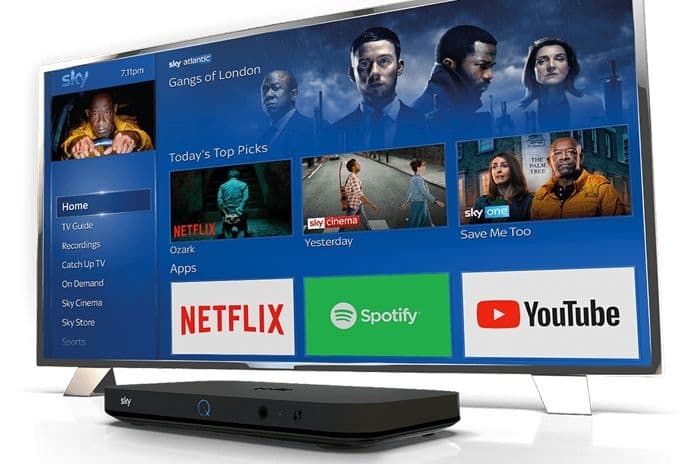
TL;DR: What you need to know
Sky Q and Virgin TV 360 are no longer sold to new customers, but millions of households still use them today. Sky now sells Sky Stream instead, while Virgin Media has moved all new customers to its Stream box.
The BT TV Box Pro - now branded as the EE TV Box Pro - is still available to new customers, with existing BT customers continuing to use the same hardware under the new EE branding.
This guide compares Sky Q, Virgin TV 360 and BT / EE TV Box Pro specifically for existing customers, and for anyone deciding whether to keep their current box, upgrade, or switch to a newer streaming-based alternative.
Quick verdict
If you already have one of these boxes and value live TV recording, familiar set-top box controls and broadcast-style viewing, they still deliver a strong experience. Among them, Sky Q remains the best overall box, thanks to its wider app support, optional larger storage capacity, voice control and accessibility features.
Virgin TV 360 comes a close second, offering many of the same core features - including voice control and the ability to record up to six programmes at once - with the added benefit of personalised profiles for different household members.
The BT / EE TV Box Pro ranks third overall but shouldn't be overlooked. It supports multi-recording, includes a 1TB hard drive, and is the only box here to offer a fully wireless installation, reducing cable clutter.
That said, new customers are now generally better served by Sky Stream or Virgin Media's Stream box, unless recording live TV to a hard drive is a priority. These newer platforms reflect where UK pay TV is heading, with cloud-based streaming replacing traditional broadcast hardware.
At a glance: Key differences
The TV boxes provided with Sky TV, Virgin Media TV, and BT TV all have similar specifications, but there are some standout differences:
| Sky Q box | Virgin 360 box | BT TV Box Pro | |
|---|---|---|---|
| Storage | 1TB / 2TB | 1TB | 1TB |
| Tuners | 7 | 6 | 4 |
| Resolution | Ultra HD 4K | Ultra HD 4K | Ultra HD 4K |
| Wireless | No | No | Yes |
| On-demand apps | Yes | Yes | Yes |
| Voice control | Yes | Yes | No |
These boxes were provided as part of a premium TV subscription. Sky TV could be taken on its own or bundled with broadband, while both Virgin Media TV and BT / EE TV required customers to also take a broadband package.
Storage
Winner: Sky Q offers the most flexible storage. Sky customers can upgrade to a 2TB Sky Q box, while Virgin TV 360 and the BT / EE TV Box Pro are limited to 1TB of internal storage.
| Storage capacity | |
|---|---|
| Sky Q | 1TB (upgrade to 2TB) |
| Virgin 360 | 1TB |
| BT TV Box Pro | 1TB |
All three TV boxes come with 1TB of internal storage as standard. Sky Q is the exception in that existing Sky customers can choose to upgrade to a larger 2TB box for an additional cost.
To put that into context, 1TB (one terabyte) is equal to around 1,000GB. While that once felt generous, modern HD and Ultra HD recordings take up far more space than standard-definition TV did when these boxes were first launched.
On a 1TB box, users can typically record up to around 600 hours of SD content, but this falls to roughly 175 hours in 1080p HD, and significantly less for 4K Ultra HD programmes, which can be more than twice the size of HD recordings.
In practice, this still equates to around 60-90 two-to-three-hour HD films, which will be sufficient for most households - particularly as much more content is now watched on demand rather than recorded.
Sky Q does have the edge on storage flexibility. Customers can upgrade to a 2TB box, doubling recording capacity to around 350 hours of HD content. The upgrade typically costs £99 on a self-installation basis.
Tuners
Winner: Sky Q offers the most tuners, allowing more simultaneous recordings than the other boxes.
| Tuners | |
|---|---|
| Sky Q | 7 (Record 6 and watch a 7th live) |
| Virgin 360 | 6 (Record 6 and watch a recording) |
| BT TV Box Pro | 4 (Record 3 and watch a 4th live) |
Both Sky Q and Virgin TV 360 allow customers to record up to six programmes at once while watching live TV.
Sky Q has a slight edge, with seven tuners compared with Virgin 360's six. This allows Sky customers to record six channels while watching a seventh live, whereas Virgin Media customers must watch a recorded or on-demand programme once all six tuners are in use.
In practice, this difference is unlikely to matter for most households, as six simultaneous recordings already exceeds typical viewing needs.
The BT / EE TV Box Pro is more limited, with four tuners in total. This allows customers to record up to three programmes while watching a fourth live channel. While less flexible on paper, four tuners will still be sufficient for many households.
TV Guide
Winner: Virgin TV 360, thanks to its household profile system.
Sky Q, Virgin TV 360 and the BT / EE TV Box Pro all include a modern electronic programme guide (EPG) for navigating live channels, recordings and on-demand apps.
The Sky Q guide is organised by content type, with a live preview window shown in the top-left corner. This makes it easy to browse channels without fully switching away from what's currently on.
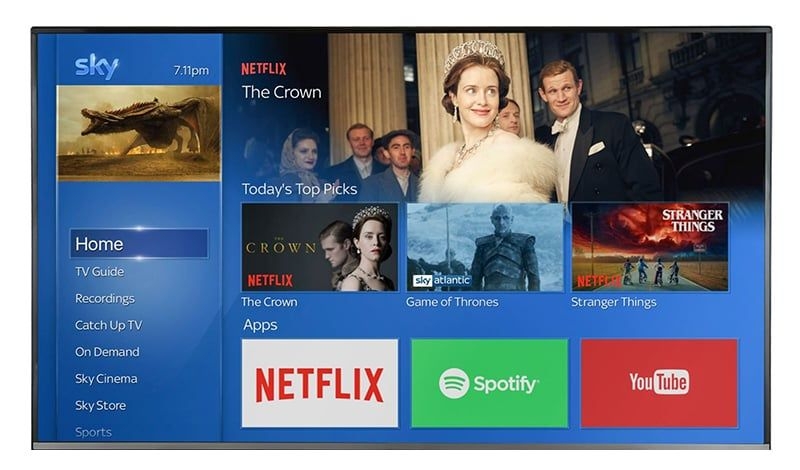
The Virgin TV 360 guide is a significant improvement over earlier Virgin platforms, offering clearer navigation and channel filters so viewers only see the channels they actually watch.
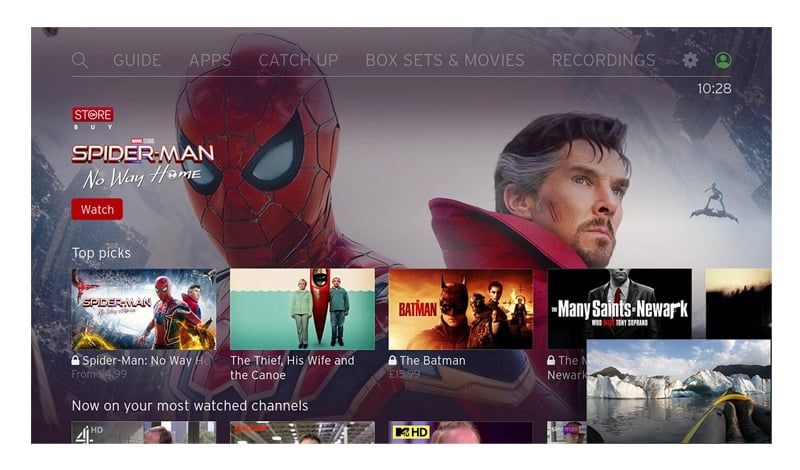
All three platforms support some level of personalisation, such as favourites and viewing preferences.
Where Virgin TV 360 pulls ahead is with its Personal Profiles feature, which allows up to six individual profiles per household. Each profile maintains its own recommendations, watchlists and viewing history, making it easier for families to share one box without mixing preferences.
On-demand apps
Winner: Sky Q, for the breadth of integrated streaming apps.
All three set-top boxes from Sky, Virgin Media and BT / EE allow customers to watch live TV alongside a range of on-demand streaming apps, including services such as Netflix and Prime Video.
Some apps are bundled into TV packages, while others require separate subscriptions that can be added independently of the TV contract.
Sky Q offers the widest overall app support, covering most major UK streaming services within a single interface. Virgin TV 360 and the BT / EE TV Box Pro also support a strong selection of apps, but both miss a small number of popular services compared with Sky.
Below is a comparison of which on-demand apps are supported on each platform:
| Sky Q | Virgin 360 | BT TV Box Pro | |
|---|---|---|---|
| BBC iPlayer | Yes | Yes | Yes |
| ITVX | Yes | Yes | Yes |
| All4 | Yes | Yes | Yes |
| Youtube | Yes | Yes | No |
| Netflix | Yes | Yes | Yes |
| Prime Video | Yes | Yes | Yes |
| NOW TV | No | No | Yes |
| Disney Plus | Yes | Yes | No |
| Paramount+ | Yes | Yes | Yes |
| Discovery+ | Yes | No | Yes |
| Spotify | Yes | No | No |
| Apple TV+ | Yes | Yes | Yes |
| Peacock | Yes (content included) | No | No |
| Fiit | Yes | Yes | No |
Sky Q continues to offer the broadest range of integrated on-demand apps, including services such as Netflix, Prime Video, Disney Plus, Apple TV+, Paramount+, and Discovery+, alongside Sky's own on-demand content. Sky has also retained access to Peacock-branded programming, with shows integrated into its wider channel and on-demand catalogue rather than delivered through a standalone app.
Virgin TV 360 now covers most of the major streaming apps households expect, including Netflix, Prime Video, Disney+, Apple TV+ and Paramount+, but it does not support Discovery+ as a standalone app. This narrows the gap with Sky compared with previous years, although Sky still holds a slight edge for overall app breadth.
The BT / EE TV Box Pro has improved its app support in recent years and now includes services such as Netflix, Prime Video, Apple TV+, Discovery+ and Paramount+, alongside NOW TV, which is uniquely integrated due to BT and EE using NOW memberships within their TV platform. However, BT / EE TV still does not support Disney+, meaning customers must rely on a separate smart TV or streaming device to access it.
Overall, the differences in app support between the three boxes are now much smaller than they once were. Sky Q remains the most comprehensive option, but both Virgin TV 360 and BT / EE TV Box Pro cover the core streaming services used by most households, making them perfectly adequate for everyday viewing.
Picture quality
Winner: Virgin Media offers the most HD and Ultra HD content as standard, with fewer add-ons required.
The Sky Q box, Virgin TV 360 and BT / EE TV Box Pro all support picture quality up to 4K Ultra HD, provided customers have a compatible TV and sufficient broadband speed.
However, access to HD and Ultra HD content is handled differently by each provider, and in some cases requires additional paid add-ons.
As we explain in our guide to the best HD TV content, this is how the three platforms compare:
| 1080p HD | Ultra HD 4K | |
|---|---|---|
| Sky | £9 per month | £13 per month (Includes HD) |
| Virgin Media | Included where available | Some Sky content on a per channel basis (£6-£7 per month) |
| BT TV | £6 per month | TNT Sports Ultimate only (Included in HD plan) |
There are some variations to the above for different content types, for example Sky TV includes Sky Sports and Sky Cinema in HD as standard, whereas these packs are in SD with Virgin Media and BT unless customers upgrade.
Virgin Media customers can now access Sky Sports in Ultra HD as well, but again this requires an extra fee of £7 per month.
While BT includes channels such as BT Sport Ultimate in 4K with their HD pack, most of their content is provided through NOW Memberships which can only be boosted up to 1080p HD.
Overall, while Sky has the most HD and Ultra HD content available customers have to pay more for it. On the other hand Virgin Media include more high quality viewing as standard in their plans, particularly in their Mega TV plans and Max Volt Bundle.
Connectivity
Winner: BT TV Box Pro offers wireless functionality so customers don't need to install trailing wires as they do with Sky Q and Virgin 360.
The headline feature when the BT TV Pro Box was released in mid-2021 was the wireless connectivity option.
Whereas set-top boxes are traditionally connected to a customer's broadband router by wires, the BT TV Box Pro is the first to allow customers to do away with the wires and to connect wirelessly instead.
It's a simple feature that many customers will probably think should be part and parcel of modern life, yet BT have got there first.
There are still some downsides to their wireless connectivity such as the stipulations that the router should be within five meters of the box and the box itself should be kept in the open to improve the signal, but it's still a new and exciting option from BT, that's not yet available with either Sky or Virgin's boxes.
Accessibility
Winner: Sky TV offers an accessible remote that customers can request.
Accessibility options come in many different varieties as set-top box providers try to ensure their services can be used by as many customers as possible.
All three set-top boxes have options for subtitles, sign language and audio description (where these are available), yet there are shortcomings on the remotes offered by all providers.
In the name of simplifying things, they have hidden the accessibility features within the settings menus, so customers have to go into a menu and then select their accessibility functions. For subtitles, especially, where remotes used to have a prominent button, this can be frustrating.
Voice control can switch subtitles on with Sky and Virgin remotes, but that doesn't help all customers who are hard of hearing and may not want to use voice control on their TV.
Sky do allow customers to order a Sky Accessibility remote, however customers must be an Accessibility customer and that's something they shouldn't necessarily need to disclose in order to get a remote more suited to their needs.
Verdict: Sky Q vs Virgin 360 vs BT TV Box Pro
Overall verdict: Sky Q remains the strongest of the three legacy TV boxes for app coverage, storage flexibility and accessibility features.
Each of the boxes from Sky TV, Virgin Media and BT TV covers the core expectations of a premium set-top box.
All three allow customers to pause and rewind live TV, record multiple programmes at once, and access popular on-demand services such as Netflix and Prime Video.
Where Sky Q still has the edge is breadth. It offers the widest overall range of integrated on-demand apps, alongside features such as voice control and the option to upgrade to a larger 2TB hard drive for customers who rely heavily on recordings.
Virgin TV 360 comes a close second. It supports most major streaming apps, includes HD as standard, and adds useful household features such as personalised viewing profiles, but it lacks the storage upgrade flexibility and some of Sky Q's accessibility options.
The BT / EE TV Box Pro performs well for live TV and recording, and benefits from integrated NOW access, but still trails slightly on overall app coverage and advanced platform features compared with Sky and Virgin.
It's also worth noting that Sky Q and Virgin TV 360 are now legacy products for new customers. Sky and Virgin Media both shifted to streaming-first platforms in 2022 with the Sky Stream Puck box and Virgin Media Stream box, while the BT / EE TV Box Pro remains available to new customers today.
For existing customers, all three boxes still offer a strong traditional TV experience. For new sign-ups, however, streaming-based platforms are now usually the better long-term option unless recording live TV is a priority.
Read more about the differences between Sky and Virgin Media, or how Sky and BT broadband compare.