
Most Sky full fibre broadband customers now receive the WiFi 6-enabled Sky Max Hub at no extra cost.
Customers taking the newest Gigafast+ plans on the CityFibre network receive the Gigafast+ Hub, which supports the newer WiFi 7 standard.
Customers in part fibre areas get the Sky Broadband Hub, but can upgrade to the Sky Max Hub with the WiFi Max add-on.
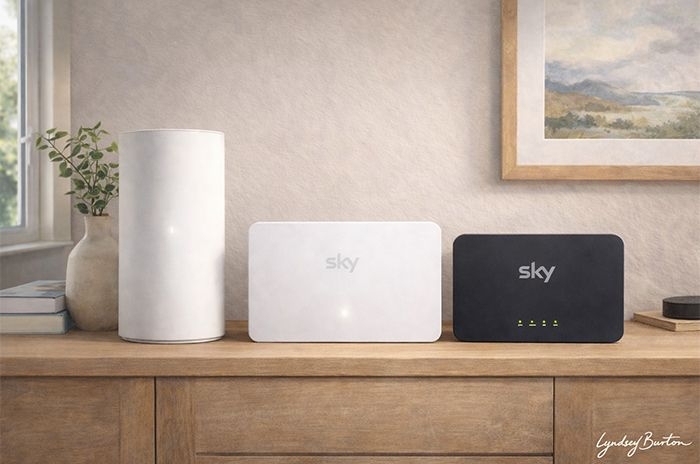
Which Sky router will I get?
Sky currently offers three broadband routers depending on the type of broadband package and network used.
- Sky Max Hub - supplied with most Sky full fibre broadband plans and supports WiFi 6.
- Gigafast+ Hub - supplied with the newest Gigafast+ plans on the CityFibre network and supports WiFi 7.
- Sky Broadband Hub - supplied with the Sky Superfast part fibre (FTTC) broadband package and supports WiFi 5.
Customers in part fibre areas can also upgrade to the Sky Max Hub for £4 per month through the Sky WiFi Max add-on, which also includes Sky's whole-home WiFi guarantee.
Sky router comparison
Sky currently offers three broadband routers depending on the type of broadband connection and package chosen. The table below compares the main features of the Sky Max Hub, Gigafast+ Hub and the earlier Sky Broadband Hub.
| Sky Max Hub | Gigafast+ Hub | Sky Broadband Hub | |
|---|---|---|---|
| Supplied with | Most Sky Full Fibre plans | Gigafast+ (CityFibre network) | Sky Superfast / part fibre plans |
| WiFi standard | WiFi 6 (802.11ax) | WiFi 7 (802.11be) | WiFi 5 (802.11ac) |
| WiFi bands | Dual-band (2.4GHz, 5GHz) | Tri-band (2.4GHz, 5GHz, 6GHz) | Dual-band (2.4GHz, 5GHz) |
| Mesh WiFi support | Yes (Max Pods) | Yes (Max Pods) | Yes (Boost / Sky Q customers) |
| WiFi guarantee | Up to 25Mbps with WiFi Max | Up to 25Mbps (Included) | 3Mbps with Broadband Boost |
| Security | WPA3 | WPA3 | WPA2 |
| Ethernet ports | 4 x 1Gb | 1 x 10Gb + 3 x 1Gb | 4 x 1Gb |
| Released | 2023 | 2024 | 2019 |
| Model | SR213 | Gigafast+ | SR203 |
Sky Max Hub
Released in July 2023, the Sky Max Hub (SR213) is now available to all Sky full fibre broadband customers at no extra cost, and to Sky Superfast customers as part of the WiFi Max add-on.
The Sky Max Hub upgrades various aspects of its predecessor, the Sky Broadband Hub. It supports the newer WiFi 6 protocol (802.11ax) and also improves security, upgrading from WPA2 to WPA3.

Sky Max Hub (model SR213) router. Credit: Choose.co.uk
All three of Sky Stream, Sky Glass and Sky Glass Air support WiFi 6, meaning customers using Sky's newer TV platforms may see improved wireless performance with the Sky Max Hub.
WPA3 offers enhanced security for wireless networks, better protecting information transferred against password cracking and any possibility of decrypting traffic.
The Sky Max Hub also offers real-time device monitoring, with alerts sent and viewable on the MySky app, which has also been updated to support the new router features.
| Sky Max Hub | Sky Broadband Hub | |
|---|---|---|
| Model | SR213 | SR203 |
| Release date | 2023 | 2019 |
| WiFi Protocol | WiFi 6 (802.11ax) | WiFi 5 (802.11ac) |
| Intelligent Mesh | Yes | Yes |
| Antennas | 8 | 8 |
| Ethernet ports | 4 x 1 Gigabit | 4 x 1 Gigabit |
| Security | WPA3 | WPA2 |
While the Sky Max Hub now comes as standard on all Sky full fibre broadband plans, those living in part fibre areas who take Sky Superfast can upgrade by paying an extra £4 per month for Sky WiFi Max.
Sky WiFi Max is Sky's current whole-home WiFi guarantee, replacing Sky Broadband Boost. It promises minimum wireless speeds of up to 25Mbps and includes the Sky Max Hub for customers who don't already receive the router as standard.
Gigafast+ Hub
The Gigafast+ Hub is Sky's newest broadband router, launched in 2025 alongside the provider's Full Fibre 2.5 Gigafast+ and Full Fibre 5 Gigafast+ packages.
Unlike Sky's other routers, the Gigafast+ Hub is currently only supplied to customers on the CityFibre network taking these multi-gigabit plans, which offer speeds of up to 5Gbps.

Sky Gigafast+ Hub router. Credit: Choose.co.uk
The router supports the newest WiFi 7 wireless standard (802.11be), using a tri-band design across 2.4GHz, 5GHz and 6GHz frequencies to help deliver higher wireless capacity and lower latency in busy homes.
WiFi 7 also allows the router to manage traffic more efficiently across connected devices, helping maintain stable performance during high-bandwidth activities such as 4K streaming, cloud gaming and large file transfers.
The Gigafast+ Hub includes two 10Gb Ethernet ports - one WAN port connecting to the fibre ONT and one 10Gb LAN port for high-speed wired devices - alongside additional gigabit LAN ports for standard wired connections.
| Gigafast+ Hub | Sky Max Hub | |
|---|---|---|
| Release date | 2025 | 2023 |
| WiFi protocol | WiFi 7 (802.11be) | WiFi 6 (802.11ax) |
| WiFi bands | Tri-band (2.4GHz, 5GHz, 6GHz) | Dual-band (2.4GHz, 5GHz) |
| Ethernet ports | 1 x 10Gb WAN 1 x 10Gb LAN 3 x 1Gb LAN |
4 x 1Gb LAN |
| Security | WPA3 | WPA3 |
The Gigafast+ Hub is currently only available with Sky's fastest broadband packages delivered over the CityFibre network. Customers on standard full fibre or part fibre broadband plans instead receive either the Sky Max Hub or Sky Broadband Hub.
Sky Broadband Hub
The Sky Broadband Hub (SR203) was released in September 2019 alongside the original Sky Broadband Boost WiFi guarantee.
It is provided to part fibre Sky broadband customers, including those taking Superfast 35, Superfast, and previously the Ultrafast plans, whether they bundle Sky TV or not.
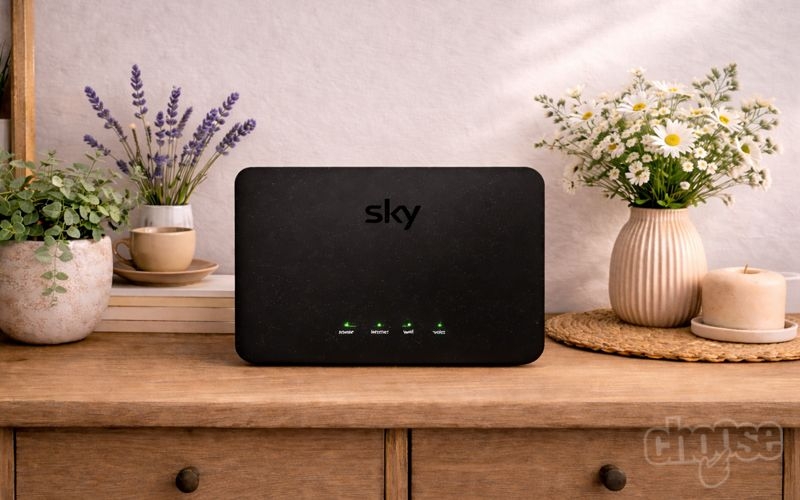
Sky Broadband Hub (model SR203) router. Credit: Choose.co.uk
The Sky Broadband Hub offers dual-band wireless with 8 internal antennae in a small, sleek-looking black shell. It's a smaller design than equivalent routers from other providers, like the BT Smart Hub 2 or Virgin Media Hub 4.
It supports WiFi 5, or 802.11ac. While this is no longer the latest protocol, WiFi 6 devices remain fully backwards compatible with WiFi 5 networks.
It offers a noticeable benefit in wireless coverage compared to its predecessor the Sky Q Hub (ER115), launched in 2018, which had only 5 internal antennae. In real tests we found the Sky Broadband Hub had much better wireless coverage than the previous Sky Q Hub.
| Sky Broadband Hub | Sky Q Hub | |
|---|---|---|
| Model | SR203 | ER115 |
| Release date | 2019 | 2018 |
| WiFi Protocol | WiFi 5 (802.11ac) | WiFi 5 (802.11ac) |
| Intelligent Mesh | Yes | No |
| Antennas | 8 | 5 |
| Ethernet ports | 4 x 1 Gigabit | 4 x 1 Gigabit |
| Security | WPA2 | WPA2 |
Expert explainer: WiFi 6 vs WiFi 7 - what do Sky customers actually benefit from?
The newest Sky router, the Gigafast+ Hub, supports WiFi 7 - the latest wireless standard. WiFi 7 (officially IEEE 802.11be) was introduced commercially in early 2024 when the Wi-Fi Alliance launched its Wi-Fi Certified 7 programme, although the final technical standard was only formally published in 2025.
WiFi 7 builds on WiFi 6 by supporting three wireless bands (2.4GHz, 5GHz and 6GHz) and wider 320MHz channels, allowing much higher theoretical speeds and lower latency. In ideal conditions, WiFi 7 can deliver theoretical throughput of more than 20Gbps, although real-world speeds are typically far lower.
However, most devices currently in UK homes still use WiFi 5 or WiFi 6. Only a small number of newer devices support WiFi 7 today, including some flagship smartphones, laptops and gaming hardware released since 2024.
Examples currently include the Apple iPhone 16 range, and high-end Android phones using Qualcomm Snapdragon 8 Gen 3 chipsets, including the Samsung Galaxy S24 Ultra, Galaxy Z Fold Special Edition, and Galaxy Tab S10 Ultra, as well as newer Intel WiFi 7 laptop chipsets, and a growing number of premium gaming laptops and motherboards.
For many Sky households, the Sky Max Hub may therefore provide the most immediate benefit. It supports WiFi 6, which is already widely supported by modern phones, tablets and laptops. Importantly, Sky's own streaming platforms - Sky Stream, Sky Glass and Sky Glass Air - also support WiFi 6, meaning customers using these devices may see improved wireless performance when paired with the Sky Max Hub.
Over the next few years this will gradually change as WiFi 7 becomes more common in new phones, laptops and smart home devices. For now though, the biggest improvements most households notice still come from stronger WiFi coverage throughout the home rather than the wireless standard alone.
In practice, a Sky Max Hub paired with Sky Max Pods to extend coverage around the house will often deliver more consistent real-world performance than a WiFi 7 router operating from a single location. This is because wireless speeds fall rapidly through walls and floors, meaning extending coverage can matter more than the theoretical speed of the router itself.
Previous Sky routers
Existing Sky broadband customers may still be using an older router. Prior to 2019 Sky supplied different routers depending on whether customers also bundled Sky Q.
Sky Q Hub (ER115)
Sky standalone broadband customers were previously supplied with the Sky Hub, while those bundling Sky broadband with Sky Q received the newer Sky Q Hub.
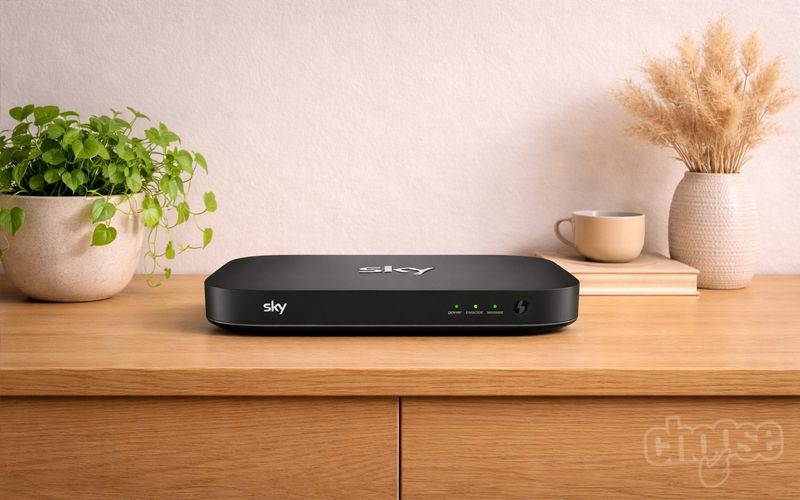
Sky Q Hub (model ER115) router. Credit: Choose.co.uk
Customers with a Sky Q Hub can request an upgrade to the newer Sky Broadband Hub, which offers improved wireless performance.
Up until June 2024, NOW Broadband were still supplying a rebranded version of the Sky Q Hub, called the NOW Hub Two.
The Sky Q Hub (and NOW Hub Two) supports dual-band WiFi 5, however as mentioned, only has 5 internal antennas which limits the wireless coverage and strength in comparison to newer models.
Likely due to the smaller size, the router saw a decrease in the number of Ethernet LAN ports available to just two.
Sky Hub (SR102)
The Sky Hub (SR102) is an even older device, first launched back in 2013, and unlikely to have many customers still using it. It supports WiFi 4 (802.11n) over single band 2.4GHz wireless.
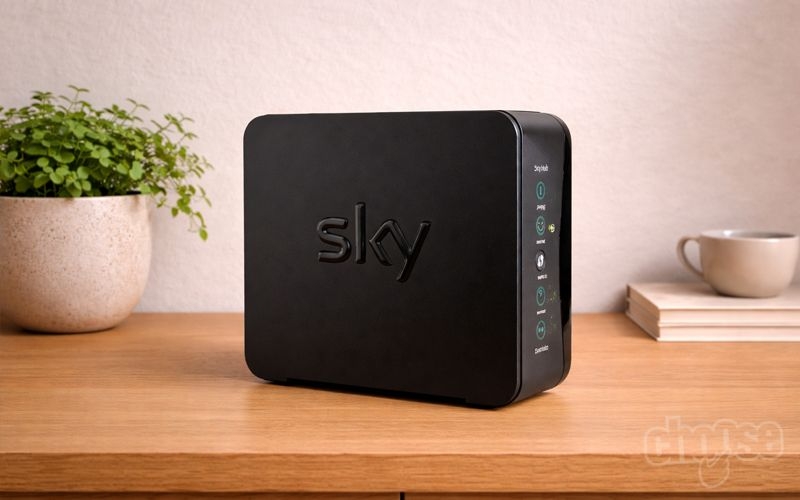
Sky Hub (model SR102) router. Credit: Choose.co.uk
Quite a boxy design, the Sky Hub houses four Ethernet LAN ports, and has just two internal antennae.
Any customers still using the Sky Hub would benefit from upgrading to the newer Sky Broadband Hub.
Find out more in our review of Sky broadband.