The Sky Broadband Hub is Sky's WiFi 5 router, supplied to Sky part-fibre customers and NOW Broadband's 'Powered by Sky' part-fibre and full-fibre services.
It supports dual-band 2.4GHz and 5GHz wireless with 4x4 MU-MIMO, and works with Sky Broadband Boost to improve coverage for Sky Q customers.
Customers wanting WiFi 6 can upgrade by adding Sky's WiFi Max add-on, which replaces the router with the newer Sky Max Hub and boosts the WiFi guarantee.
Quick answer: What is the Sky Broadband Hub?
The Sky Broadband Hub is Sky's WiFi 5 router, introduced in 2019 and widely used by customers on Sky's part-fibre broadband and NOW Broadband's 'Powered by Sky' part-fibre and full-fibre services.
Key facts:
- WiFi 5 router (802.11ac)
- Dual-band 2.4GHz and 5GHz wireless
- 4x4 MU-MIMO support
- Four gigabit Ethernet ports
The router can handle broadband speeds up to 1Gbps over Ethernet, although real-world WiFi performance depends on distance, interference, and device capability. On a typical 70Mbps part-fibre connection, devices close to the router will usually see speeds close to the full line speed, falling to 40-60Mbps in neighbouring rooms and lower through walls or across larger properties.
Customers wanting WiFi 6 can upgrade by adding Sky's WiFi Max add-on for £4-£6 per month, which replaces the router with the newer Sky Max Hub. While WiFi 5 and WiFi 6 use the same wireless bands, WiFi 6 routers are generally better at managing congestion and interference from neighbouring networks and multiple connected devices.
The Broadband Hub is still widely used today - including by existing Sky Q customers using Sky Broadband Boost, as Sky Q does not support the newer Sky Max Hub.
Sky Broadband Hub specifications
The Sky Broadband Hub (model SR203) supports dual-band WiFi 5 networking designed for Sky's part-fibre broadband services.
| Feature | Sky Broadband Hub |
|---|---|
| Router model | Sky Broadband Hub (SR203) |
| WiFi standard | WiFi 5 (802.11ac) |
| WiFi bands | Dual-band (2.4GHz / 5GHz) |
| MU-MIMO | 4x4 |
| Antennas | 8 internal |
| Maximum broadband speed | Up to 1Gbps |
| Ethernet ports | 4 x Gigabit LAN |
| WAN port | 1 x Gigabit WAN (shared with a LAN port) |
| Broadband support | ADSL2+, VDSL2 (FTTC), FTTP via WAN |
| Security | WPA2 |
| Parental Controls | Sky Broadband Shield |
| Mesh support | No native mesh (Boost uses additional hardware) |
| Launch year | 2019 |
Who gets the Sky Broadband Hub?
The Sky Broadband Hub is supplied to customers on Sky's part-fibre broadband packages, including Sky Superfast plans on the Openreach FTTC network.
Customers joining Sky on these services today will receive the Broadband Hub as their standard router.
The router is also supplied to all NOW Broadband customers, whose services run on Sky's 'Powered by Sky' network - including both part-fibre and full-fibre plans offering speeds of up to 300Mbps.
| Package | Broadband | Monthly price | Upfront price | Contract term | |
|---|---|---|---|---|---|

|
Full Fibre 75 | 75Mb average | £23 | £5 | 24 months |
 Offer: £5 refundable advance fee for new customers if applicable Offer: £5 refundable advance fee for new customers if applicable | |||||

|
Superfast Broadband | 67Mb average | £24 | £5 | 24 months |
| Offer: WiFi Max just £4/mth + £5 refundable setup fee for new customers if applicable | |||||
|
|
Full Fibre 100 | 100Mb average | £25 | £5 | 24 months |
| Offer: £5 refundable advance fee for new customers if applicable | |||||
|
|
Full Fibre 300 | 300Mb average | £30 | £5 | 24 months |
| Offer: £5 refundable advance fee for new customers if applicable | |||||
While Sky's newer full-fibre plans now use the Sky Max Hub, the Broadband Hub remains widely used across both providers due to the large number of existing customers still on part-fibre connections.
Hardware and connectivity
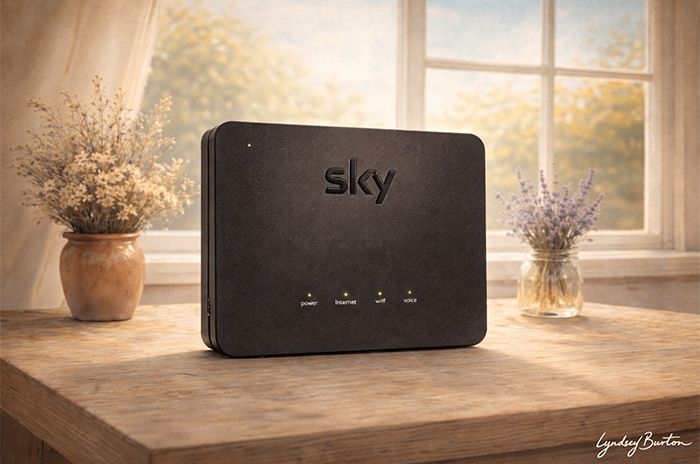
The Sky Broadband Hub (model SR203) is a low, rectangular router with rounded edges and a black plastic casing - a noticeably different look to the upright white Sky Max Hub. It sits flat on a shelf or desk, and with all eight antennas housed internally, there are no protruding aerials to contend with.
The rear of the hub is well-equipped for a part-fibre router. Four gigabit Ethernet ports handle wired connections, with LAN port 4 doubling as a WAN port for full-fibre installations - connecting to the home's Optical Network Terminal via a standard Ethernet cable rather than the DSL port. Two phone ports are also present, covering both UK and Ireland connections.
Wireless performance is handled by dual-band WiFi 5 (802.11ac) across 2.4GHz and 5GHz, using a 4x4 MU-MIMO configuration to serve multiple devices simultaneously. One area where the Broadband Hub has an edge over its successor is channel control - unlike the Sky Max Hub, users can manually select WiFi channels through the hub's local admin panel at 192.168.0.1, which can help in congested areas with heavy neighbouring network interference.
Five LED indicators on the front cover broadband, telephone, power, Ethernet, and WiFi status at a glance, with a WPS button on the side for quick wireless pairing. Sky manages firmware updates remotely, but basic configuration - WiFi name, password, and channel selection - remains accessible locally.
Performance
The Sky Broadband Hub is designed primarily for use on Sky's part-fibre network, where line speeds top out at around 80Mbps on Superfast and 35Mbps on the lower Superfast 35 tier. At those speeds, the hub's hardware is not the limiting factor - the line itself is, and the Broadband Hub handles it comfortably.
Over a wired connection, the four gigabit Ethernet ports mean there is no ceiling imposed by the router itself. Devices connected directly will receive whatever speed the line delivers.
Wireless performance is where real-world results vary more. On a typical 70Mbps part-fibre connection, devices close to the router will usually see speeds close to the full line speed - dropping to around 40-60Mbps in neighbouring rooms, and lower still through walls or across larger properties. For most households on a part-fibre line, this is unlikely to cause problems in practice. The line speed is modest enough that even a weakened WiFi signal will handle everyday streaming, browsing, and video calls without issue.
Where the Broadband Hub begins to show its age is on faster connections. NOW Broadband's full-fibre plans reach speeds of up to 300Mbps, and while the hub's gigabit WAN port can technically pass those speeds over a wired connection, WiFi 5 will struggle to deliver them consistently over wireless - particularly across multiple rooms or with several devices active simultaneously.
As a result, NOW Broadband customers on full-fibre plans who rely heavily on wireless may find the hub a genuine constraint, and would be better served by upgrading to Sky's WiFi Max add-on - which replaces the router with the WiFi 6-capable Sky Max Hub for £6 per month.
Upgrading from the Sky Broadband Hub
The most straightforward route to a newer router is Sky's WiFi Max add-on, which costs £4 per month for Sky Superfast customers and £6 per month for NOW Broadband customers.
As well as replacing the Broadband Hub with the WiFi 6-capable Sky Max Hub, WiFi Max includes Sky's whole-home WiFi guarantee and access to Sky Max Pods for mesh coverage in larger properties.
It's worth noting that WiFi Max runs on its own 24-month term, separate from the underlying broadband contract. Customers adding it mid-way through an existing plan should be aware they're committing to a new agreement that may outlast their current broadband deal.
For a full breakdown of what's included and whether it's worth the cost, see our Sky WiFi Max review.
Sky full-fibre customers receive the Sky Max Hub as standard, so switching to a full-fibre plan - where available - is another route to newer hardware without paying an ongoing add-on fee.
For customers who want more control over their home network, replacing the Sky Broadband Hub with a third-party router is possible but not officially supported. Sky authenticates connections using MER with DHCP Option 61 credentials, meaning a third-party router will only work if it supports that configuration. Those who do make the switch largely rely on community forums rather than Sky's own support team, who will typically advise returning to the original hub if problems arise.
Sky Broadband Hub vs Sky Max Hub
The Sky Max Hub is the natural successor to the Broadband Hub, and the differences between the two are meaningful - though how much they matter in practice depends largely on the broadband connection and devices in the home.
The most significant upgrade is the move from WiFi 5 to WiFi 6. On paper, WiFi 6 offers higher throughput and lower latency, but its more practical advantage is how it handles congestion - managing interference from neighbouring networks and juggling multiple connected devices more efficiently than WiFi 5. In a busy household with many simultaneous connections, that difference is noticeable.
Security is also improved, with the Max Hub upgrading from WPA2 to WPA3 - offering stronger protection against password attacks and making it harder for traffic to be intercepted or decrypted.
Both routers share the same physical antenna configuration - eight internal antennas with 4x4 MU-MIMO - so the core wireless architecture is similar. The Max Hub's advantage comes from the newer wireless standard built on top of it.
One area where the Broadband Hub retains an edge is manual channel selection, which is available through its local admin panel but has been removed on the Max Hub, where Sky handles channel management automatically.
For most households on Sky's part-fibre network, the Broadband Hub remains perfectly capable. The case for upgrading strengthens on faster connections, in larger homes, or where WiFi 6 compatible devices - including Sky Stream, Sky Glass, Sky Glass Air, and newer phones and laptops - make up a significant share of the network.
| Sky Broadband Hub | Sky Max Hub | |
|---|---|---|
| Model | SR203 | SR213 |
| Released | 2019 | 2023 |
| WiFi standard | WiFi 5 (802.11ac) | WiFi 6 (802.11ax) |
| WiFi bands | Dual-band (2.4GHz, 5GHz) | Dual-band (2.4GHz, 5GHz) |
| Antennas | 8 internal | 8 internal |
| MU-MIMO | 4x4 | 4x4 |
| Ethernet ports | 4 x 1Gbps | 4 x 1Gbps |
| Security | WPA2 | WPA3 |
| Manual channel selection | Yes | No |
| Mesh support | Sky Broadband Boost | Sky Max Pods |
Can you replace the Sky Broadband Hub with your own router?
Replacing the Sky Broadband Hub with a third-party router is possible, but it is not officially supported by Sky and requires some technical confidence to get working.
Sky authenticates broadband connections using MER (MAC Encapsulated Routing) with DHCP Option 61 credentials - a method that ties the connection to specific login details rather than simply the physical line. A third-party router will only work if it supports DHCP Option 61 configuration, which not all consumer routers do, and even those that do will require manual setup to authenticate correctly with Sky's network.
For customers on full-fibre through NOW Broadband, the process is broadly similar - the router needs to connect via the WAN Ethernet port from the ONT and pass the correct credentials to authenticate the connection.
Sky's support team will not assist with third-party router configuration, and if connection problems arise after replacing the hub, the advice will typically be to revert to the original Sky Broadband Hub. Most customers who successfully run their own hardware do so using guidance from community forums rather than anything officially provided.
For users who want the benefits of third-party hardware - more advanced configuration, better performance, or features the Broadband Hub doesn't offer - it is a viable option with the right equipment. For everyone else, the Sky Broadband Hub remains the simpler and fully supported choice, with the Sky Max Hub available as an upgrade through the WiFi Max add-on if newer hardware is the goal.
How does the Sky Broadband Hub compare?
The Sky Broadband Hub is one of a shrinking number of WiFi 5 routers still supplied as standard by major UK broadband providers. As the industry moves toward WiFi 6 and beyond, it now has just two like-for-like counterparts - BT's Smart Hub 2 and the Plusnet Hub Two.
The two are closely related: the Plusnet Hub Two is a rebranded version of the BT Smart Hub 2, with Plusnet being a BT subsidiary. Both support WiFi 5 across dual-band 2.4GHz and 5GHz, and like the Sky Broadband Hub, both remain in active use across a large existing customer base on part-fibre connections.
One notable difference is antenna count - the BT Smart Hub 2 and Plusnet Hub Two both have seven internal antennas compared to eight on the Sky Broadband Hub, though all three share the same four gigabit Ethernet ports.
Elsewhere, the market has moved on considerably. Virgin Media is actively upgrading its entire customer base to the Hub 5, a WiFi 6 router, as part of a free rollout that began in late 2025. EE has gone further still, becoming the first major UK provider to supply a WiFi 7 router as standard across its entire full-fibre range. Vodafone also offers WiFi 7 on its Pro 3 packages, though customers on standard plans receive a WiFi 6 router instead.
That context matters when weighing up Sky's hardware position. For part-fibre customers, WiFi 5 remains broadly fit for purpose - the line speeds involved don't demand more. But as full-fibre becomes the norm and WiFi 6 devices proliferate, the Broadband Hub is looking increasingly like a transitional router rather than a long-term fixture.
| Sky Broadband Hub | BT Smart Hub 2 | Plusnet Hub Two | |
|---|---|---|---|
| WiFi standard | WiFi 5 (802.11ac) | WiFi 5 (802.11ac) | WiFi 5 (802.11ac) |
| WiFi bands | Dual-band | Dual-band | Dual-band |
| Antennas | 8 internal | 7 internal | 7 internal |
| Security | WPA2 | WPA2 | WPA2 |
| Ethernet ports | 4 x 1Gbps | 4 x 1Gbps | 4 x 1Gbps |
| Mesh support | Yes (paid) | Yes (paid) | No |
| Supplied with | Sky part-fibre / NOW Broadband | BT part & full fibre | Plusnet part & full fibre |
Verdict: Does the Sky Broadband Hub matter when choosing Sky broadband?
The Sky Broadband Hub is a capable router for the network it was designed for. On Sky's part-fibre connections, where line speeds are modest, it handles everyday broadband use comfortably - and for most households on Superfast or Superfast 35, it will never be the weak link in the chain.
Where it starts to feel its age is on faster connections and in larger homes. NOW Broadband customers on full-fibre plans are getting a 2019 WiFi 5 router on a connection capable of 300Mbps - a mismatch that will show up in wireless performance across multiple rooms or with several devices active simultaneously. For those customers, the WiFi Max upgrade is worth serious consideration.
The comparison with the Sky Max Hub is straightforward. WiFi 6, WPA3 security, and better congestion handling make it the better router in almost every respect. The Broadband Hub's only meaningful advantage is manual channel selection, which matters in specific circumstances but is unlikely to be a deciding factor for most people.
When choosing a broadband deal, the router is rarely the right place to start. Line availability, speed tier, price, and contract length all matter more. But if you're an existing Sky or NOW Broadband customer wondering whether your hardware is holding you back - on a part-fibre line, it probably isn't. On a full-fibre line, it might be.