Pay TV providers and on-demand platforms are required to make their services accessible to viewers who are hard of hearing or visually impaired.
This includes accessible menus and TV guides, as well as tools to help users find programmes with features such as subtitles or audio descriptions.
Live broadcast channels are also required to provide subtitles, audio descriptions and sign language on a proportion of their content.
TL;DR: Quick overview
Subtitles are well supported across most UK TV services, but meaningful differences still exist - particularly for live sport, on-demand apps, and signed programming.
If subtitles are your main requirement, Sky, Virgin Media and BT TV all perform well, allowing subtitles to be switched on permanently across supported channels and apps. In practice, the bigger differences are usability: Sky remains the easiest to control day-to-day (with voice commands and accessible remotes), while Virgin Media offers strong platform-level accessibility but requires more menu navigation.
For sports fans who are hard of hearing, TNT Sports is often a better choice than Sky Sports. While Sky Sports generally meets Ofcom's subtitling quotas, TNT Sports also provides sign-presented programming, which Sky does not offer directly. This makes TNT Sports a stronger option where accessibility needs go beyond subtitles alone.
On-demand viewing now matters as much as live TV. Services like Disney+ and ITVX deliver consistently high levels of subtitling and improving audio description, while others lag behind. As streaming becomes the default way many people watch TV, Ofcom's expanding regulation of on-demand services is increasingly important - and is beginning to narrow these gaps, though uneven coverage remains.
How accessible is UK TV?
The regulatory framework for TV accessibility in the UK is currently expanding, following the introduction of the Media Act 2024 and a series of new consultations led by Ofcom.
The Media Act became law on 24 May 2024 and introduces a new regime covering video-on-demand services and connected TV platforms. While the Act itself is now in force, the detailed scope of the new accessibility and prominence obligations is being developed through further regulation, consultation and Ofcom guidance.
A key element of this is the new "Tier 1" framework for video-on-demand services. As part of this process, Ofcom requested information from industry stakeholders at the end of 2024 and delivered a report on the UK VoD market to the Secretary of State on 30 May 2025. The report has not been made public, but will inform which on-demand services are designated and what accessibility obligations they will face.
In January 2026, Ofcom also opened a consultation on a draft code of practice covering both public service broadcaster (PSB) prominence and accessibility on connected TV platforms. Alongside proposals on how PSB player apps should be positioned within menus, search results and live TV areas, Ofcom set out recommended actions to improve accessibility for disabled users.
These recommendations include voice guidance as an alternative to visual navigation cues, magnification or zoom controls, high-contrast settings, and clearer labelling of accessible content such as subtitles, audio description or signing, including within search results. The code of practice is not mandatory, but platforms that adopt the recommendations would be treated by Ofcom as compliant.
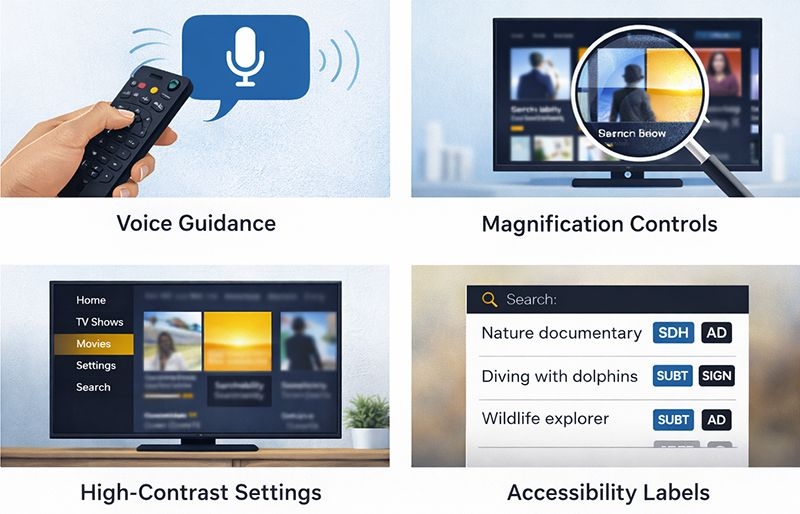
Ofcom recommended actions to improve accessibility for disabled users. Credit: Choose.co.uk
The consultation closes on 25 March 2026, with Ofcom expecting to publish final guidance later in 2026.
Alongside these newer regimes, Ofcom continues to regulate live broadcast TV channels in the UK - and some on-demand services - to ensure they provide access services for hearing-impaired and visually impaired viewers.
This includes subtitling, sign language and audio description services, which broadcasters are required to meet specific obligations for.
For 2025, Ofcom added 11 new channels, bringing the total to 82 channels required to meet Level 1 ("full requirement") obligations. These require:
- 5% of programmes to include in-vision signing;
- 10% to carry audio description (rising to 20% for BBC, ITV, Channel 4 and Sky);
- 80% to be subtitled (90% for ITV and Channel 4, and 100% for BBC channels).
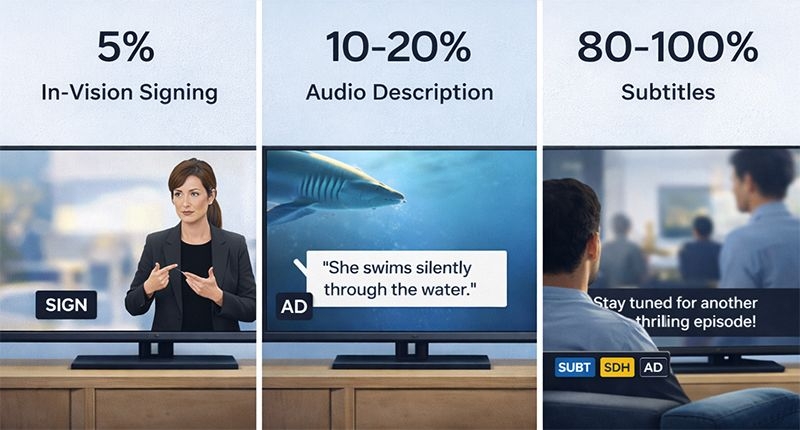
Ofcom accessibility requirements for broadbast TV - 2025. Credit: Choose.co.uk
The full requirement applies to channels that have been on air for ten years or more, and includes BBC, ITV, Channel 4, Channel 5, Sky channels, TNT Sports, TNT Sports, and a number of Discovery-owned channels.
In April 2024, Ofcom also updated its guidance on access services to explicitly include video-on-demand providers. This covers broadcaster-owned services such as ITVX and Channel 4, as well as subscription platforms including NOW and Amazon Prime Video.
The guidance extends beyond content production to cover how platforms are designed and operated, including text size controls, speech volume, and how easy it is for users to find and enable subtitles or audio description.
Pay TV providers are also required to ensure their Electronic Programme Guides (EPGs) are accessible. The EPG Code applies to Freeview, Freesat, Sky, Virgin Media and YouView, and requires support for:
- text-to-speech functionality;
- highlighting or filtering of content with audio description or signing;
- text magnification;
- high-contrast displays.
Ofcom reporting shows that Freeview, Sky and Virgin Media meet all required EPG accessibility features, while Freesat and YouView currently offer a more limited subset.
The regulator's most recent Television Access Services report, published in October 2025, confirms that broadcast channels continue to meet their annual subtitling, audio description and signing quotas under the existing Code.
At a glance: Best TV service for the hard of hearing
In general, Sky and Virgin Media TV platforms offer a broader range of accessibility features than BT's YouView-powered TV boxes, particularly around voice guidance, audio controls and how easily accessible content can be found.
| Text to speech | Highlighting/filtering | Text Magnification | High-contrast displays | |
|---|---|---|---|---|
| Sky Q | Yes | Yes | Yes | Yes |
| Sky Stream | Yes | Yes | No | Yes |
| Virgin Media TV 360 | Yes | Yes | Yes | Yes |
| Virgin Media Stream | Yes | Yes | Yes | Yes |
| BT TV | No | No | Yes | Yes |
Sky and Virgin Media both offer strong accessibility support across their TV platforms, including reliable subtitle coverage on live TV, catch-up and box sets. Sky also offers an Easy Grip remote for Sky Q users who need a more accessible physical controller.
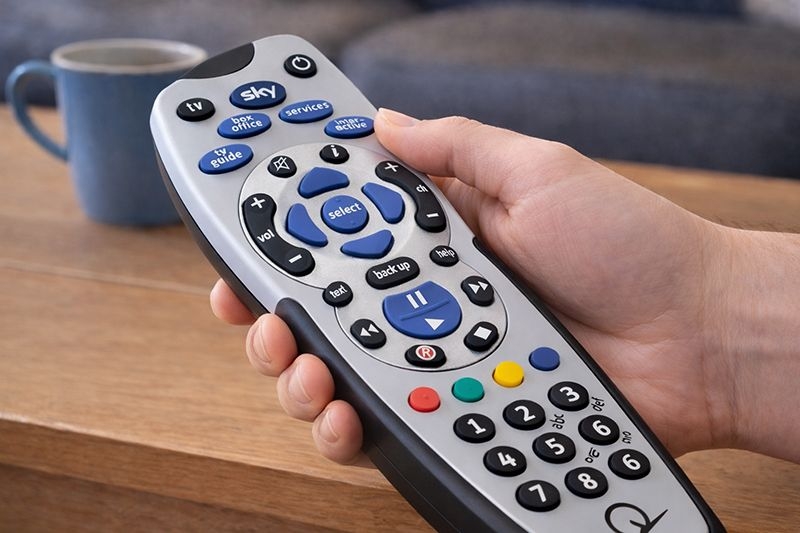
Sky Q Easy Grip Remote Controller. Credit: Choose.co.uk
BT TV is slightly more limited by comparison. While subtitles are available across supported content, its YouView-based interface does not currently offer text-to-speech navigation or tools to filter or highlight programmes specifically by accessibility features such as subtitles or audio description.
Streaming platforms accessed via Android and iOS devices are not regulated by Ofcom in the same way as traditional pay TV services. However, they benefit from built-in operating system accessibility tools, including Android's TalkBack and Apple's VoiceOver, which can read menus and on-screen controls aloud as users navigate apps and settings.
Although many UK pay TV providers carry broadly the same broadcast channels - meaning subtitle availability is often similar at a channel level - accessibility varies much more widely across on-demand and streaming services.
Disney+ stands out for accessibility support, with the vast majority of its catalogue subtitled and a significant proportion of content also available with audio description. By contrast, other streaming services tend to offer less consistent coverage, particularly when it comes to audio description, even where subtitles are widely supported.
Sky TV
Sky TV continues to offer one of the most accessible electronic programme guides (EPGs) in the UK. The Sky Q box meets all four Ofcom-defined accessibility requirements, with Screen Magnifier support added in August 2024.
Sky's newer streaming-based platform, available on Sky Stream and Sky Glass, currently meets three of the four requirements, as it does not yet include a screen magnifier feature.
On Sky Stream, customers can:
- Permanently enable subtitles or audio description across supported content
- Use high-contrast display settings to reduce background colour and visual effects
- Turn on Voice Guidance, which reads out on-screen menus and guide items
- Highlight programmes in the TV guide that include subtitles, audio description and/or sign language
- Control the TV using voice commands via the remote
Subtitles can be enabled either through the on-screen menus or by using voice control, for example by saying "turn subtitles on".
Sky also provides access to British Sign Language programming via the BSL Zone, available through the TV guide and the dedicated BSL Zone player.
While the Sky platform enables and surfaces accessibility features, the availability of subtitles, audio description and sign language ultimately depends on the individual TV channel or on-demand service. Many of Sky's broadcast channels are regulated by Ofcom and subject to minimum accessibility quotas.
Ofcom's Television Access Services Report for the first half of 2025 shows that Sky's broadcast channels continue to deliver high levels of subtitled content, in line with other major UK pay TV providers:
| Subtitled programme hours | Audio description programme hours | |
|---|---|---|
| Sky Atlantic | 100% | 65.6% |
| Sky Showcase | 96.6% | 29.2% |
| Sky Max | 100% | - |
| Sky Sci-Fi | 100% | 20.9% |
| Sky Witness | 100% | 40.7% |
| Sky Crime | 100% | 40.6% |
| Sky Comedy | 100% | 37.6% |
| Sky Documentaries | 100% | - |
| Sky Nature | 100% | 34.5% |
| Sky Mix | 99.9% | 23.9% |
| Sky Arts | 100% | 34.6% |
| Sky News | 83.1% | Exempt |
| Sky Cinema Action | 100% | 41.3% |
| Sky Cinema Family | 100% | 41.4% |
| Sky Cinema Greats | 100% | 20.3% |
| Sky Cinema Premiere | 100% | 44.2% |
| Sky Cinema Select | 100% | 52.5% |
| Sky Cinema Animation | 100% | 41.2% |
| Sky Sports Premier League | 80% | 21.1% |
| Sky Sports Action | 80.1% | 35.1% |
| Sky Sports Cricket | 80.2% | 14.6% |
| Sky Sports F1 | 80.2% | 29.2% |
| Sky Sports Golf | 82% | 13.9% |
| Sky Sports Main Event | 85.4% | Exempt |
| Sky Sports Mix | 70.1% | 26.5% |
| Sky Sports Arena | - | - |
| Sky Sports Football | 74% | 23.8% |
Overall, Sky's entertainment and cinema channels deliver near-universal subtitling with steadily improving audio description coverage, while sports channels remain more variable - particularly for audio description - reflecting the practical challenges of live broadcast sport.
This pattern is largely expected. Pre-recorded programmes on channels such as Sky Atlantic and Sky Showcase are easier to subtitle and audio-describe consistently than live or rolling-output channels like Sky News and Sky Sports. Even so, Sky continues to meet Ofcom's minimum access service requirements across its regulated channels.
Many of these Sky channels are also carried on Virgin Media (with the exception of Sky Atlantic) and are available to BT and EE TV customers via NOW.
For Sky customers specifically, it's also useful to look at how accessible Sky's on-demand services are - including Sky On Demand, Sky Kids and the Sky Go app - where access services are applied differently from live broadcast TV.
| Subtitled programme hours per year | Audio description programme hours per year | |
|---|---|---|
| Sky Go app | 91.83% | 0% |
| Sky Kids | 82.77% | 0% |
| Sky on-demand | 50.68% | 0% |
| Sky Store | 42.06% | 0% |
This data comes from Ofcom's Television and on-demand programme services report, covering January to December 2024.
Sky's on-demand services show improved subtitle coverage year on year, particularly on Sky Go and Sky Kids, but continue to provide no audio description across on-demand platforms.
This highlights a persistent gap between broadcast accessibility - where Sky generally meets or exceeds Ofcom quotas - and on-demand delivery, where accessibility features are more inconsistently implemented despite content often originating from fully accessible broadcast versions.
Virgin Media
Both Virgin Media TV 360 and Virgin Media Stream support all four of Ofcom's core accessibility requirements within their TV guides.
Across both platforms, customers can:
- Turn subtitles on permanently wherever available
- Turn audio description on permanently wherever available
- Highlight programmes with sign language in the TV guide
- Use high-contrast display modes and enlarged guide text
- Enable voice guidance to speak on-screen menu items
- Navigate the TV guide using voice commands via the remote
- Use the Virgin TV Go app with Apple VoiceOver or Android TalkBack for spoken feedback
Virgin Media's accessibility feature set is broad and covers both hearing and visual impairments well. However, the physical remote control does not include a dedicated subtitles or accessibility button.
Subtitles can still be enabled quickly using voice commands (for example, by saying "subtitles on"), but manual activation requires navigating several menu layers. This contrasts with Sky, which offers a dedicated subtitles button on its Sky Q Easy Grip remote and a single-button shortcut on Sky Stream.
Unlike Sky, Virgin Media does not produce original TV content, meaning the availability of subtitles, audio description and sign language depends entirely on the broadcasters and on-demand services carried on the platform.
As with Sky, Virgin Media customers can access British Sign Language programming through the BSL Zone on supported channels.
BT TV
BT's latest set-top box, the BT TV Box Pro (now branded as the EE TV Box Pro), runs on the YouView platform. At present, accessibility support is more limited than on Sky or Virgin Media, focusing primarily on visual presentation rather than spoken guidance.
The accessibility features currently available include:
- Zoom Interact, which magnifies the TV guide to increase text and menu size
- A high-contrast colour scheme, displaying white text on a black background and removing gradients
- Audio feedback tones when navigating menus
- Support for control via a UK USB keyboard
- The ability to turn subtitles on permanently for all supported content
The BT / EE TV Box Pro remote does not include a dedicated subtitles or accessibility button. However, subtitles can be accessed relatively quickly by pressing the "More" button, which links directly to subtitle settings.
Once enabled, subtitles will appear automatically on all programmes where they are available. Within the TV guide, programmes that support subtitles are marked with an [S] icon.
In terms of accessible content rather than interface features, BT relies heavily on third-party services. Premium entertainment is primarily delivered via NOW Memberships, while customers can also access streaming apps such as Netflix, each with their own accessibility standards and controls.
| Subtitled programme hours per year | Audio description programme hours per year | Sign-presented programming per month | |
|---|---|---|---|
| NOW | 89.99% | 0% | 0% |
TNT Sports is another big reason to choose BT TV, and we can see how accessible these channels are using Ofcom's latest published access services data covering January to December 2024.
| Subtitled programme hours per year | Audio description programme hours per year | Sign-presented programming per month | |
|---|---|---|---|
| TNT Sports 1 | 85.3% | 11% | 194 minutes |
| TNT Sports 2 | 81.8% | 16.6% | 170 minutes |
| TNT Sports 3 | 77.5% | 14.4% | 137 minutes |
For viewers who are hard of hearing, TNT Sports may be a preferable option for live sport, as it offers a combination of subtitles and a limited amount of sign-presented programming.
By contrast, while Sky Sports meets Ofcom's subtitling quota of 80% on average across its channels, Sky does not provide sign-presented programming on its sports channels, instead contributing financially to the British Sign Language Broadcasting Trust (BSLBT).
Overall, TNT Sports delivers strong subtitling coverage across its channels, while audio description and signed programming remain more limited, reflecting the operational challenges of live sports broadcasting.
On-demand apps
In April 2024, Ofcom extended its accessibility regulation to cover on-demand video players for the first time.
This guidance applies not only to the accessibility of the platform itself - such as menus, navigation and programme guides - but also to the availability of access services on content, including subtitles, audio description and, where possible, sign language.
Ofcom's most recent data on on-demand services, published in May 2025, highlights clear differences in how well major streaming apps provide these accessibility features.
| Subtitled programme hours per year | Audio description programme hours per year | Sign-presented programme hours per year | |
|---|---|---|---|
| Amazon Prime Video | 74.69% | 2.80% | 0% |
| BritBox | 100% | 0% | 0% |
| Channel 4 | 99.10% | 0% | 4.55% |
| Disney+ | 99.49% | 24.62% | 0% |
| ITVX | 99.05% | 21.75% | 2.09% |
| My5 | 89.36% | 16.33% | 0.28% |
| NOW | 89.99% | 0% | 0% |
Disney+ continues to perform strongly for accessibility, with almost all content subtitled and around a quarter of programme hours now carrying audio description, placing it among the best major streaming services for supported access features.
The UK's main broadcaster apps - ITVX, Channel 4 and My5 - also show very high levels of subtitling, typically close to full coverage, alongside meaningful provision of audio description and small but notable amounts of sign-presented programming, reflecting their regulated public service obligations.
NOW performs well for subtitles, with close to 90% of content subtitled, but still offers no audio description or sign-presented programming on its on-demand service. Amazon Prime Video, while improving its subtitling coverage compared with previous years, continues to lag behind most rivals for accessibility, with limited audio description and no signed content.
Summary: Best TV services for subtitles and accessible content
For viewers who are hard of hearing and primarily rely on subtitles, UK TV services now offer consistently strong support across both live broadcast channels and on-demand platforms.
While modern remote controls have fewer physical buttons - making subtitle activation less immediately obvious than on older Sky and Virgin Media remotes - all major TV platforms now allow subtitles and audio description to be enabled permanently, reducing the need for repeated manual adjustment.
Sky and Virgin Media both meet Ofcom's requirements for accessible TV guides, including features such as voice guidance, high-contrast displays and text enlargement. Among on-demand services, broadcaster apps such as ITVX and Channel 4 continue to deliver very high levels of subtitling alongside growing provision of audio description.
Recent Ofcom data shows that on-demand viewing now accounts for a substantial and growing share of how people watch TV, which has prompted regulators to extend accessibility requirements beyond traditional broadcast channels. From 2024, major on-demand programme services have been brought into Ofcom's access services framework, marking a significant shift in policy.
While subtitling coverage across on-demand services is generally strong, audio description remains more uneven and sign-presented programming is still limited. Some broadcasters, including Sky, continue to meet their obligations by contributing to the British Sign Language Broadcasting Trust (BSLBT), funding signed content on BSL Zone rather than embedding sign-presented programming directly within their own services.
Overall, accessibility for hearing-impaired viewers in the UK is improving, particularly as regulation begins to reflect real-world viewing habits that increasingly prioritise streaming and catch-up services. Ongoing Ofcom consultations and forthcoming legislation, including measures within the Media Bill, are expected to further strengthen accessibility standards across broadband-delivered and on-demand TV services in the coming years.