Sky confirms April 2026 price rises for broadband and TV

Sky has confirmed price rises for broadband and TV services that will take effect from April 2026.
The changes will affect both new and existing customers, with increases now visible in many customers' future bills.
The announcement matters because Sky uses "prices may rise" wording in its contracts, which shapes when - and whether - customers can exit penalty-free.
Sky prices to rise
Sky has confirmed that prices for broadband and TV services will rise from 1 April 2026, in what amounts to its latest round of annual increases.
For new customers signing up from 4 February 2026, Sky has updated the information shown at the point of sale to make clear that prices will rise in April. On those new tariffs:
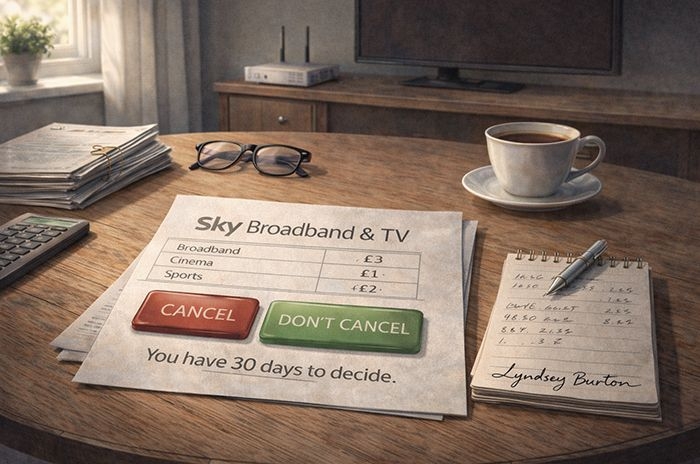
- Sky Broadband will increase by £3 a month from 1 April.
- Sky Cinema, when taken with a TV product, will increase by £1 a month.
- Triple Play bundles (broadband, TV and phone together) will rise by £3 a month, reflecting the broadband element of the package.
For existing customers, Sky has not issued a single, uniform public list of rises - but many are already seeing April increases appear in their future bills via MySky. Based on those early billing updates, customers are reporting that:
- Sky Broadband is rising by £3 a month.
- TNT Sports is rising by around £3 to about £34 a month.
- Sky Sports is rising by around £2 to about £36 a month.
- Netflix Premium via Sky is rising by about £1 to £14.49 a month.
- Sky Cinema is rising by about £1 a month.
- On Sky Q, Sky Signature is rising by £2 to £42.50 a month, and the Ultimate TV pack is rising by £1 to £4.50 a month.
Once customers have been notified by Sky of changes to their bill, they have 30 days to contact Sky if they do not want to accept those changes and wish to end their contract. If customers do not act within that window, Sky treats this as acceptance of the revised terms.
Existing vs new customers
For customers already in contract, Sky's broadband and TV terms say prices "may rise" during the minimum term, rather than setting out fixed future increases in pounds and pence at the point of sale. In practice, Sky must give advance notice of any increase, and when it does so, broadband customers typically have a 30-day window to leave without early-exit fees if they don't want to accept the higher price.
The impact on household bills will vary widely by package, discounts and add-ons. Some customers have reported total bill increases of around £5 a month, while others have said their overall bill is rising by about 6.85%. Others will see smaller or larger changes depending on their mix of broadband, sports, cinema, and Netflix add-ons.
How this plays out for TV is less straightforward than for broadband. Where a customer takes a bundle that includes broadband, a price rise linked to the broadband element can trigger the usual 30-day penalty-free exit right. But the position for TV-only plans is more contested: Sky's TV terms and conditions operate differently from its broadband contracts and generally do not offer the same automatic exit right on price rises.
Anyone taking a new Sky Broadband or TV package from 4 February 2026 is being told up front that prices will rise in April. Because that specific April 2026 increase is disclosed at the point of sign-up, new customers are unlikely to have a penalty-free exit right in April 2026 purely because of that rise - they are agreeing to a price path that already includes it.
However, Sky's standard wording for new broadband contracts still says that "prices may change during the 24-month minimum term." That means that while the April 2026 rise is effectively baked in, any further mid-contract broadband increases in future years would still be subject to notice and could trigger a 30-day penalty-free exit window in the usual way.
More transparent - or more opaque?
When Sky announced its Sky Mobile price rise earlier this year, it used the moment to restate its broader philosophy on pricing. Unlike many rivals, Sky said it does not apply automatic inflation-linked mid-contract rises. Instead, it relies on "variable" pricing - a model it argues gives it flexibility to stay competitive while protecting customers through a 30-day penalty-free exit window whenever it notifies them of a mid-contract increase.
On paper, that sounds more consumer-friendly than contracts that lock in automatic rises from day one. In practice, it leaves more of the uncertainty with customers, who must react to changes as and when they happen rather than knowing in advance what they will pay over a full term.
Sky's headline figures also look less distinctive once set against the wider market. This year's £3 broadband rise is lower than BT's latest £4 figure - but £3 increases are now common across providers such as Onestream, Hyperoptic, Direct Save Telecom and KCOM. In other words, Sky's rises tend to sit broadly in line with the market rather than materially undercutting it.
Where Sky does look different is not the size of its broadband rise, but how increases are spread across a bill. Virgin Media, BT and EE's current deals apply a single increase across broadband and TV, which is simpler for customers to understand even when the headline number is higher. Sky, by contrast, layers smaller rises across broadband and multiple TV add-ons - which helps explain why some households are reporting total monthly increases of £5 or more, even though broadband itself is "only" up by £3.
That structure sits alongside Sky's continued use of "prices may change" wording in its contracts. For new broadband customers, the April 2026 rise is now clearly disclosed at the point of sign-up - but future years remain open-ended within a 24-month term. Yet elsewhere in the market, the direction of travel has been towards clearer upfront pricing, trading flexibility for greater certainty.
Whether Sky's reliance on a 30-day exit window is a sufficient protection is also under scrutiny. Ofcom has already been urged to reassess mid-contract price rises - particularly models that lean heavily on exit rights rather than upfront price certainty. In practice, most customers do not switch within 30 days, which limits how much exit windows actually constrain provider behaviour. That debate was sharpened recently when O2 used a similar flat-rate increase plus exit-window model, which attracted significant criticism.
The result is that Sky sits in an awkward middle ground. Its annual increases are usually not out of line with the market, but its combination of variable pricing, open-ended contract wording and layered add-on rises means customers often face more uncertainty about what they will pay - and more complexity in understanding their rights - than with some simpler, fixed-in-advance models used elsewhere.

We're independent of the products and services we compare.

We order our comparison tables by price or features - never by referral revenue.

We donate at least 5% of net profits to charity, and operate a climate-positive workforce.