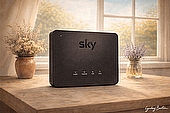
The Sky Gigafast+ Hub is Sky's first WiFi 7 router, supplied exclusively with its multi-gigabit broadband plans on the CityFibre network.
It supports tri-band wireless across 2.4GHz, 5GHz, and 6GHz, with two 10Gbps Ethernet ports designed to handle Sky's fastest available speeds.
Unlike Sky's other routers, WiFi Max - including Sky Max Pods for whole-home mesh coverage - is bundled at no extra cost.

Quick answer: What is the Sky Gigafast+ Hub?
The Sky Gigafast+ Hub is Sky's WiFi 7 router, launched in 2025 alongside its first multi-gigabit broadband plans on the CityFibre network. It is the first Sky router to support speeds beyond 1Gbps over both wired and wireless connections.
Key facts:
- WiFi 7 (802.11be) tri-band router across 2.4GHz, 5GHz, and 6GHz
- Multi-Link Operation (MLO) and 320MHz channels for faster, more stable wireless
- 10Gbps Ethernet - 1 x WAN and 1 x LAN, plus 3 x 1Gb LAN ports
- WiFi Max included at no extra cost, with up to 3 Sky Max Pods
- Exclusively available with Sky's 2.5Gbps and 5Gbps Gigafast+ plans on CityFibre
The router connects to CityFibre's optical network terminal via the 10Gb WAN port, with the 10Gb LAN port available for wired devices that can take advantage of multi-gigabit speeds - such as a NAS, gaming PC, or media server. The remaining three ports handle standard gigabit wired connections.
The Gigafast+ Hub also marks a design departure for Sky. Its cylindrical form and textured white casing differ noticeably from the flat and upright routers Sky has supplied previously.
Sky Gigafast+ Hub specifications
The table below summarises the key hardware and wireless features of the Sky Gigafast+ Hub.
| Sky Gigafast+ Hub | |
|---|---|
| Router model | Sky Gigafast+ Hub |
| WiFi standard | WiFi 7 (802.11be) |
| WiFi bands | Tri-band (2.4GHz / 5GHz / 6GHz) |
| Maximum broadband speed | Up to 5Gbps |
| WAN port | 1 x 10Gbps |
| Ethernet ports | 1 x 10Gb LAN, 3 x 1Gb LAN |
| Security | WPA3 |
| MLO support | Yes |
| Channel width | Up to 320MHz |
| Parental controls | Sky Broadband Shield, MySky app |
| Mesh support | Sky Max Pods (included with WiFi Max) |
| Phone port | 1 x RJ-11 |
| Dimensions | 125mm x 241mm (W x H) |
| Launch year | 2025 |
Who gets the Sky Gigafast+ Hub?
The Sky Gigafast+ Hub is supplied exclusively with Sky's two Gigafast+ broadband plans - Full Fibre 2.5 Gigafast+ and Full Fibre 5 Gigafast+ - both of which run on the CityFibre network rather than Openreach.
Here is the current pricing and terms for those deals:
| Package | Broadband | Monthly price | Upfront price | Contract term | |
|---|---|---|---|---|---|

|
Full Fibre 2.5 Gigafast+ | 2.5Gb average | £70 | £5 | 24 months |
|
|
Full Fibre 5 Gigafast+ | 5Gb average | £80 | £5 | 24 months |
CityFibre completed its nationwide upgrade to 10Gb XGS-PON technology at the end of 2025, meaning its entire network of 4.7 million premises is now capable of supporting multi-gigabit speeds. In practice, that means all homes in CityFibre's footprint should be able to access either Gigafast+ plan where Sky is available.
Customers in Openreach areas are not eligible for the Gigafast+ Hub. Sky's fastest Openreach-based plan is Full Fibre Gigafast, which tops out at 900Mbps and is supplied with the Sky Max Hub instead.
Unlike Sky's other routers, the Gigafast+ Hub is not available as an add-on or upgrade for customers on standard full-fibre or part-fibre plans. The only route to the hardware is taking one of the Gigafast+ plans, which start at £70 per month for 2.5Gbps and £80 per month for 5Gbps.
WiFi Max is included at no extra cost with both plans, meaning Sky Max Pods come as part of the package rather than as a paid add-on - a difference from Sky's other broadband tiers.
Hardware and connectivity
The Gigafast+ Hub takes a different design approach to Sky's previous routers. Where the Sky Broadband Hub sits flat and the Sky Max Hub stands upright, this one is cylindrical - 125mm wide, 241mm tall, with a textured white casing and laser-etched finish. It is designed to sit out in the open rather than be tucked away. The casing is made from 85% recycled plastic, with all antennas housed internally.
The port layout on the rear reflects the hub's multi-gigabit purpose. Two 10Gbps Ethernet ports - one WAN, one LAN - allow wired devices to connect at speeds that match Sky's fastest plans. Three further gigabit LAN ports handle standard wired connections for TVs, consoles, and PCs, while a single RJ-11 phone port supports Sky's digital voice service.
The hub connects to CityFibre's Optical Network Terminal via the 10Gb WAN port, with the 10Gb LAN port available for devices that can make use of multi-gigabit wired speeds - such as a NAS, gaming PC, or media server.
On the wireless side, tri-band WiFi 7 (802.11be) operates across 2.4GHz, 5GHz, and 6GHz. The 6GHz band is new territory for Sky routers - neither the Broadband Hub nor the Max Hub supports it - and it provides a less congested wireless environment for compatible devices.
It also means the hub supports WiFi 6E devices, which use the 6GHz band but predate WiFi 7. Newer phones and laptops with WiFi 6E will benefit from the less congested band even without full WiFi 7 compatibility.
Multi-Link Operation (MLO) allows devices to draw on multiple bands simultaneously for more stable connections, while 320MHz channels increase available bandwidth compared to WiFi 6. In busy households with many active devices, that combination can make a noticeable difference.
A single indicator light on the front handles status at a glance - solid white in normal operation, red for a fault or lost connection, with green, amber, and blue combinations appearing during setup, pod pairing, updates, and resets.
Firmware is managed automatically by Sky, with device controls, parental controls, and security tools available through the MySky app.
Performance and speed limits
The Gigafast+ Hub is the first Sky router built around multi-gigabit broadband. With a 10Gbps WAN port and tri-band WiFi 7, it can deliver the full speed of the plans it comes with over a wired connection without the router being a limiting factor.
Over Ethernet, devices with a 2.5Gb or 10Gb network card - a gaming PC, NAS, or workstation - can connect directly and take full advantage of the line speed. Early users on the 2.5Gbps plan have reported wired speeds close to the advertised rate.
Wireless performance varies more, as it does with any router. On a 2.5Gbps connection, WiFi 7 devices close to the hub can expect speeds in the region of 1.5-2Gbps in good conditions, falling with distance and through walls. WiFi 6E devices will benefit from the 6GHz band, though without MLO support they won't reach the same speeds as WiFi 7 hardware. Older WiFi 5 and WiFi 6 devices connect normally, falling back to the highest standard they support.
It's worth being clear about the current device landscape. WiFi 7 support is present in a growing number of flagship smartphones, newer laptops, and high-end gaming hardware, but most devices in a typical UK home are still WiFi 5 or WiFi 6. The hub handles all of them, but the full benefit of the hardware will only be realised as WiFi 7 device adoption grows.
For larger homes, Sky Max Pods extend coverage as part of the included WiFi Max service, with a guarantee of at least 25Mbps in every room.
Sky WiFi Max and mesh coverage
Unlike Sky's other broadband tiers, WiFi Max is included at no extra cost with both Gigafast+ plans - saving customers the £4-£6 per month add-on fee, with no separate 24-month term to consider.
WiFi Max brings whole-home coverage through Sky Max Pods - mesh boosters that extend the hub's signal into rooms further from the router. Up to three pods can be supplied depending on the layout of the home, forming a single seamless network.
It's worth noting that Sky Max Pods are WiFi 6 devices, rather than WiFi 7. Devices connecting through a pod rather than directly to the Gigafast+ Hub will be limited to WiFi 6 performance. For most everyday use this is unlikely to be noticeable, but it is worth being aware of if WiFi 7 speeds throughout the whole home are a priority.
The in-room speed guarantee promises at least 25Mbps in every room. If that threshold isn't met, Sky will first supply additional pods and, if needed, arrange an engineer visit.
WiFi Max also unlocks a broader set of controls in the MySky app, which is worth highlighting for larger households and families.
Parents can create profiles that group a child's devices together - phone, tablet, and laptop managed in one place - with downtime schedules to cut off access automatically at bedtime or during homework hours, or pause individual devices instantly at any time.
Households can also prioritise specific devices, such as a work laptop or games console, to receive bandwidth priority when the network is busy.
Advanced Security runs in the background, blocking malicious sites, phishing attempts, and malware before they reach anything on the network.
For a full breakdown of what WiFi Max includes and how it works, see our Sky WiFi Max review.
Will the Sky Gigafast+ Hub make a difference?
The Gigafast+ Hub is capable hardware - but how much difference it makes in practice depends on what's connected to it, and where.
WiFi 7's improvements over WiFi 6 are real. MLO, wider channels, and the 6GHz band deliver faster speeds, lower latency, and more stable connections under load. In a household with multiple people streaming, gaming, and video calling simultaneously, a WiFi 7 router manages that demand more efficiently than its predecessors. The difference tends to show up not in peak speeds on a single device, but in how consistently the network performs when several are active at once.
The caveat is device support. Most phones, laptops, and smart home devices in UK homes today are WiFi 5 or WiFi 6. WiFi 7 support is growing, but remains far from universal. Households running mostly older devices will find the hub performs well, but won't see the full benefit for some time yet.
It's also worth remembering that Sky Max Pods are WiFi 6 devices. Rooms served by a pod will be limited to WiFi 6 performance - adequate for most everyday use, but meaning the WiFi 7 advantage is largely limited to areas close to the hub itself.
On the broadband speeds, the position is similar. For most everyday uses - streaming, browsing, video calls, even 4K on multiple screens - a 500Mbps or 900Mbps connection is sufficient. The case for 2.5Gbps or 5Gbps is strongest in households with heavy simultaneous demand: large file transfers alongside streaming and gaming, frequent backups, or a busy home office alongside a family's full online activity.
For those households, the Gigafast+ Hub is a reasonable fit. For everyone else, the gap between it and the Sky Max Hub is likely to narrow as WiFi 7 device support becomes more common.
How does the Gigafast+ Hub compare?
The Gigafast+ Hub sits in a small group of provider-supplied WiFi 7 routers in the UK, alongside offerings from EE and Vodafone at their premium tiers.
EE offers two WiFi 7 routers. The Smart Hub 7 Plus is dual-band and supplied across all EE full-fibre plans, making EE the first major UK provider to offer WiFi 7 as standard across its entire range. The more capable Smart Hub 7 Pro is tri-band, adding the 6GHz band, and is reserved for EE's 1.6Gbps Ultimate plan. Neither EE router matches the Gigafast+ Hub on wired performance - both top out at 2.5Gbps on their fastest ports, compared to 10Gbps on the Gigafast+ Hub.
Vodafone's Ultra Hub 7, supplied with Pro 3 packages, is a dual-band WiFi 7 router without the 6GHz band. It includes one feature absent from both EE and Sky routers: a built-in 4G backup that automatically switches to Vodafone's mobile network if the broadband connection drops. Its wired performance tops out at 2.5Gbps.
The Gigafast+ Hub's main distinguishing feature is its 10Gbps Ethernet ports, which are not currently matched by other provider-supplied routers in the UK. Its tri-band wireless also puts it alongside the EE Smart Hub 7 Pro rather than the dual-band devices from Vodafone and EE's standard range. The trade-off is availability - the Gigafast+ Hub is limited to CityFibre areas, while EE and Vodafone's WiFi 7 routers cover a much wider footprint.
| Sky Gigafast+ Hub | EE Smart Hub 7 Plus | EE Smart Hub 7 Pro | Vodafone Ultra Hub 7 | |
|---|---|---|---|---|
| WiFi standard | WiFi 7 (802.11be) | WiFi 7 (802.11be) | WiFi 7 (802.11be) | WiFi 7 (802.11be) |
| WiFi bands | Tri-band | Dual-band | Tri-band | Dual-band |
| 6GHz band | Yes | No | Yes | No |
| Security | WPA3 | WPA3 | WPA3 | WPA3 |
| Max WAN speed | 10Gbps | 2.5Gbps | 2.5Gbps | 2.5Gbps |
| Max LAN speed | 10Gbps | 2.5Gbps | 2.5Gbps | 2.5Gbps |
| 4G backup | No | No | No | Yes |
| Mesh support | Yes (included) | Yes (paid on most plans) | Yes (included) | Yes (included) |
| Supplied with | Gigafast+ plans (CityFibre) | All full-fibre plans | 1.6Gbps Ultimate plan | Pro 3 plans |
Verdict: Is the Sky Gigafast+ Hub worth it?
The Gigafast+ Hub is a capable router on a fast network. Its 10Gbps Ethernet ports, tri-band WiFi 7, and included WiFi Max put it ahead of what EE and Vodafone currently offer at their premium tiers on wired performance, though the comparison on wireless is closer.
The hardware is only part of the picture. The Gigafast+ Hub is only available on Sky's CityFibre plans, which limits it to a footprint of 4.7 million premises. Customers outside CityFibre areas cannot access it.
For those who can, the question is whether the plans themselves make sense. At £70 per month for 2.5Gbps and £80 for 5Gbps, these are premium products - more than double the cost of Sky's Openreach full-fibre range, which starts at £33 per month, and priced above most competitors at equivalent speeds.
For most households, a well-performing 500Mbps or 900Mbps connection covers everything they do online. The case for multi-gigabit is strongest where demand is genuinely heavy - large file transfers, frequent cloud backups, or a busy home office running alongside a family's full online activity.
What the Gigafast+ Hub does represent is where Sky's hardware is heading. The cylindrical design, the 10Gbps ports, the tri-band WiFi 7 - it feels like a considered step forward rather than an incremental update.
For customers in CityFibre areas whose usage justifies the price, it is a strong package. For everyone else, the Sky Max Hub remains the more practical choice - and a very capable one at that.