


Unlimited mobile data plans are now widely available in the UK, with smaller networks such as SMARTY, iD Mobile and ASDA Mobile often offering the lowest-priced SIM-only deals.
These plans are aimed at customers who want to stream, browse and download without worrying about data limits, whether on a SIM-only deal or with a handset.
However, unlimited data isn't always necessary - many people use far less data than they think, and some customers may get better value from a cheaper limited-data plan.

TL;DR: Quick summary
Verdict: Unlimited SIM-only data is now easy to get, but the "best" plan depends less on the word unlimited and more on speed caps, tethering rules, roaming, and whether you care about mid-contract price rises.
- Best cheap unlimited: budget MVNOs like SMARTY, iD Mobile, giffgaff, Lebara or ASDA Mobile usually undercut the big networks.
- Best for tethering / using your phone as broadband: Three is generally the most permissive; other networks can be stricter in practice.
- Best with no speed caps: Three, EE's higher-tier plans, and Vodafone's Unlimited Max.
If you want bill certainty, fixed-price MVNOs or 30-day rolling plans are usually the safest bet. If you want maximum performance or the strongest coverage, the premium tiers from EE, Vodafone or Three tend to deliver that - but you'll usually pay more, and annual price rises are likely.
What "unlimited mobile data" actually means
"Unlimited" mobile data means your network will not cut you off once you hit a monthly usage limit. You can keep using data for streaming, browsing, downloads and apps without running out or being charged per gigabyte.
However, unlimited does not always mean identical performance. Some networks apply speed restrictions, traffic management or other limits to certain plans, especially at busy times or after very high usage. In practice, this means two "unlimited" plans can feel very different.
The main differences between unlimited plans usually come down to:
- Speed caps: some plans limit maximum speeds (for example, around 100Mbps), while others allow full 4G/5G performance.
- Traffic management: networks may slow speeds during peak times to manage congestion.
- Tethering (hotspots): some plans include it fully, others restrict it or treat it differently.
- Roaming: unlimited data at home does not always mean unlimited data abroad.
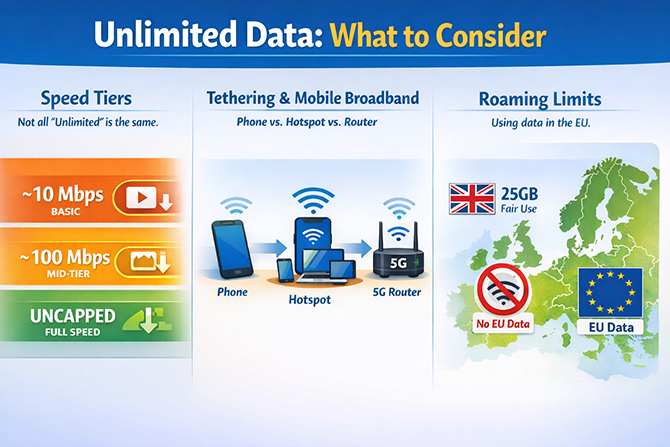
Unlimited mobile data and what to consider. Credit: Choose.co.uk
So, while unlimited data removes the stress of running out, it is still worth checking the small print to understand how your plan behaves in the real world.
Best unlimited SIM-only deals
Unlimited mobile data is now available from all four major networks (EE, O2, Vodafone and Three) and from many MVNOs that use those networks. Prices typically range from around £16 a month at the budget end to £40+ for faster or perk-heavy plans.
In practice, "unlimited" almost always means unlimited for normal personal use in the UK. Providers still keep fair-use clauses in their small print, but these rarely act as hard caps. They are mainly there to prevent extreme or commercial use (for example, running a server or tethering dozens of devices constantly). Where soft thresholds are referenced, they usually sit around 450-650GB per month, depending on the network.
All major networks now include 5G access on unlimited plans (if you have a 5G handset and coverage). The main differences between plans are therefore speed limits, roaming allowances and extras - not the UK data itself.
At-a-glance comparison: unlimited SIM-only plans
This table compares widely available unlimited SIM-only plans across the main UK networks and major MVNOs, focusing on price, speed limits, fair-use policies, roaming allowances and whether prices are fixed during the contract term. It is intended as a quick, side-by-side snapshot before the provider-by-provider detail below.
| Provider | Speed | Fair use / usage limits | Roaming | Tethering | Fixed price? | Typical price band |
|---|---|---|---|---|---|---|
| EE | Either ~10Mbps or uncapped (plan-dependent) | Rough ~600GB guideline | ~50GB included on many plans | Allowed (personal use) | No (scheduled rises) | ~£20-£40+ |
| O2 (Virgin Media O2) | Generally uncapped | Heavy use reviewed around ~650GB | ~25GB EU fair use | Allowed (personal use) | No (scheduled rises) | ~£20-£35 |
| Vodafone | 10Mbps / 100Mbps / uncapped (tiered) | No hard UK cap | ~25GB (more with Xtra) | Allowed (personal use) | No (scheduled rises) | ~£20-£40+ |
| Three | Generally uncapped 5G | No routine throttling in UK | Paid passes required on new plans | Allowed (personal use) | No (scheduled rises) | ~£20-£35 |
| giffgaff (O2) | Uncapped (5G where available) | Similar ~650GB review threshold | Small EU allowance on some plans | Allowed | Yes (18-month contracts); rolling otherwise | ~£25-£35 |
| VOXI (Vodafone) | Uncapped 5G | No routine UK cap | Paid pass required | Allowed | Rolling (no annual rises) | ~£35 |
| Lebara (Vodafone) | Uncapped (5G where available) | No hard UK cap | Often 30GB included | Allowed | Yes (12-month or rolling) | ~£25-£30 |
| Lycamobile (EE) | Uncapped (5G where available) | Soft ~450GB review threshold | Plan-dependent | Allowed | Rolling | ~£20-£25 |
| SMARTY (Three) | Uncapped 5G | No routine UK cap | ~12GB EU included | Allowed | Rolling (no annual rises) | ~£18-£20 |
| iD Mobile (Three) | Uncapped 5G | No hard UK cap | ~30GB in many destinations | Allowed | Yes (SIM-only) | ~£16-£20 |
| ASDA Mobile (Vodafone) | Uncapped 5G | No hard UK cap | ~5GB EU included | Allowed | Yes (12/24-month) | ~£19-£22 |
| Tesco Mobile (O2) | Uncapped 5G | No hard UK cap | ~25GB EU fair use | Allowed | Yes - Clubcard Price only | ~£25-£30 |
Notes: "Fair use" figures are indicative and based on typical network guidance. Roaming allowances vary by plan and can change over time. Speed caps apply where stated.
Unlimited plans on the big networks
Below we set out how the four major UK mobile networks handle "unlimited" data, focusing on speed limits, fair-use rules, roaming and other practical differences that matter in day-to-day use.
EE
EE sells two broad types of unlimited SIM-only plan. Cheaper "no-frills" unlimited plans cap download speeds at around 10Mbps, which is usually enough for browsing and standard-definition streaming. Higher-tier plans remove the speed cap and can deliver full 5G speeds where available.
EE typically references a ~600GB monthly fair-use guideline and usually applies a ~50GB cap to inclusive roaming data.
O2
O2 markets its unlimited plans as "truly unlimited" in the UK, with no routine speed throttling. It still reserves the right to review very heavy use (roughly 650GB twice in six months or extensive multi-device tethering).
EU roaming is generally included with a 25GB fair-use limit, with higher tiers sometimes adding wider international roaming.
Vodafone
Vodafone structures unlimited data around speed tiers. The basic Unlimited plan is typically capped at 10Mbps, Unlimited Plus at around 100Mbps, and Unlimited Max is uncapped. All tiers include 5G access.
Vodafone does not impose a UK data cap, but inclusive roaming is usually limited to about 25GB per month unless you add an "Xtra" roaming package.
Three
Three's unlimited SIM-only plans typically offer full 5G speeds in the UK and allow tethering for personal use. The main trade-off is roaming: free EU roaming has largely been removed from new plans, with paid passes now required.
Unlimited plans on smaller networks (MVNOs)
How the main MVNOs handle unlimited data in practice.
giffgaff
giffgaff offers an unlimited monthly rolling option (often marketed as a "Golden Goodybag") and an 18-month contract option. It applies similar heavy-use review thresholds to O2, and includes a small EU roaming allowance on some plans.
VOXI
VOXI's Endless Data plan typically offers uncapped 5G speeds in the UK. Its standout feature is zero-rated social media on many plans, although EU roaming usually requires a paid pass.
Lebara
Lebara is often strong value for customers who also make international calls. Its unlimited plans commonly include a larger EU roaming allowance than many rivals, alongside bundled international minutes (or unlimited international minutes on higher tiers).
Lycamobile
Lycamobile sells unlimited plans that are often competitively priced, particularly on introductory offers. Like other providers, it may reference a fair-use review threshold for very heavy users.
SMARTY
SMARTY is typically one of the cheapest options for unlimited data on a 30-day rolling basis. It includes 5G access where available and usually offers a modest EU roaming allowance, with a clear focus on simple, low-cost plans.
iD Mobile
iD Mobile offers unlimited data on 1-month, 12-month and longer SIM-only contracts. It often includes roaming in a wider set of destinations than some budget brands, with a fair-use limit on inclusive roaming data.
ASDA Mobile
ASDA Mobile offers unlimited SIM-only plans with 5G access where available, typically with a small EU roaming allowance and simple pricing. It is often positioned as a lower-cost alternative to the main Vodafone brand.
Tesco Mobile
Tesco Mobile sells unlimited SIM-only plans on 12-month contracts, using the O2 network with 5G access where available. Its unlimited plans typically have no UK data caps or speed limits, with EU roaming limits broadly in line with O2's policy.
One important detail is how Tesco handles price certainty. Tesco can offer fixed contract pricing with no mid-term increases, but this fixed-price protection applies only if you take a Clubcard Price deal. If you don't take a Clubcard Price deal, Tesco may still increase the monthly price annually during the contract term, with the future increases shown clearly in pounds and pence at the point of sale.
What really matters when choosing
- If price certainty is your priority, look to fixed-price providers such as ASDA Mobile, giffgaff, Lebara or iD Mobile - or take a Tesco Mobile Clubcard Price deal.
- If you care most about speed and coverage, uncapped plans from EE, Vodafone (Unlimited Max) or Three tend to deliver the best performance where 5G is available.
- If you travel in Europe, providers such as O2, Lebara, SMARTY and iD Mobile are often more generous with inclusive roaming data than premium "perk" plans.
- If you want flexibility rather than a fixed contract, 30-day rolling SIM-only plans from MVNOs can be a simple way to stay in control.
Unlimited vs limited data - which is right for you?
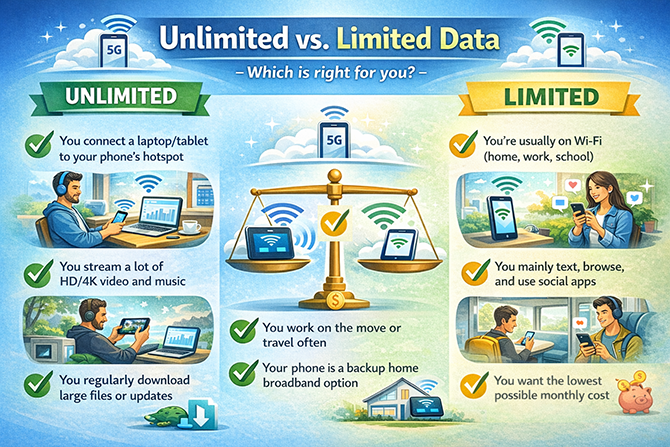
Unlimited vs limited mobile data. Credit: Choose.co.uk
Unlimited data is widely available, but it is not always the most cost-effective choice. The right option usually depends on how you actually use your phone, rather than how much data you think you might need.
Who genuinely benefits from unlimited data
Unlimited plans tend to make sense if you regularly do one or more of the following:
- Stream video frequently (especially HD or 4K)
- Use your phone as a hotspot for laptops, tablets or smart devices
- Rely on mobile data as a partial or full replacement for home broadband
- Download large files, games or system updates over mobile
- Spend a lot of time away from Wi-Fi (for work, travel or commuting)
For these users, the peace of mind of "never thinking about data" often outweighs the extra cost of an unlimited plan.
When a limited plan is usually better value
Many people overestimate how much mobile data they really need.
If most of your usage happens on Wi-Fi at home, work or school, a limited plan is often cheaper and entirely sufficient.
Limited plans typically suit people who:
- Mainly use mobile data for messaging, browsing and social media
- Rarely stream video outside Wi-Fi
- Do not tether other devices regularly
- Want the lowest possible monthly cost
For context, average monthly mobile data use in the UK is still well below the level where unlimited is strictly necessary for many users.
The middle ground: "large but not unlimited"
If you want flexibility without paying for unlimited, large-allowance plans (for example 50-150GB) can be a good compromise.
These are often cheaper than unlimited, but still generous enough to cover occasional streaming or hotspot use.
How to choose in practice
- If you stream a lot or hotspot regularly - choose unlimited.
- If you mostly use Wi-Fi and want to save money - choose a limited plan.
- If your usage varies month to month - consider a large allowance or a 30-day rolling plan.
Whichever you pick, it's worth checking your recent data usage in your current provider's app before switching - it's usually the most reliable guide to what you actually need.
What the small print really means
Even with "unlimited" data, plans are not all the same. The headline price often hides practical differences that can materially affect how a plan works in everyday use.
- Speed caps can make some plans feel slower.
- Fair-use policies still exist for very heavy use.
- 5G performance depends on coverage and congestion.
- EU roaming is often limited or paid-for.
- Tethering rules vary by network and plan.
- Home broadband use is treated differently from phone use.
Speed limits (not just "5G")
Many networks advertise 5G access, but some unlimited plans still cap download speeds.
- EE's cheaper unlimited plans are typically limited to around 10 Mbps.
- Vodafone's Unlimited plan is capped (around 10 Mbps), Unlimited Plus around 100 Mbps, with only Unlimited Max fully uncapped.
- Three generally does not impose routine speed caps in the UK.
If you stream in HD/4K, use cloud backups, or tether regularly, these differences can matter more than the price.
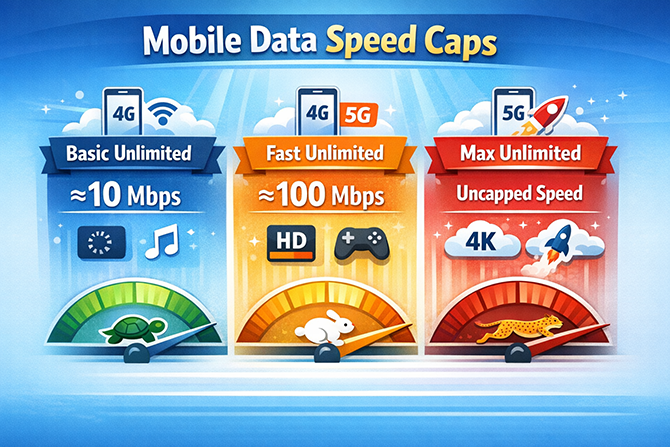
Unlimited mobile data can have speed limitations. Credit: Choose.co.uk
Fair-use policies
"Unlimited" usually means unlimited for normal personal use, not limitless data in every circumstance.
Most providers retain a fair-use clause to prevent extreme or commercial usage (for example, running a server or permanently tethering dozens of devices).
Soft review thresholds typically sit around 450-650GB per month, depending on the network, but these are rarely enforced for ordinary users.
Tethering and mobile broadband use
Some unlimited plans are less generous when used to tether as a home internet replacement.
- Three generally allows personal tethering without routine limits.
- Other networks may monitor very heavy hotspot use or apply different fair-use rules.
- Dedicated 4G/5G home broadband plans often have separate pricing and limits.
Roaming allowances
Inclusive EU roaming varies widely and is often the biggest practical difference between plans.
- O2, SMARTY and iD Mobile are typically more generous with EU roaming data.
- Three has largely removed free EU roaming on new plans and usually requires a paid pass.
- Lebara is strong for international users, but allowances depend on the plan.
Mid-contract price rises
Unlimited does not mean fixed price.
Most major networks (EE, O2, Vodafone and Three) still build annual price rises into their contracts, now stated in pounds and pence at sign-up.
If you want to avoid this, look at fixed-price MVNOs (such as ASDA Mobile, giffgaff, Lebara or iD Mobile SIM-only) or 30-day rolling plans from providers like SMARTY or VOXI.
Perks vs real value
Bundled subscriptions (Disney+, Prime Video, Apple TV+, etc.) can look attractive, but they do not reduce your data usage.
If your priority is cost certainty or raw value, a cheaper unlimited SIM with fewer perks is often better than a premium plan with extras you may not use.
How unlimited data works with mobile broadband

Unlimited mobile WiFi hotspots and USB dongles. Credit: Choose.co.uk
Many customers use mobile SIMs not just in phones but also in mobile broadband devices such as home hubs, Mi-Fi units or USB dongles. While unlimited mobile SIM-only plans technically allow this, there are practical differences from using data on a phone that are worth understanding.
Unlimited SIM data vs dedicated mobile broadband plans
Unlimited data on a phone SIM means you can generally use the same data allowance in a mobile broadband device (hotspot or hub). However, some networks treat this differently for heavy use - especially when the SIM is in a device that is permanently online or replacing home broadband.
Dedicated mobile broadband plans (sometimes called 4G/5G home broadband) are sold specifically for routers and hubs, and often include separate data policies, performance profiles or prioritisation rules compared with phone SIMs.
What providers support mobile broadband use on unlimited SIMs?
| Provider | Mobile broadband use allowed | Dedicated MBB plan available? | Notes |
|---|---|---|---|
| EE | Yes (personal use) | Yes | Unlimited SIM can be used in hubs; dedicated plans marketed separately |
| O2 | Yes (personal use) | Yes | SIMs work in routers; roaming/use policies apply |
| Vodafone | Yes (personal use) | Yes | Unlimited SIMs can tether to devices; dedicated home broadband also offered |
| Three | Yes (personal use) | Yes | Unlimited SIM is widely used for hubs; roaming via passes |
| SMARTY | Yes (personal use) | No | Rolling plans used for hotspot; no dedicated MBB product |
| giffgaff | Yes (personal use) | No | Works in hotspots; heavy/tethered use may be reviewed |
| VOXI | Yes (personal use) | No | Unlimited SIMs tether; EU roaming pass needed |
| iD Mobile | Yes (personal use) | No | Used in hotspots; roaming limits apply |
| ASDA Mobile | Yes (personal use) | No | Works in routers/hubs; small EU roaming allowance |
| Lebara | Yes (personal use) | No | Can be used for mobile broadband; international roaming differs |
Notes: "Mobile broadband use" here means using the SIM for hotspots, routers or hubs. "Dedicated MBB plan" refers to specific plans sold for home broadband devices, which may have different policies or performance commitments than a standard phone SIM.
Practical differences when using SIMs in broadband devices
Traffic management and heavy usage: Some networks reserve the right to manage speeds or prioritise traffic differently when a SIM is in a router or hub rather than a handset, especially if usage is extremely high.
Performance expectations: Unlimited mobile SIMs can deliver excellent real-world speeds on 4G and 5G, but total performance depends on signal quality, network congestion and device capability. Dedicated home broadband plans may be marketed with different speed expectations.
Roaming and device location: Unlimited SIM data generally applies when you are in the UK. Roaming outside the UK (including Europe) is usually limited and may require a paid pass or use specific fair-use policies.
Battery/tethering behaviour: Using a phone as a hotspot is fine for occasional device sharing, but constant use can drain phones quickly and may be treated differently under some providers' fair-use terms.
Bottom line
Unlimited SIM-only plans can often serve as effective mobile broadband connections in hubs and hotspots, but they are not always marketed or managed in the same way as dedicated mobile broadband products. If you want a plan specifically for a home router or constant broadband replacement, check whether the provider offers a dedicated mobile broadband option and what policies apply to that service.
Frequently asked questions
Is "unlimited" really unlimited?
For normal personal use in the UK, yes - you can generally use as much data as you like for everyday activities such as streaming, browsing and downloads.
However, all providers keep a fair-use clause in their terms to prevent extreme or commercial use (for example, running a server or permanently tethering dozens of devices). These clauses are rarely triggered by ordinary use.
Can I tether on all unlimited plans?
Most unlimited plans allow tethering (using your phone as a hotspot), but the rules are not identical.
Three is usually the most flexible for personal tethering. Other networks may monitor very heavy hotspot use or apply different fair-use rules when data is shared with multiple devices.
If you intend to use a SIM as a main home-broadband replacement, a dedicated 4G/5G mobile broadband plan is often a better fit.
Do unlimited plans include 5G?
Yes - all major networks include 5G access on their unlimited plans, provided you have a compatible handset and coverage.
The key difference is speed: some "unlimited" plans include 5G but still cap download speeds (for example around 10 Mbps on entry-level tariffs), while others are fully uncapped.
Do providers limit data after a certain amount?
Most networks do not apply a hard data cap, but they may review very heavy usage under their fair-use policies.
Soft review thresholds typically sit around 450-650GB per month, depending on the provider. These are rarely reached by ordinary users.
If your usage is consistently extreme - particularly via tethering - a provider may contact you to discuss it.
What about EU roaming on unlimited plans?
Inclusive EU roaming varies widely between providers.
O2, SMARTY and iD Mobile are generally more generous with roaming data allowances, while Three has largely removed free EU roaming on new plans and usually requires a paid pass.
Even where roaming is included, it is almost always subject to a separate fair-use limit (often around 20-30GB per month).
Can unlimited plans still have mid-contract price rises?
Yes - "unlimited" does not mean "fixed price."
Most major networks (EE, O2, Vodafone and Three) still build annual price rises into their contracts, now stated in pounds and pence at the point you sign up.
If you want to avoid in-contract rises, you need either a fixed-price SIM-only deal (for example ASDA Mobile, giffgaff, Lebara or iD Mobile SIM-only) or a 30-day rolling plan from providers like SMARTY or VOXI.
Verdict: who offers the best unlimited data deals?
There isn't a single "best" unlimited plan - the right choice depends on whether you care most about price, speed, roaming, or bill certainty.
If you want the cheapest, simple unlimited SIM, smaller networks tend to win on price. SMARTY, iD Mobile, giffgaff, Lebara and ASDA Mobile regularly sit at the budget end of the market, and most of these also avoid mid-contract price rises on SIM-only deals.
If you care most about speed and performance, the major networks are usually stronger. Three typically offers the simplest uncapped experience, while EE and Vodafone can deliver very fast 5G - provided you choose their higher-tier (uncapped) plans rather than entry-level unlimited tariffs.
If you travel in Europe, roaming allowances are often the real differentiator. O2, SMARTY, iD Mobile and Lebara are generally more generous with inclusive EU data than many premium plans, while Three now usually requires a paid roaming pass.
If you want to avoid annual price rises, your safest options are fixed-price SIM-only providers (such as ASDA Mobile, giffgaff, Lebara or iD Mobile) or 30-day rolling plans from SMARTY or VOXI. Most of the big networks still build cash rises into their contracts.
Overall, unlimited data makes the most sense if you stream a lot, tether regularly, or use your phone as a partial home-broadband replacement. If most of your usage happens on Wi-Fi, a large but limited allowance (e.g. 50-150GB) is often better value.
Whichever you choose, don't just look at the headline price. Check speed caps, roaming allowances, tethering rules and any scheduled price rises - these often matter more than the fact that the data itself is "unlimited."









Comments