All four major networks - O2, Vodafone, EE and Three - allow tethering on pay-monthly plans, and most smaller networks do too.
In practice, you can usually use your normal data allowance for tethering, although some PAYG and budget plans apply tighter limits.
Turning your phone into a personal hotspot is straightforward on both Android and iPhone - but tethering can drain your battery quickly and use data faster than you expect.
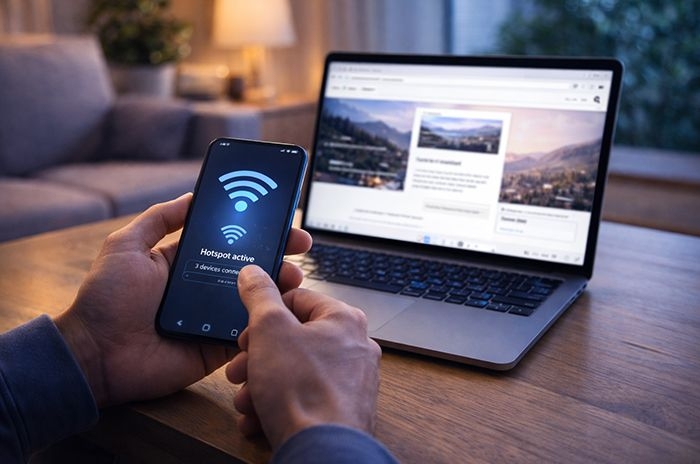
At a glance: can I tether on my network?
Most UK mobile networks allow you to tether - that is, use your phone as a personal Wi-Fi hotspot - but the details vary by provider and by plan. The table below gives a quick, practical snapshot of what you can (and can't) do on each network, including any fair-use limits, speed caps, and whether tethering is permitted while roaming.
| Provider | Tethering allowed? | Heavy-use review (fair use)? | Speed caps? | Roaming tethering allowed? |
|---|---|---|---|---|
| EE | Allowed on all pay-monthly and SIM-only plans | Very heavy use can be reviewed around ~600GB per month, or if 12+ devices are regularly connected | Some unlimited plans are capped at ~10Mbps; higher tiers are uncapped | Allowed, but capped at your inclusive roaming allowance (typically up to ~50GB on most plans) |
| O2 | Yes (uses your normal allowance) | Reviewed if you exceed ~650GB twice in 6 months or regularly connect 12+ devices | No specific tethering cap (real-world speeds vary by coverage/congestion) | Allowed within the ~25GB EU roaming fair-use limit |
| Vodafone | Allowed on all pay-monthly and SIM-only plans | No specific UK fair-use cap stated; usage must be for personal/non-commercial purposes | Yes - speed caps vary by plan (e.g., Unlimited ~10Mbps, Unlimited Plus ~100Mbps, Unlimited Max uncapped) | Allowed - roaming tethering counts toward the roaming allowance (typically ~25GB fair-use cap) |
| Three | Tethering included on all post-paid and unlimited plans | No UK fair-use cap on data; no tethering-specific review threshold | No speed caps for tethered unlimited data in the UK | Allowed abroad but subject to roaming fair-use allowances (e.g., up to ~12GB in Europe) |
| Sky Mobile | Allowed on all pay-monthly and SIM-only plans | Fair use review if data use exceeds ~550GB per billing period | No specific tethering speed cap beyond plan speeds | Roaming tethering allowed with roaming passes; roaming data is usually capped (~25GB) |
| giffgaff | Allowed on all SIM-only plans (uses your plan data) | Fair-use limits apply (avoid 650GB+ in a month and tethering 12+ devices) | No specific tethering speed caps | Roaming tethering allowed within your roaming allowance |
| VOXI | Tethering allowed using your plan's data allowance | No UK data fair-use cap for tethering on unlimited data plans (normal terms apply) | No specific tethering speed cap (plan speeds apply) | Roaming tethering allowed with a European Roaming Pass (capped at ~20GB per 30-day plan) |
| Lebara | Allowed on all SIM-only plans; tethering uses your normal data allowance | No specific UK data fair-use cap stated (standard personal-use terms apply) | No dedicated tethering speed cap (plan speeds apply) | Roaming tethering allowed within roaming fair-use limits (e.g., ~30GB in EU/India) |
| Lycamobile | Tethering allowed using your phone's data allowance | Some plans reference a general fair-use guideline (~450GB/month) on unlimited plans | No specific tethering speed caps beyond plan speeds | Roaming tethering allowed but subject to roaming fair-use limits |
| SMARTY | Allowed - you can tether and hotspot all of your data in the UK | No UK fair-use cap on unlimited plans (normal personal-use terms apply) | No tethering speed caps (5G/4G speeds available) | Roaming tethering allowed but subject to roaming fair-use (~12GB/month in EU) |
| iD Mobile | Tethering allowed - use your data as a personal hotspot | No domestic data cap on unlimited plans (uses your plan allowance) | No published tethering speed caps (plan speeds apply) | Roaming tethering allowed; roaming data may be capped (~30GB in EU) |
| ASDA Mobile | Tethering allowed - your data allowance can be used to create a mobile hotspot | No UK fair-use cap on unlimited plans (normal terms apply) | No specific tethering speed caps (plan speeds apply) | Roaming tethering allowed within roaming data limits (~5GB EU) |
| Tesco Mobile | Hotspot/tethering allowed - use your plan's data to share a Wi-Fi hotspot | No published UK fair-use cap on unlimited data; normal data allowance applies | No separate tethering speed caps (plan speeds apply) | Roaming tethering allowed using roaming data (Home From Home destinations) |
| Talkmobile | Tethering permitted - use your plan's data to hotspot other devices | Data use includes tethering; typical fair-use roaming limits apply | No separate tethering speed caps (normal plan speeds apply) | Roaming tethering allowed within roaming data limits (e.g., ~5GB in EU) |
What is tethering?
Tethering is the technical term for turning your mobile phone into a mobile broadband hotspot.
This lets you connect other devices - such as laptops, tablets or other phones - to the internet using your phone's mobile data connection.
Tethering is also commonly referred to as:
- Mobile hotspot
- Personal hotspot
- Portable hotspot
- Wi-Fi hotspot
In practice, these terms are usually used interchangeably whenever someone is sharing their phone's internet connection with another device.
Two key points to understand:
- Tethering uses your mobile data allowance - so if you don't have unlimited data, it can be used up quickly.
- Tethering is usually wireless, but you can also tether via a USB cable if you prefer.
Is tethering allowed on UK networks?
In short: yes - on almost all UK mobile networks.
Most providers allow you to tether other devices using your phone's data, and in most cases you can use your full data allowance for tethering, including on unlimited plans.
There are a few practical caveats to be aware of:
- Fair-use rules still exist. Even on "unlimited" plans, providers reserve the right to review very heavy use - typically around 600-650GB per month.
- Speed caps still apply. If your plan has a download speed limit (for example ~10Mbps), that cap also applies when you tether.
- Extreme use can be flagged. Providers may discourage permanently running a home network from your phone, or connecting unusually high numbers of devices at once.
For everyday personal use - working on a laptop, streaming, or occasional hotspotting - tethering is widely accepted and rarely restricted in practice.
Network-by-network tethering rules
Tethering on the big networks
Below we look at how the four major UK mobile networks handle using your mobile phone as a hotspot - or tethering.
EE
EE lets you use your phone as a personal hotspot or tether to share your mobile data with other devices - Wi-Fi, Bluetooth or USB can all be used. Tethering uses your regular data allowance.
- Fair use: EE's unlimited plans include a fair-use policy; very heavy usage (for example above ~600GB in a month) or regularly tethering a high number of devices (e.g., 12+) may be reviewed and could lead to traffic management or a move to a more suitable plan.
- Speed caps: Speeds depend on the specific unlimited plan you're on - some cheaper unlimited plans have capped speeds, while higher-tier plans offer uncapped speeds.
- Roaming tethering: Allowed where your plan includes roaming data; outside the UK roaming data is subject to a separate fair-use limit.
O2
O2 allows tethering on all pay-monthly and SIM-only plans, using your normal data allowance.
- Fair use: There is no hard UK data cap, but very heavy use can be reviewed - typically if you exceed around 650GB in two months within a six-month period, or if you regularly connect 12 or more devices.
- Speed: O2 does not apply a separate speed cap specifically to tethering on unlimited plans; real-world speeds depend on coverage and network congestion.
- Roaming: Tethering is permitted while roaming in O2's Europe Zone, but it counts towards the ~25GB EU fair-use roaming limit.
Vodafone
Vodafone lets you use your phone as a personal hotspot or tether without extra charges on all its postpaid (pay-monthly) and SIM-only plans. Your tethering data counts towards your regular data allowance.
- Fair use: Vodafone's terms do not specify a hard UK data cap for tethering, but all unlimited usage must be for personal and non-commercial purposes under its acceptable use policy.
- Speed: Plan tier determines speeds: basic Unlimited plans are typically capped (e.g., ~10Mbps), Unlimited Plus around ~100Mbps, and Unlimited Max offers fully uncapped speeds where 5G is available.
- Roaming: Tethering while roaming is allowed, but it uses your roaming data and is subject to Vodafone's roaming fair-use limit (typically ~25GB per month). Roaming passes or plan benefits may provide larger allowances in some destinations.
Three
Three includes tethering (personal hotspot) on all its pay-monthly and SIM-only plans as standard - you can use your plan's data allowance to share with other devices.
- Fair use: Three's unlimited data plans in the UK do not have a published data cap or formal tethering "fair-use threshold." Unlimited plans are intended for regular personal use without usage limits, although traffic management may apply in extreme cases as part of normal network practice.
- Speed: Three's unlimited data in the UK does not have speed caps - tethered traffic benefits from the same available network speeds as regular data.
- Roaming: When roaming within Go Roam in Europe destinations, you can use up to ~12GB of your data allowance for tethering or other use per month before roaming charges may apply.
Sky Mobile
Sky Mobile lets you use your phone as a personal Wi-Fi hotspot (tethering) on all its pay-monthly and SIM-only plans - your tethered data simply comes out of your regular data allowance.
- Fair use: Sky's unlimited data plans are subject to a fair-usage policy that considers up to around 550GB per billing period as reasonable data use. If you use significantly more than this, Sky may intervene in line with its fair-use terms.
- Speed: There is no separate tethering speed cap - speeds on a hotspot connection are the same as the plan's regular mobile speeds.
- Roaming: Tethering while roaming is permitted when you have an appropriate roaming pass, but roaming data is usually limited by a fair-use cap (for example, around ~25GB per billing period on roaming passports).
Tethering on smaller networks (MVNOs)
SMARTY
SMARTY allows you to use your mobile data for tethering (mobile hotspot) on all its SIM-only plans. Your hotspot traffic simply uses your existing data allowance at no extra cost.
- Fair use: SMARTY's unlimited data plans do not impose a UK data cap specific to tethering - there are no published fair-use thresholds for domestic use; the only restriction is that usage must remain personal rather than commercial.
- Speed: There are no tethering speed caps on SMARTY plans - hotspot speeds match the regular 4G/5G speeds of the plan.
- Roaming: You can tether while roaming in destinations where roaming is included, but roaming data is subject to a fair-use cap (typically around ~12GB per month in the EU).
iD Mobile
iD Mobile lets you use your phone as a mobile hotspot (tethering) and share your data with other devices such as laptops and tablets. When you tether, the data you use simply comes from your plan's allowance.
- Tethering use: You can turn on a personal hotspot with an iD Mobile SIM and tether other devices. On unlimited data plans, you can tether as much as you like as long as you stay within your plan's allowance.
- Fair use/domestic data: For unlimited plans, there is no separate UK cap on tethered usage - it simply draws from your monthly data.
- Speed: iD Mobile does not publish specific tethering speed limits - hotspot speeds are generally the same as your regular mobile data speeds.
- Roaming: Tethering while roaming abroad is allowed, but roaming data is typically limited by fair-use rules (for example, around ~30GB in EU roaming).
giffgaff
giffgaff allows you to use your phone as a personal hotspot on all its SIM-only and unlimited data plans. Tethered data comes out of your normal data allowance.
- Fair use: Your data use for tethering is subject to giffgaff's Fair Usage Policy, which asks you to avoid regularly using very large amounts of data (such as around ~650GB in a month) or tethering to 12 or more devices on a regular basis.
- Speed: There are no separate tethering speed caps - your hotspot speeds are determined by the plan's normal mobile speeds and network coverage. (No official separate speed limit is published.)
- Roaming: You can tether while roaming in destinations where your plan includes roaming data, and that roaming data counts against your roaming allowance.
Tesco Mobile
Tesco Mobile lets you use your mobile data to create a personal hotspot and share that connection with other devices. If your tariff includes a data allowance, you can use that data for tethering at no extra charge as part of your plan's allowance.
- Tethering use: Tesco's support pages confirm that if your plan includes data, you can use your phone as a Wi-Fi hotspot and share that data with other devices.
- Fair use/domestic data: On unlimited data plans there's no specific UK fair-use cap published - your tethered data simply counts as normal data use under your plan. Independent guides report Tesco's unlimited plans *don't limit tethering domestically* as long as usage is personal.
- Speed: Tesco Mobile does not state any special speed limits for tethering - connection speed is governed by normal mobile plan performance.
- Roaming: You're able to use roaming data (e.g., in Home From Home destinations) for tethering, and that roaming data will be drawn from your roaming allowance.
- SIM/routing use: Consumer reports indicate Tesco Mobile SIMs are intended for use in phones/tablets for personal use; using them in 4G/5G routers or MiFi devices may breach the terms unless you take a dedicated data SIM.
Lebara
Lebara allows you to use your phone as a personal hotspot (tethering) on all its SIM-only plans. When you tether, the data used comes out of your regular data allowance, with no extra charge for the hotspot feature.
- Fair use: Lebara does not publish a specific UK data cap tied to tethering. Your data use is governed by your plan's allowance and Lebara's standard personal-use terms rather than a separate tethering limit.
- Speed: There are no separate tethering speed caps - tethered data uses the same network speeds provided by the plan (Lebara runs on the Vodafone network).
- Roaming: Tethering while roaming is allowed where your plan includes roaming data, and this is subject to roaming fair-use limits - for example, up to about 30GB per month in EU/India destinations on qualifying plans.
VOXI
VOXI lets you use your phone as a mobile hotspot to share your plan's data with other devices such as phones, tablets or laptops. When tethering, the data you use counts towards your regular data allowance and unlimited passes.
- Fair use: VOXI does not publish a specific UK fair-use cap for tethering on its unlimited data plans. Your data use is governed by the plan's allowance and Vodafone's standard acceptable-use terms.
- Speed: There are no separate speed caps specifically for tethered connections - tethered speeds are the same as the plan's normal mobile speeds.
- Roaming: Tethering while roaming is allowed if you purchase a European Roaming Pass. Roaming data is typically limited to around 20GB per 30-day plan under VOXI's roaming terms.
Talkmobile
Talkmobile allows you to use your data allowance to create a personal hotspot and share your internet connection with other devices such as tablets and laptops. Tethered use draws from your plan's data and does not incur extra charges beyond your normal data usage.
- Tethering use: You can use all of your plan's data for tethering/personal hotspot - this is included on Talkmobile SIM-only plans.
- Fair use/domestic data: There is no specific UK fair-use cap published solely for tethering, but your data is subject to the terms of your plan and any roaming fair-use limits where relevant.
- Speed: Talkmobile does not publish any special speed caps for tethering - the tethered connection will generally perform at the same speeds as your plan's normal mobile data.
- Roaming: When you're roaming in included destinations, you can tether using your roaming data but are limited by the roaming fair-use policy - typically around 5GB per month for customers who joined Talkmobile after March 2023.
ASDA Mobile
ASDA Mobile lets you use your phone's data allowance to create a mobile hotspot, sharing that data with laptops, tablets and other devices. If you're on an unlimited data plan, there's no separate cap on how much data you can consume while tethering in the UK - it simply comes out of your existing allowance.
- Fair use: ASDA's unlimited data plans don't publish a UK data fair-use cap - domestic data and tethering are governed by the plan's normal terms.
- Speed: There are no separate speed limits for tethered use - the speeds you get on a hotspot are the same as your plan's regular mobile speeds.
- Roaming: When you're roaming in included European destinations, you can tether using your roaming data, but roaming is typically limited to around 5GB per month.
Lycamobile
Lycamobile lets you use your phone as a personal hotspot (tethering) on its SIM-only and unlimited data plans. When you tether, the data you use comes from your plan's data allowance.
- Fair use: Lycamobile does not publish a hard monthly cap for UK data on all plans, but some unlimited data plans reference a fair-use guideline (often around ~450GB per month) above which extremely heavy usage may be reviewed according to their fair-use terms.
- Speed: There are no separate tethering speed caps - speeds on a tethered device follow the normal mobile data speeds of the plan you're on.
- Roaming: Tethering while roaming is permitted where Lycamobile's roaming feature is included, but usable roaming data is subject to fair-use limits which vary by destination and plan.
Speed caps and fair use
Even on "unlimited" plans, performance can vary. The two things that most often affect how tethering actually feels in practice are speed caps and fair-use rules.
Speed caps (what you'll actually get)
Some networks limit maximum download speeds on cheaper unlimited plans, even though your data allowance is unlimited. In practice, this can make a big difference if you stream video, download large files, or tether regularly.
- EE: Cheaper unlimited plans are typically capped at around 10Mbps. Higher-tier plans remove this cap and allow full 5G speeds where available.
- Vodafone: Uses speed tiers:
- Unlimited: around 10Mbps
- Unlimited Plus: around 100Mbps
- Unlimited Max: uncapped 5G speeds
- Three: Generally does not impose routine speed caps on its unlimited mobile plans in the UK.
If you mainly browse and message, a capped plan may be fine. If you stream in HD/4K, work from your hotspot, or tether multiple devices, speed caps are much more noticeable.
Fair-use rules (for very heavy use)
"Unlimited" almost always means unlimited for normal personal use, not limitless in every possible circumstance.
Most networks keep a fair-use clause that allows them to review extreme or commercial use - for example, permanently running a server, or tethering dozens of devices around the clock.
Providers sometimes reference soft review thresholds in the region of ~450-650GB per month, depending on the network. For ordinary users, these are rarely triggered, but they do exist in the small print.
Tethering while roaming
Tethering your phone while abroad is allowed on most UK networks as long as your plan includes roaming data. Whether you can do this without paying extra depends on how each provider handles roaming allowances and fair-use limits.
The key distinction is this:
- Some providers let you use your regular roaming data allowance for tethering at no extra cost when travelling in included roaming zones (e.g., in the EU).
- Others still offer roaming data only if you buy a daily roaming pass or add-on first - once you've activated that pass, tethering is normally permitted within that allowance.
Providers that generally let you use your inclusive roaming data (no extra roaming pass) for tethering
- O2 - free EU roaming with up to ~25GB data in Europe per month before you need a bolt-on.
- Tesco Mobile - lets you use your UK allowance abroad in "Home From Home" EU destinations; roaming data counts toward your plan.
- iD Mobile - roaming in included destinations uses your UK data allowance; typical roaming data fair-use ~30GB.
- SMARTY - roaming in EU included up to a fair-use limit (commonly ~12GB).
- Lebara - inclusive roaming in EU or India with fair-use (often ~30GB) - subjective per plan.
- giffgaff - inclusive EU roaming up to a fair-use level (typically ~5GB).
- Talkmobile - free roaming in a set of EU destinations with a small fair-use data allowance (about 5 GB, sometimes up to 15 GB for older customers).
On all of these networks, if your roaming allowance includes data, that roaming data can normally be used for tethering without needing to buy a separate roaming pass - although fair-use limits apply and tethered use will count against your roaming data.
Providers that often require a roaming add-on or pass first
- EE - most newer plans do not include free EU roaming; you usually must buy a daily roaming pass or use pay-as-you-go roaming data before you can use roaming data (and thus tether) abroad.)
- Vodafone / VOXI - free roaming is not included on many newer plans in the EU; roaming data is typically accessed via daily passes or pay-as-you-go roaming bundles.
- Sky Mobile - roaming charges usually apply unless your plan specifically includes roaming; any roaming data allowance can then be used for tethering within limits.
In short: you can tether while roaming if your plan includes roaming data - but on some major networks you need to activate a roaming pass or add-on first. Providers that include free roaming (typically MVNOs and O2/Tesco) let you tether within your roaming data allowance, while others (EE, Vodafone/VOXI, Sky) require an add-on before you have roaming data to share.
Bottom line
No major UK network now bans tethering outright when you have usable roaming data - the difference is simply whether that data is included in your plan or requires a paid pass.
Can I use my SIM in a 4G/5G router?
This is one of the most confusing areas of tethering, because there is a gap between what providers say in their terms and what people actually do in practice.
In simple terms:
- Some providers technically restrict unlimited SIMs to phones and tablets, rather than always-plugged-in 4G/5G routers or MiFi devices.
- In practice, many customers still use unlimited SIMs in routers - but this can be a breach of terms and conditions.
- If router use is important to you, a dedicated mobile broadband (MiFi) or home 4G/5G plan is usually the safest option.
How this works by provider
Generally more permissive / commonly used in routers (but still not officially sold for this purpose):
- Three - often used in routers and home 4G/5G devices, especially on unlimited plans.
- SMARTY and iD Mobile (Three network) - many users use these in routers, though they are marketed as phone SIMs.
- giffgaff - allows tethering and is frequently used in MiFi/routers in practice.
More restrictive in the wording of their terms (phone hotspot preferred):
- EE - generally expects you to use your phone as a hotspot rather than a fixed router.
- Vodafone - similar position; router use is not what standard phone SIMs are designed for.
- Sky Mobile - typically framed around phone use rather than routers.
O2 / Tesco Mobile
O2 (and by extension Tesco Mobile, which uses the O2 network) does allow tethering from your phone - using your handset as a personal hotspot is permitted.
However, O2's unlimited data terms include a clause that plans should be used in devices "that do not require to be plugged in in order to work." In practice, this means:
- Phone hotspot use is fine.
- Putting an unlimited SIM into a permanently mains-powered 4G/5G router could be viewed as outside the intended use of the plan.
Notably, giffgaff (also on the O2 network) explicitly allows tethering on all plans, including PAYG, which shows how differently MVNOs can interpret the same underlying network.
What to choose if you actually want a router
If your goal is to replace home broadband or run a router full-time, you are usually better off with:
- A dedicated 4G/5G home broadband plan (Three, Vodafone, EE, O2 all sell these), or
- A MiFi/mobile broadband plan designed for portable routers.
These are priced and designed for router use, so you avoid any risk of breaching terms - even if many people do use phone SIMs in routers in practice.
How tethering works
Tethering works by turning your mobile phone into a portable Wi-Fi hotspot that other devices can connect to using your mobile data.
You can tether in three main ways: via Wi-Fi (most common), Bluetooth, or USB. Each method has slightly different trade-offs in speed, battery use and how many devices you can connect.
Wi-Fi tethering (most common)
Your phone broadcasts a Wi-Fi network that other devices (laptops, tablets, games consoles, etc.) can join using a password.
- Fastest and most practical option for everyday use.
- Supports multiple devices at the same time.
- Uses more battery than Bluetooth or USB.
Bluetooth tethering
Your phone shares its data connection with one paired device over Bluetooth.
- Uses less battery than Wi-Fi tethering.
- Slower than Wi-Fi.
- Usually limited to one connected device at a time.
USB tethering
Your phone is physically connected to a laptop or computer via a cable.
- More stable and battery-friendly than Wi-Fi (your phone can often charge while tethering).
- Fast connection.
- Limited to a single connected device.
How to tether wirelessly (Android & iPhone)
The exact menu names can vary by phone and software version, but the steps are broadly the same on most modern devices.
On Android
- Settings
- Connections
- Mobile Hotspot & Tethering
- Mobile Hotspot
- Turn Mobile Hotspot on
- Note the Wi-Fi network name and password (or create your own)
- On the device you want to connect, select your phone's hotspot from the Wi-Fi list and enter the password
On iPhone
- Settings
- Personal Hotspot
- Turn on "Allow Others to Join"
- Note the Wi-Fi password (or change it if you prefer)
- On the device you want to connect, select your iPhone from the Wi-Fi list and enter the password
In both cases, switch your hotspot off when you're finished to avoid unnecessary data use and battery drain.
If you change your hotspot password, make sure it's strong and unique - this is your main protection against unauthorised access.
Is tethering right for you?
Tethering can be an excellent way to get online when you're away from Wi-Fi, but it isn't always the best solution for every situation. The trade-offs are mainly about battery life, speed and how much data you actually use.
Pros
- Instant internet access wherever your phone has signal
- Generally more secure than public Wi-Fi
- Often faster and more reliable than public hotspots
- Multiple devices can connect at once
Cons
- Your phone's battery drains much faster
- Data can be used very quickly, especially with video or large downloads
- Speeds are shared across all connected devices
Tethering your phone is generally more secure than connecting to public Wi-Fi, because you control the network and who can join it. The main security risk is your hotspot password - always keep it turned on and make it strong and unique.
Can tethering replace home broadband?
For most people, tethering is not a full replacement for home broadband.
Unlimited mobile plans are usually more expensive than fixed-line broadband, and real-world speeds can be slower or more variable - especially indoors or in busy areas.
Tethering can work well as a temporary or back-up solution, or for very light single-user households, but it tends to struggle if several devices are online at once or you rely heavily on video calls, gaming or smart-home devices.
If your fixed broadband is very slow, a dedicated 4G or 5G home broadband router is usually a better option than relying on your phone as a hotspot. You can read more about this in our guide to mobile broadband for the home.
PAYG tethering
Tethering is usually allowed on pay-as-you-go (PAYG), but it is often poor value because data bundles are small and expensive compared with SIM-only deals.
If you want to tether occasionally on PAYG, it is usually better to buy a dedicated PAYG data SIM (or a cheap rolling SIM-only plan) rather than relying on your main PAYG phone credit.
Summary: Tethering in 2026
Tethering is now a mainstream way to get online, and most UK networks allow it as standard on modern plans.
- You can usually use your normal data allowance for tethering, but check for speed caps, fair-use rules and roaming limits.
- Battery drain is the biggest real-world drawback - expect your phone to run down much faster when acting as a hotspot.
- If you don't have unlimited data, tethering can burn through allowances quickly, especially with video or large downloads.
- Where available, 5G has made tethering far more usable than before, with faster and more stable speeds in many areas.
If you're choosing a plan mainly for tethering, it's worth looking for one with no speed caps, clear fair-use rules and sensible roaming terms.
To find an unlimited SIM-only plan suitable for tethering, compare mobile deals from major operators and smaller providers, or read more about whether tethering has replaced the dongle.