Funding broadband affordability: a proposal to support social tariffs through VAT

Ofcom has taken a series of steps in recent years to improve access to social tariffs, including monitoring affordable telecoms tariffs from 2020, introducing automated eligibility checks with the Department for Work and Pensions in 2022 and strengthening protections for vulnerable customers, publishing provider-level take-up data in 2023 to increase transparency and encourage competition, and supporting voluntary industry commitments such as the Telecoms Consumer Charter in 2026.
Despite these successive regulatory and industry measures, Ofcom's latest pricing and consumer engagement report shows uptake remains limited relative to eligibility. More than 500,000 households were using a social tariff as of 2025, representing less than 10% of eligible households, while around 70% of eligible households remain unaware these tariffs exist. Social tariffs are now offered by more than 30 broadband providers and are widely available across the market, yet most eligible households are still not using them.
Social tariffs have therefore moved beyond an early rollout phase. Their continued low uptake despite regulatory oversight and industry commitments suggests inherent limitations in a voluntary, provider-funded affordability model.
Broadband is recognised as essential national infrastructure, with public funding supporting fibre rollout through programmes such as Project Gigabit. However, affordability measures remain funded largely through voluntary retail tariffs rather than dedicated public mechanisms.
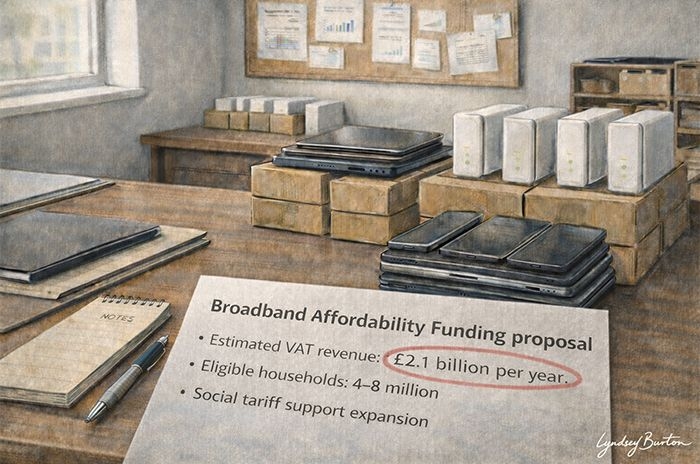
We propose that broadband VAT revenue could be partially ring-fenced into a dedicated digital inclusion fund to support social tariffs and broader digital access initiatives in a financially sustainable and transparent way.
Broadband VAT and essential infrastructure
Broadband services are currently subject to the standard VAT rate of 20%, despite being recognised as essential infrastructure. The UK Government has established a Universal Service Obligation guaranteeing every home access to a minimum broadband connection, and public funding programmes continue to support full-fibre rollout nationwide.
At the same time, affordability support is delivered primarily through voluntary social tariffs offered by retail providers. These tariffs are typically priced at £12-£20 per month, often close to wholesale network access cost, meaning providers absorb much of the financial burden directly.
Reducing broadband VAT to the reduced rate of 5% while ring-fencing the difference into a dedicated digital inclusion fund would allow affordability measures to be funded systematically rather than relying entirely on voluntary retail discounts.
This would align broadband affordability policy with existing public investment in infrastructure and ensure funding is transparently directed toward digital inclusion.
A dedicated broadband affordability fund
Revenue generated through broadband VAT could support a ring-fenced affordability and digital inclusion fund with several objectives:
- Providing direct funding to broadband providers offering regulated social tariffs
- Supporting digital skills training and confidence programmes
- Helping low-income households access essential devices and connectivity equipment
- Reducing barriers to broadband adoption among vulnerable households
This approach would ensure that affordability measures are funded transparently and sustainably, without relying entirely on commercial retail pricing structures.
Ofcom's research continues to show that affordability challenges persist. Around 7% of UK households report difficulty affording their fixed broadband service, rising significantly among lower-income households. Some households rely on mobile connectivity alone or go without fixed broadband due to cost barriers.
These findings underline the importance of targeted affordability support alongside infrastructure rollout.
Improving access to social tariffs
Social tariffs are now offered by most major broadband providers, including BT, Sky, Virgin Media O2, Vodafone, and others. However, take-up remains limited compared to eligibility.
This reflects structural challenges within the current voluntary system. Social tariffs rely on customers being aware of their eligibility and actively requesting the tariff, and providers fund affordability support through discounted retail pricing.
A publicly supported affordability fund could allow social tariffs to be delivered more consistently, reducing reliance on individual providers and enabling clearer promotion across the market.
Additional policy changes could further improve access, including standardising eligibility criteria across providers and integrating affordability support more directly into the benefits system, so eligible households are informed automatically rather than relying on provider-level promotion.
The goal should be to ensure that broadband affordability support is delivered as reliably as broadband infrastructure itself, recognising connectivity as essential to participation in modern society.

We're independent of the products and services we compare.

We order our comparison tables by price or features - never by referral revenue.

We donate at least 5% of net profits to charity, and operate a climate-positive workforce.