
The Samsung Galaxy Buds Live, Sennheiser CX True Wireless and Amazon Echo Buds occupy a similar affordable price bracket, but feel very different in everyday use.
The Sennheisers deliver the best sound, while the Galaxy Buds Live stand out for their unusual open fit and long-term comfort.
Amazon's Echo Buds focus more on convenience and value, with Alexa integration and useful multi-device connectivity that neither rival can match.
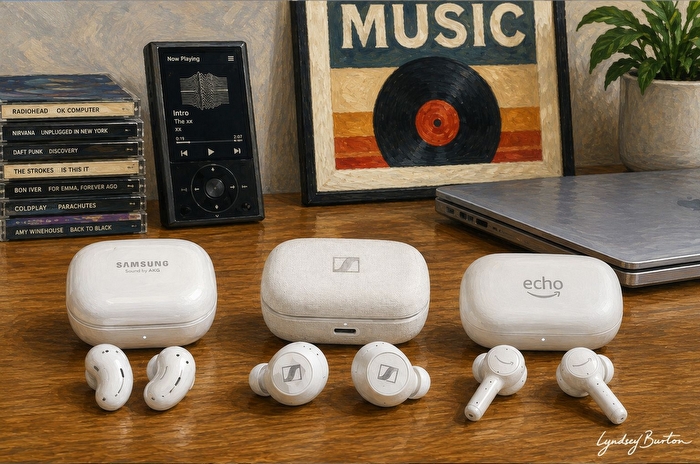
TL;DR: Which earbuds should you buy?
Choose the Sennheiser CX True Wireless for sound quality. They're the best-sounding of the three, with more detail, better separation and aptX support, while IPX4 water resistance also makes them the strongest choice for exercise. The downside is their bulky fit and some concerns around long-term reliability.
Choose the Samsung Galaxy Buds Live for comfort. Their unusual open, bean-shaped design is remarkably comfortable for long listening sessions, particularly if you dislike silicone ear tips. They work best with Samsung phones, but weak ANC, IPX2 water resistance and occasional connection problems make them less convincing outdoors.
Choose the Amazon Echo Buds for value and connectivity. They have the weakest sound of the three, but they're much cheaper and the only pair with true Bluetooth multipoint. That makes them particularly useful for anyone regularly switching between a phone and laptop.
Who are these earbuds actually for?
| Samsung Galaxy Buds Live | Sennheiser CX True Wireless | Amazon Echo Buds (2023) | |
|---|---|---|---|
| Primary strength | All-day ear comfort | High-fidelity audio clarity | Price and multi-device setup |
| Best used for | Office, casual listening, podcasts | Critical music listening at home | Bedside companion, secondary pair |
| Ecosystem lock-in | Best on Samsung (Scalable Codec) | Platform-agnostic (iOS/Android) | Best with Alexa smart home |
| Avoid if you... | Sweat heavily or have tiny ear canals | Need active noise cancellation | Want deep bass or immersive sound |
Side-by-side specifications
| Samsung Galaxy Buds Live | Sennheiser CX True Wireless | Amazon Echo Buds (2023) | |
|---|---|---|---|
| Price | £100-£150 | £120 | £49.99 |
| Fit / IP rating | Open bean-shaped, IPX2 | Sealed in-ear, IPX4 | Open-ear, IPX2 |
| Codecs | SBC, AAC, Samsung Scalable | SBC, AAC, aptX | SBC, AAC |
| ANC | Yes, fit-dependent | No | No |
| Multipoint | No (Samsung auto-switch only) | No | Yes, two-device pairing |
| Charging | Qi wireless + PowerShare | USB-C only, no wireless | USB-C only, no wireless |
| Battery (buds/case) | ~6-8 hrs / 21 hrs total | ~9 hrs / 27 hrs total | ~5-6 hrs / 20 hrs total |
| Known weak point | Bluetooth dropouts outdoors | Long-term reliability | Weak call mic in noisy settings |
Samsung Galaxy Buds Live: wonderfully comfortable, frustratingly inconsistent
The Galaxy Buds Live are easily the strangest-looking earbuds of the three. Samsung's bean-shaped design sits inside the outer ear rather than pushing a silicone tip down the ear canal, and it makes a bigger difference than you might expect.
For me, comfort is their standout feature. They're light, unobtrusive and particularly pleasant to wear for several hours at a time. If you dislike the plugged-up feeling of conventional sealed earbuds, the Buds Live are immediately appealing.
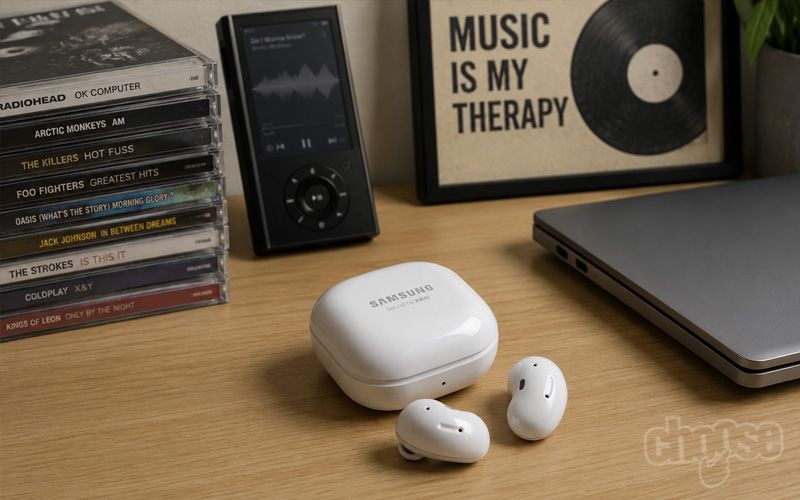
Samsung Galaxy Buds Live. Credit: Choose.co.uk
The catch is that fit affects almost everything else.
Each earbud packs in three microphones, a bass duct and an accelerometer, but because there's no conventional ear tip creating a seal, positioning the Buds Live correctly has a noticeable effect on both sound quality and active noise cancellation.
Get it right and they produce a surprisingly full sound. Bass is punchy and gives pop and electronic tracks plenty of energy, while voices come through well for podcasts and everyday listening.
Put them directly alongside the Sennheiser CX True Wireless, though, and the difference is clear. The Samsungs don't have the same definition through the mids or detail at the top end, and more complicated tracks can sound slightly congested by comparison.
They're much better with a Samsung phone
The Galaxy Buds Live also make considerably more sense if you own a Samsung Galaxy phone.
With compatible Samsung hardware, they can use Samsung's proprietary Scalable Codec, which dynamically moves between roughly 96 and 512kbps depending on connection quality. Instead of simply dropping between fixed quality levels, it can prioritise higher audio quality when the connection allows it and stability when conditions become more difficult.
Connect the Buds Live to something outside Samsung's ecosystem and you're back to SBC or AAC.
They still work perfectly well with other phones, but you lose one of the main technical advantages of buying them. The experience feels very clearly designed around Galaxy hardware.
There's no standard Bluetooth multipoint either. Samsung offers automatic switching between compatible devices signed into the same Samsung account, but that's not the same as keeping a phone and arbitrary laptop connected simultaneously.
That's particularly noticeable when switching to the much cheaper Echo Buds, which can do exactly that.
Connectivity is the bigger concern
Connection reliability is the Buds Live's more worrying weakness.
They can behave perfectly well indoors but become less consistent once you're outside and moving around. One earbud - frequently the left - dropping connection during a walk is a recurring issue, and it isn't necessarily solved by resetting or even replacing the earbuds.
It isn't something that affects every pair, but reports of the same behaviour stretch from 2020 through to 2024, often specifically during outdoor or moving use.
The unusual hardware design may help explain it. Fitting the antenna and electronics into such a small, curved bean-shaped enclosure places tighter constraints on antenna positioning than a conventional stem-and-bud design.
Whatever the precise cause, if you're primarily buying earbuds for walking or running, it's something I'd take seriously.
ANC doesn't overcome the open design
Samsung technically has another major advantage over both rivals here: active noise cancellation.
In practice, it's nowhere near as useful as that specification suggests.
ANC works best when an earbud already creates a good physical seal and the electronics are left to deal with the remaining background noise. The Buds Live deliberately don't seal your ear.
They can reduce some persistent low-frequency noise, but traffic, voices and general environmental sound still get through easily. In some situations, switching ANC off makes surprisingly little difference.
It's the fundamental trade-off behind the entire product. The open design is why the Galaxy Buds Live are so comfortable, but it's also why their noise cancellation is so limited.
They're not my first choice for workouts either. The IPX2 rating is enough for light drizzle or a mildly sweaty session, but not much more. Repeated heavy sweating is exactly the sort of use I'd be reluctant to subject IPX2 earbuds to, particularly given the long-term reliability complaints associated with them.
Charging is considerably better. The case supports standard Qi wireless charging as well as Samsung Wireless PowerShare, so if you have a compatible Galaxy phone you can simply place the case on the back of it to top up the battery.
It's a small feature, but one that's genuinely useful if you're already invested in Samsung's ecosystem.
Sennheiser CX True Wireless: the sound quality pick, with a longevity question mark
Move from the Galaxy Buds Live to the Sennheiser CX True Wireless and the improvement in audio quality is immediately apparent.
These are the best-sounding earbuds of the three.
There's more space around instruments, vocals are clearer and treble has considerably more detail. Bass is powerful too, although it's prominent enough that anyone looking for completely neutral tuning may find the low end a little overdone.
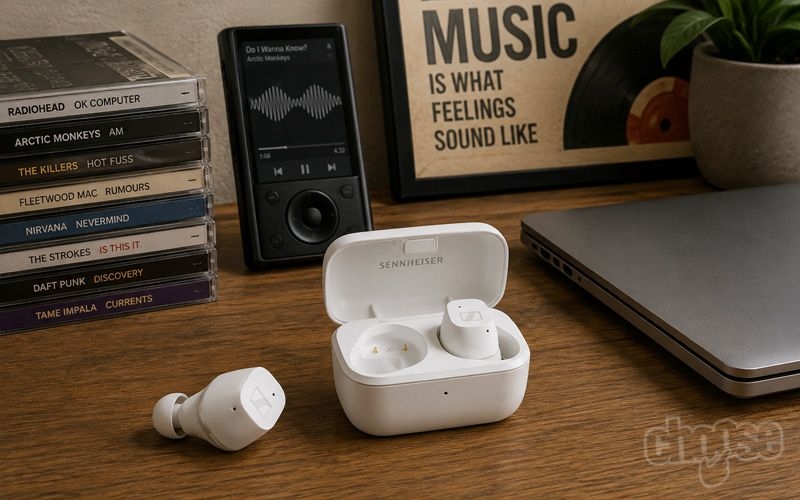
Sennheiser CX True Wireless. Credit: Choose.co.uk
They're not perfect. Bass can occasionally lack refinement, brighter tracks can push the treble towards harshness, and some rhythmically complicated music exposes weaknesses in timing.
But none of that changes the overall result. Put all three pairs in front of me and ask which I'd choose purely for listening to music, and it's the Sennheisers.
aptX makes a meaningful difference
Part of the appeal is codec support.
The CX True Wireless support SBC, AAC and aptX. That gives compatible Android devices a better option than basic SBC, with lower latency and the potential to preserve more audio detail.
It's an important distinction between the three.
Samsung has its Scalable Codec, but you need compatible Samsung hardware to take advantage of it. Amazon only offers SBC and AAC. Sennheiser's aptX implementation isn't tied to one manufacturer's ecosystem.
That makes the CX True Wireless particularly compelling if you're an Android user who cares about audio quality but doesn't want your earbuds tied to a particular phone brand.
They're the best choice for exercise
Sennheiser also wins on water resistance.
The CX True Wireless carry an IPX4 rating, compared with IPX2 for both the Galaxy Buds Live and Echo Buds. That makes them much better suited to sweat and splashes, and the pair I'd be most comfortable using regularly at the gym or outside in unpredictable weather.
The touch controls are good too.
The large, flat touch surfaces are easy to locate without looking, but they're not overly sensitive when you're simply adjusting the earbuds. Controls can also be customised through the Sennheiser Smart Control app.
It sounds minor on a specifications sheet. When you're actually swapping between earbuds throughout the day, not accidentally pausing your music every time you adjust the fit becomes surprisingly important.
Comfort is less convincing
The CX True Wireless can't match Samsung for comfort.
They're considerably bulkier and use a conventional sealed in-ear design. That gives them much better passive isolation, but you're also much more aware that they're in your ears.
The size is particularly worth considering if you have smaller ears. During longer listening sessions, the housings can start to press uncomfortably rather than disappearing in the way the Galaxy Buds Live can.
Long-term reliability is a bigger concern.
There are repeated reports of individual earbuds eventually refusing to charge or connect, sometimes after only a year or two of ownership. Factory resets don't always revive them, and similar single-earbud failures have appeared across other Sennheiser true-wireless models as well.
That doesn't mean every CX True Wireless pair is going to fail after two years, but it's enough of a pattern that I'd factor it into the buying decision.
Charging is basic too. There's no wireless charging and no quick-charge feature; the case is USB-C only.
The CX True Wireless therefore aren't the most feature-packed earbuds here. What you're paying for is primarily the sound - and on that front, they deliver.
Amazon Echo Buds: cheap, capable and mediocre on audio
The 2023 Amazon Echo Buds make their priorities obvious almost immediately.
At £49.99, they're substantially cheaper than the other two and don't attempt to compete directly with more expensive earbuds on sound quality. Amazon has also moved away from the sealed, ANC-equipped design of its second-generation Echo Buds in favour of an open-ear fit with no active noise cancellation.
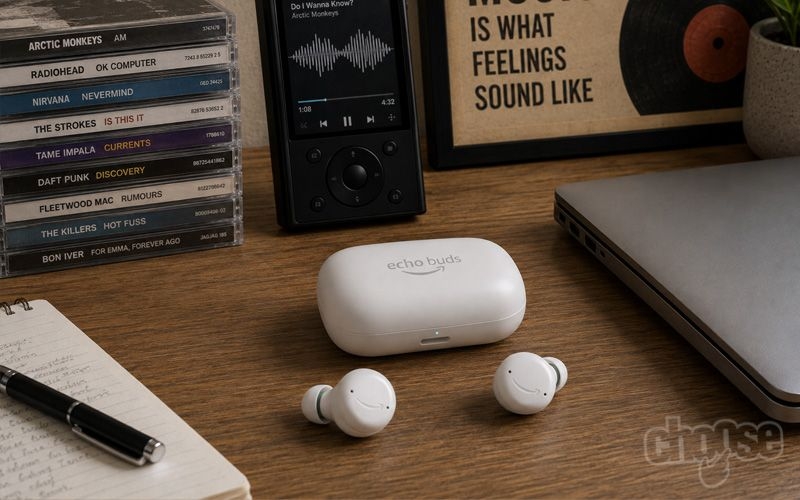
Amazon Echo Buds (2023). Credit: Choose.co.uk
That makes them more comfortable for staying aware of what's happening around you, but it also removes isolation.
Of these three pairs, they're the least immersive.
Bass lacks the depth and impact of the Galaxy Buds Live, never mind the Sennheisers, and music generally sounds thinner and flatter. There's less separation between instruments and less sense of space.
Codec support is equally basic: SBC and AAC, with no aptX.
For podcasts, background music and everyday listening, they're perfectly usable. If you're sitting down specifically to listen to an album, I'd choose either of the other two first.
Comfort is mixed too. The open design avoids the pressure of a silicone ear tip, but the shape isn't as successful as Samsung's bean design. The plastic edges can become noticeable after longer listening sessions and, depending on your ears, can eventually become uncomfortable.
Multipoint is the reason to buy them
Then you discover the feature that completely changes the Echo Buds proposition: proper Bluetooth multipoint.
Unlike the Galaxy Buds Live and CX True Wireless, the Echo Buds can remain connected to two devices simultaneously.
Pair them with a phone and work laptop and you don't need to disconnect one before using the other. Start playing audio on the laptop and they can switch across; go back to your phone and they're already connected.
For hybrid working, that's genuinely useful.
In fact, it's slightly ridiculous that the £49.99 earbuds are the only pair here offering true two-device multipoint. Samsung's ecosystem switching isn't the same thing, and the Sennheisers simply don't have it.
If most of your earbud use involves moving between Teams calls on a laptop, music on your phone and podcasts during the day, this feature alone makes the Echo Buds much more interesting than their audio performance suggests.
Call quality is less impressive
They're considerably less convincing once there's background noise.
The open stem design leaves the microphones exposed to more ambient sound, and voices can become processed, garbled or intermittently difficult to understand in noisy environments. Male voices in particular can suffer, although female voices aren't immune to the processing either.
In a quiet room, that's less of a problem. For regular calls from busy streets, stations or cafes, I'd look elsewhere.
Battery life is modest but actually slightly better than Amazon's own five-hour claim. Real-world testing puts the earbuds at roughly six hours per charge, with one standardised test reaching 6 hours 22 minutes. The case takes total listening time to around 20 hours.
Like Samsung, Amazon only provides IPX2 water resistance. That's sufficient for light sweat or the occasional spot of rain, but these aren't earbuds I'd choose for a heavy workout routine.
There are also scattered longer-term reports of battery drain and connection problems emerging after a year or so, although everyday owner experiences tend to be considerably more forgiving than the technical performance might suggest.
And I can see why.
At £49.99, the Echo Buds don't need to beat Sennheiser on sound. They need to be convenient, reliable enough and pleasant enough for everyday listening. Look at them as an inexpensive secondary pair for a desk, bedside table or work bag and their compromises become much easier to accept.
Final verdict: Which are the best wireless earbuds to buy?
Best sound quality: Sennheiser CX True Wireless. This is the easiest verdict of the three. They have the most detailed and spacious sound, aptX is a meaningful advantage for compatible Android phones, and IPX4 protection makes them better suited to exercise. They're bulky, though, and the reports of individual earbuds failing after a year or two put an asterisk next to their otherwise excellent value.
Most comfortable: Samsung Galaxy Buds Live. If the bean-shaped design fits your ears properly, these are remarkably easy to wear for hours. They're particularly compelling with a Samsung phone, where you get the Scalable Codec, Samsung device switching and Wireless PowerShare. The trade-offs are weak ANC, limited IPX2 protection and enough reports of outdoor Bluetooth dropouts to make them a riskier choice for running and commuting.
Best for hybrid work and tight budgets: Amazon Echo Buds. They're comfortably last for outright audio quality, and microphone performance deteriorates noticeably in noisy environments. But true Bluetooth multipoint is a genuinely underrated advantage. If you spend your day bouncing between a laptop and phone, the cheapest earbuds here are ironically the most convenient.
What stands out after comparing all three is how poorly a simple good-better-best ranking works.
The Galaxy Buds Live are technically the only pair with ANC, yet they're the least able to isolate you from the outside world because of their open fit. The Sennheisers have fewer headline features but are clearly better when you actually listen to music. And the inexpensive Echo Buds sound the weakest while offering the best multi-device connectivity.
The specifications explain a lot of those differences. IPX2 isn't really enough for earbuds subjected to sweaty workouts every day. Samsung's best codec only pays off inside its own ecosystem. Sennheiser's sealed design and aptX support help it pull ahead on sound, while Amazon's multipoint support solves a mundane everyday problem that its more expensive rivals don't.
So I'd choose based on where you're actually going to use them rather than which has the longest feature list: Sennheiser for music, Samsung for comfort, and Amazon for work and multi-device convenience.