Openreach planning switchover to full fibre broadband
The plans have emerged as Openreach publish a consultation opened to the UK's internet service providers (ISPs), who according to the network have met their plans with "broad" and "strong" support.
Such plans aim to see as many as 10 million premises supplied with a full fibre broadband connection by the mid-2020s, although Openreach and ISPs still need to agree on terms as to how they could share investment.
However, while a forced switchover would be one way of overcoming the lack of demand that currently hampers FTTP broadband, its spreading of costs may be unfair to all those customers who are happy enough with FTTC broadband and don't want to upgrade to anything faster.
Low demand
Hot on the heels of their rebranding, Openreach began the consultation in mid-July, giving it the following key objectives:
- Examine the public demand for FTTP
- Examine the possible benefits and costs of a widespread FTTP rollout
- Identify the "enablers" needed to encourage investment
Openreach received responses from such ISPs as BT, Sky, TalkTalk and Vodafone, all of whom are fairly unanimous in the benefits full fibre broadband would bring. In particular, the network highlights opportunities for productivity growth, smart cities, and for the spread of e-health and e-learning services.
Yet when it comes to public demand, the verdict doesn't seem so clear. While Openreach don't go into specifics, they explained that "most CPs expect Britain's existing broadband technologies to provide enough speed for the majority of consumers" and that "there is no consensus on when Gigabit speeds will be needed".
In other words, ISPs are unconvinced there's enough market demand to justify a large scale FTTP rollout, something which makes declarations of "broad support" for such a rollout a tad irrelevant.
This lack of demand is indicated by how, according to Ofcom's latest figures, only 44% of UK households with a broadband connection have taken up a superfast broadband connection.
Given that 56% of people with internet are currently uninterested in superfast FTTC broadband, it's unlikely they'll be interested in even faster - and more expensive - FTTP broadband.
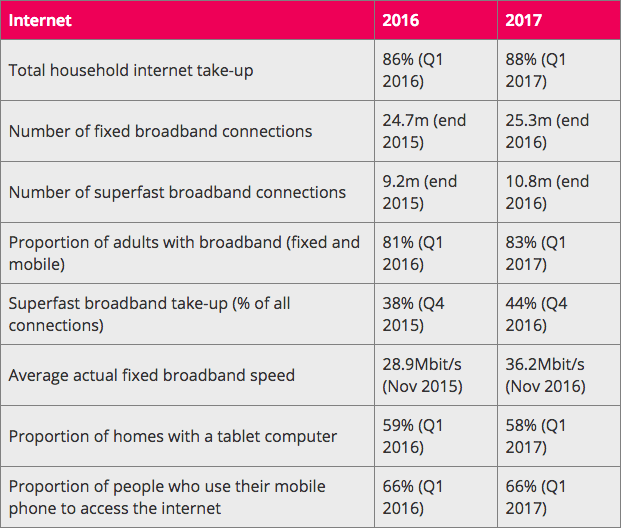
Source: Ofcom, Fast Facts
Added to this, it's unsafe to assume that all 44% of internet customers with superfast broadband will be interested in FTTP, which will be considerably more expensive than the FTTC service they use.
All of which raises serious questions as to whether the strong political drive to make the UK a "leading digital economy" has pushed the cart before the horse.
Switchover
Well, Openreach and the ISPs they serve appear to accept that public demand for FTTP isn't particularly strong, which is partly why they've been less keen on full fibre in the past.
And it's now also why Openreach's consultation proposes carrying out a more or less forced switchover to "the new network as quickly as possible after it has been built in a given area".
Such a switchover is one of the key "enablers" Openreach believe is necessary to ensure sufficient investment in FTTP broadband.
Customers would essentially be forced onto the new FTTP network, which Openreach estimate would cost anything between £3 billion and £6 billion to roll out to 10 million premises.
This forced migration may be unwanted enough for the customers being migrated, yet at least they'll be benefiting from more reliable broadband connections. Yet most interestingly, and perhaps most controversially, Openreach are proposing to spread the cost of investment in FTTP across all customers using their network, and not just those with full fibre.
This means that, under Openreach's broadly supported proposals, everyone will be paying a bit more for their broadband, even those in secluded rural areas who couldn't possibly hope to benefit from a 1Gb connection in the not-too distant future.
Further consultation
Still, as drastic as such a switchover may sound, it's not absolutely certain Openreach will pursue their plans as outlined in the consultation.
For one, they will be consulting on more specific outlines of such plans until the end of the year, with by which time its approach could have possibly changed.
Added to this, the viability of their plans depends on co-investment from ISPs. This is a sticking point insofar as some providers will invest only if they're given preferential access to FTTP products, something which will undoubtedly displease other providers (and Ofcom).
Because of this, while it's likely that a switchover will go ahead in areas that eventually see an Openreach FTTP rollout, it's not certain.
Yet what's more certain is that the UK seems now to be confronted with a choice between a world class digital infrastructure, and fair and more affordable broadband prices.

We are independent of all of the products and services we compare.

We order our comparison tables by price or feature and never by referral revenue.

We donate at least 5% of our profits to charity, and we aim to be climate positive.