Vodafone buys out CK Hutchison to take full ownership of VodafoneThree

Vodafone has agreed to buy out CK Hutchison's 49% stake in VodafoneThree for £4.3 billion, giving it full ownership of the UK's largest mobile operator.
The move was built into the original agreement, but has arrived far earlier than expected, less than a year after the merger completed.
Vodafone says there will be no immediate change to its multi-brand strategy, with Three, SMARTY, VOXI, and Talkmobile all continuing to operate as separate brands.
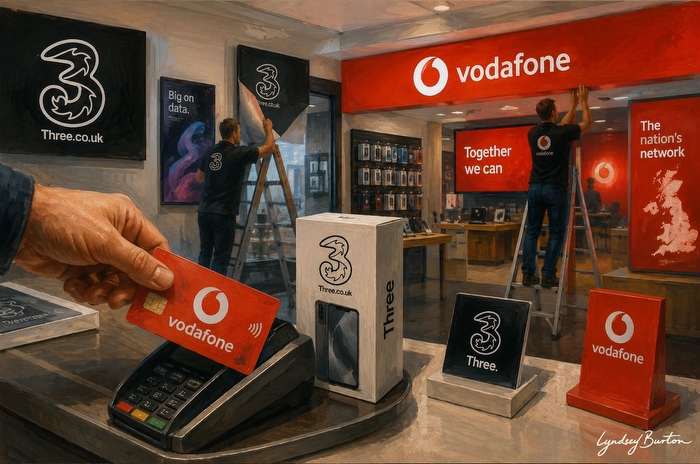
Vodafone takes full control of VodafoneThree
Vodafone and CK Hutchison have announced Vodafone's full buyout of VodafoneThree, less than a year after the merger of Vodafone UK and Three UK completed in May 2025.
Under the original agreement, Vodafone held a 51% stake in VodafoneThree, while CK Hutchison retained 49%, with Vodafone given the option to acquire full control after three years.
The move to full ownership has arrived much earlier than expected, suggesting both companies are comfortable with the early progress of integration. Vodafone said the combined business had made a "strong start", while CK Hutchison said the transaction would help reduce debt and strengthen financial flexibility.
CK Hutchison has been reducing debt and selling assets across several markets, making an earlier exit from VodafoneThree financially attractive.
Vodafone will fund the £4.3 billion buyout using existing cash resources. The deal values VodafoneThree at £13.85 billion including debt, lower than the £16.5 billion valuation set when the original merger was agreed in 2023.
The transaction still requires approval under the UK National Security and Investment Act and is expected to complete during the second half of 2026. VodafoneThree CEO Max Taylor and the existing leadership team will remain in place.
Margherita Della Valle, Chief Executive, Vodafone Group, said, "A year on from the merger, the team has made remarkable progress, as we maximise the full potential of VodafoneThree and capture the significant synergies.
"I'm delighted that we will now have full ownership of VodafoneThree as we roll out one of Europe's most advanced 5G networks, provide the UK's best customer experience and drive long-term value for our shareholders."
The deal marks the latest stage in a process that began with merger talks in 2022, before Vodafone and Three formally announced plans to combine their UK operations in 2023. The merger was later approved by the Competition and Markets Authority (CMA) in late 2024 following a lengthy regulatory investigation.
Earlier than expected
The speed of the buyout reflects how much has already changed for customers since the merger completed in May 2025.
VodafoneThree says seven million Three and SMARTY customers have experienced an average 20% boost in 4G speeds - and up to 40% in some towns and cities - through the combination of spectrum from both networks.
More than 8,000 masts have also been upgraded, giving 21 million Vodafone and Three customers access to automatic network roaming, where devices connect to whichever of the two networks has the stronger signal at no extra cost.
Coverage has also been extended across previously underserved not-spot areas covering 16,500km2 of the UK - an area roughly ten times the size of London.
Those gains have been noted by Ofcom. In January 2026, the regulator's chief executive wrote to the Prime Minister and Chancellor citing the improvements as early evidence the merger was delivering.
Because integration has moved faster than expected, the financial logic for accelerating the buyout follows naturally.
Under the joint venture structure, Vodafone captured only 51% of future growth while continuing to share governance with CK Hutchison. Full ownership means Vodafone retains all future synergies and cash flow growth from VodafoneThree, while simplifying decision-making and removing the complexity of a shared ownership structure.
Kester Mann, director of consumer and connectivity at CCS Insight, described the deal as "an endorsement of the strong start made by the merged company, notably in bringing the Vodafone and Three networks together." He added that it also "reinforces a wide-held industry view that the Vodafone brands will eventually prevail over the Three brands."
Five brands: one network
The Competition and Markets Authority approved the original merger with conditions, having warned that Three had historically acted as a lower-cost operator that helped keep pressure on pricing across the market. Reducing the UK's main mobile networks from four to three raised concerns that consumers could face higher bills over time.
Those conditions - including a three-year price cap on certain tariffs - remain in place regardless of who owns the shares. But full Vodafone ownership sharpens the underlying question: with one company now controlling the UK's largest mobile network, the competitive pressure that once came from Three as an outside force now has to come from within Vodafone's own brand portfolio.
At the same time, the UK mobile market has also changed significantly since the merger was first proposed. According to CCS Insight, MVNOs now account for nearly one in five mobile connections in the UK, up from under 15% in 2021. That growth is being accelerated by platforms such as Gigs, which allow fintech brands, retailers and other non-telecoms businesses to launch fully functional mobile services embedded in their own apps without building any network infrastructure of their own.
Revolut is already offering unlimited calls, texts and 20GB of roaming data for £12.50 a month on this basis, while Monzo, Klarna and Lidl are all moving into or actively exploring the market. The price competition the CMA was concerned about losing from Three as an independent network operator may increasingly be arriving from a different direction entirely - and from brands with large, loyal existing customer bases that traditional mobile operators cannot easily replicate.
Three's identity was also built around a specific set of network trade-offs. Historically, its spectrum holdings skewed towards higher frequencies, making it well suited to dense urban areas and high-capacity mobile data, but weaker at long-range rural coverage and indoor penetration. That helped define Three's reputation for fast, data-heavy plans in cities, often at lower prices than Vodafone.
Now that VodafoneThree is combining coverage and spectrum across both networks, those historic weaknesses are being reduced. Three customers are gaining access to Vodafone's lower-frequency coverage footprint through the MOCN roaming rollout, improving reliability and rural reach. But in doing so, the merger also erodes part of the network distinction that historically defined the Three brand in the first place.
That brings the five-brand question into sharper focus. Vodafone, Three, VOXI, SMARTY, and Talkmobile now all sit on the same underlying infrastructure. VOXI, SMARTY, and Talkmobile already occupy broadly overlapping budget and flexible SIM-only territory, differentiated more by branding and positioning than fundamentally different products. Three itself now sits awkwardly between those categories - neither clearly premium enough to rival Vodafone directly nor clearly distinct enough to separate itself from the group's lower-cost brands.
The BT Group experience shows how difficult that balancing act can become over time. In 2022, BT Group announced a major simplification strategy built around making EE its flagship consumer brand across both broadband and mobile, while gradually sidelining the BT brand for consumer services.
That strategy has since been partially reversed. BT confirmed in early 2025 that the BT consumer brand would continue alongside EE and Plusnet, amid concerns that dropping BT risked alienating older broadband customers. Reports suggest BT Mobile is on the verge of returning as a consumer brand, less than three years after BT Mobile was closed to new customers.
Even maintaining clear distinctions between EE and Plusnet has become increasingly difficult. EE broadband currently undercuts Plusnet at 300Mb and above despite being positioned as the group's premium brand, while also offering better hardware and broader service guarantees.
The lesson for VodafoneThree is that managing multiple overlapping brands on the same underlying network becomes increasingly complex over time - particularly when those brands begin competing for the same customers with increasingly similar pricing, coverage, and service quality. Eventually, the risk is that brands within the same group begin competing more against each other than the outside market.

We're independent of the products and services we compare.

We order our comparison tables by price or features - never by referral revenue.

We donate at least 5% of net profits to charity, and operate a climate-positive workforce.
Related guides



View more guides