UK broadband switching still inconsistent

TOTSCo has published the outcome of its March 2026 consultation on improving the One Touch Switch system, around 18 months after it launched.
While the system is widely used, industry feedback suggests it does not always work consistently, with some switches failing to complete first time or becoming delayed.
Responses point to ongoing issues with how providers match customer details and handle switching requests, highlighting the need for more consistent implementation across the industry.
Switching system moves into monitoring phase
TOTSCo has published the outcome of its March 2026 consultation on improving the performance of the One Touch Switch system, setting out a series of measures aimed at strengthening how broadband switching works in practice.
The proposals focus on expanding how switching performance is monitored and managed across the system. Measures include:
- publishing more detailed match-rate data
- developing new ways to measure how successfully switches complete
- introducing provider-specific performance reports
- holding voluntary service review meetings to address issues
- exploring a clearer approach to outage notifications
The outcome follows a consultation launched in March 2026 (Bulletin 104), around 18 months after the One Touch Switch process went live. The system, introduced under Ofcom rules, allows customers to switch broadband providers by simply placing an order for a new plan, with the new provider handling the switch and cancellation of the existing service.
The One Touch Switch system went live on 12 September 2024 and was designed to make switching broadband provider simpler and more consistent, particularly when moving between different networks.
While the process is now widely used - supporting around 1.8 million switches a year - the consultation highlights areas where the system can be improved to deliver a more consistent experience.
Switching failures and delays
Industry feedback gathered through the consultation suggests that switching issues persist, even with the One Touch Switch system in place.
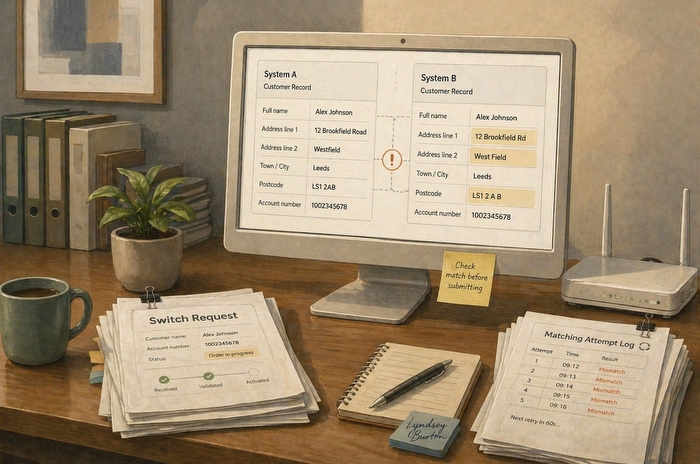
One of the most common problems is failed "matching", where systems are unable to correctly identify a customer's existing service. This can prevent a switch from progressing or require multiple attempts before it succeeds.
Some providers report that a significant proportion of successful switches do not complete on the first attempt. In one example (from Highland Broadband), around 68% of switches matched successfully first time, while roughly 32% required two or more attempts before completing - with some cases needing repeated retries before a match is achieved.
In practice, providers describe retrying requests with small changes to customer details, such as simplifying address formats or removing account references, in order to complete a switch. This reflects differences in how data is recorded across systems, which can affect match success even when the correct information is provided.
Other issues include timeouts and failed messages between providers, as well as switching requests that do not receive a response from the existing (losing) provider. These failures can cause the switching process to stall or delay completion.
For consumers, these issues are rarely visible as technical faults, but instead show up as delays, uncertainty, or the need to chase providers for updates. In some cases, a stalled switch can delay the cancellation of an existing service, which may result in customers being billed for both old and new connections at the same time.
While these issues affect a minority of switching journeys, providers including BT describe a "small but significant" volume of cases where switching does not work as intended, highlighting that the process is not yet consistently reliable across all providers.
Data and system inconsistencies
The One Touch Switch system was designed to simplify the process of changing broadband providers, removing the need for customers to coordinate between companies themselves.
But while the process is simpler on the surface, industry feedback suggests the outcome still depends heavily on how different providers' systems interact behind the scenes.
A key issue is how customer data is recorded and matched. Differences in how names, addresses and account details are stored across providers can make it harder for systems to identify the correct service, even when the information provided is accurate.
In some cases, providers report needing to retry match requests multiple times or adjust details manually to achieve a successful result. While this allows most switches to complete, it introduces additional steps that are not visible to customers and can affect how consistently the process works.
There is also evidence that switching performance varies between providers. Some responses suggest that a smaller number of underperforming providers account for a disproportionate share of issues, while others point to wider inconsistencies in implementation and data handling across the industry.
The consultation also highlights that switching performance is shaped by how providers respond to issues when they occur. Delays in communication, inconsistent handling of requests, and system outages can all affect the outcome of a switching journey. In some cases, issues with one provider's systems can impact others, reflecting the interconnected nature of the process.
Taken together, this suggests the core challenge is no longer how switching is designed, but how consistently it works across different providers' systems.
TOTSCo's focus on monitoring, benchmarking and provider-level engagement reflects that shift - from introducing the process itself to improving how reliably it works in practice.

We're independent of the products and services we compare.

We order our comparison tables by price or features - never by referral revenue.

We donate at least 5% of net profits to charity, and operate a climate-positive workforce.
Related guides



View more guides